Year of the Superbike
Year of the Superbike
If you think the 750cc sportbikes are something, get a load of what showed up at Daytona this year
RON LAWSON
WHAT'S IT TAKE TO WIN THE DAYIONA 200? SIMPLE. Assuming you're fast enough. you only need two things: good equipment and even better luck. The rest is a piece of cake.
But there's a catch. No one ever has good luck at Daytona; some teams just have less bad luck than others. And this year. the Vance & Hines Yamaha team had the least bad luck. All they had to overcome was tire trouble, engine trouble, disqualification trouble and a few other assorted speed bumps that the racing gods seattered along the road to victory lane.
The Vance & Hines crew would need all the iood for tune it could muster, too, because four other teams had the `good equipment" half of the equation well in hand. In fact, this year's Daytona 200 by Arai marked the appearance of the most-exotic Superbikes ever seen in a national roadrace sanctioned by the American Motorcyclist Association.
Before this season, the AMA’s Superbike rules were the most-restrictive in the world, requiring the racers to be heavily based on production machines that were 49-state street-legal, and that had been imported into this country to the tune of at least 200 units. What’s more, multi-cylinder Superbikes could weigh no less than 390 pounds. All the while. Superbike racing in Europe was being run under a more liberal set of rules—and was gaining in popularity.
So, for 1990. the AMA rewrote its rules to conform almost entirely to World Superbike Championship standards. Now, a large manufacturer has to import only 15 units of the model in question for Superbike homologation. and a small manufacturer need bring in only seven units. The minimum weight has been dropped to 370 pounds for Multis and 320 pounds for Twins. And a team can use carburetors, camshafts or forks other than those imported on their motorcycle if the new components are homologated separately—a process that involves paying fees and proving availability.
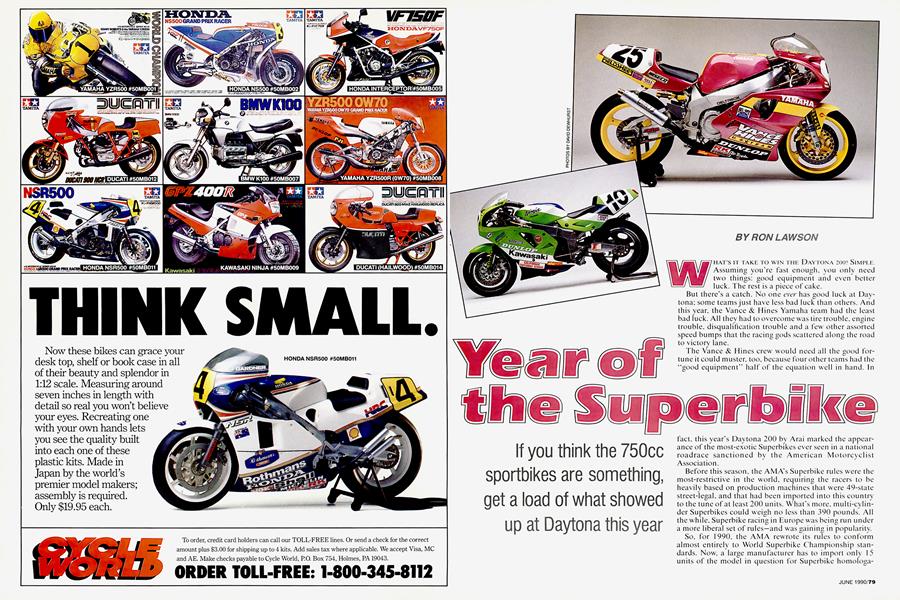
Most teams were quick to take advantage of the new rules. At this year’s 200, the entry list included 67 newly homologated motorcvcles. But of all those, the Vance & Hines OWOl Yamahas clearly were the best prepared. Back in December of 1 989. the team simulated a running of the 200 with rider David Sadowski on a lightly modified OWOl. Sadowski was able to turn consistent 1:56 lap times, a pace that would have won easily last year.
From that point, Vance & Hines did nothing but improve the bikes. Thomas Stevens’ OWOl, for example, was fitted with an on-board computer to give the team valuable data that was used, in conjunction with the usual rider input, to get the motorcycles dialed-in.
That setup included keeping the stock Öhlins shock, but with different valving and a slightly higher spring rate. As for the fork, Yamaha used the newly homologated $4000 Öhlins inverted front suspension unit. “Actually, the fork’s biggest advantage is better vision for the riders,” says Vance & Hines crew chief Steve Johnson. “Under hard braking, conventional forks flex and stutter so bad your vision gets blurry. There’s no real difference in lap times.” But the riders had some problems adapting to the more-rigid Öhlins fork, according to Johnson. “We had to raise the rear ride height to get the bikes to turn as well once fork Ilex was reduced. Evidently, a little bit of flex helps the rider set up for turns.”
Yamaha offers a race kit for its OWO Is, just as the other Japanese manufacturers do for their 750cc Superbikes. The Vanee & Hines Racing bikes were fitted with the kit’s cams, gearbox, one-millimeter-oversize pistons, and an induction system that eliminates the stock airbox. The exhaust system was a Vance & Hines unit, the front brakes were by Brembo, and the wheels were from Marchesini.
But the most controversial change to the VHR Yamahas was their 40mm Mikuni magnesium carbs that sell for $3200 a set. “They gave us a little more power and hit harder,” says Johnson, “but there's nothing exotic or unusual about them. They just worked best.” But some other teams felt that the use of such expensive components was a step past the limits of fair play. “1 wanted to homologate a fuel-injection system for the ZX-7 months ago,” says Kawasaki crew chief Rob Muzzy, “but the AMA indicated that they wouldn’t allow it. It's probably my fault. I never submitted an official form and paid the fees. I thought it would be denied.”
And, as it turned out, carburetion was what gave Muzzy his biggest headache at Daytona. The 1990 ZX-7s arrived at his shop only a few weeks before the race, and he quickly found that they were in a higher state of tune than the 1989 models he was used to working with. And after he breathed on the engines via cams, 13: l pistons, a titanium exhaust and titanium valves (all off-the-shelf Muzzy R&D parts), his riders found that the standard carbs delivered a mid-range fiat spot. A switch to 40mm Mikuni RS carburetors got rid of the flat spot, but those carbs were harder for the riders to operate. “That can be just as important as horsepower.” says Muzzy. “If a rider has to make a conscious effort to fight a sticking throttle every lap, it’ll cost you something, even if it doesn’t show up in your qualifying time.”
Muzzy was happy enough with the Mikunis to use them in the 200. but he still hopes eventually to go to fuel injection. “I don’t think I'll gain a horsepower advantage, but fuel injection is so much more versatile. The ZX-7 is limited because we can only use semi-downdraft carbs. With fuel injection, that's not a problem; you can mount it upside-down if you want,” he says.
Muzzy’s ZX-7 chassis used Performance Machine wheels and brakes. Fox shocks and newly homologated White Power inverted forks (at a retail cost of $ 1850 per copy). Still, his Kawasakis were probably the least-expensive bikes of the top contenders at Daytona—especially considering the $6449 retail cost of a new ZX-7, compared to $ 16,000 for a Yamaha OWO l and l 5 grand for a Honda RC30.
The Yoshimura Suzuki team also made an effort to keep its racebikes affordable. “We sell everything we use on our Superbike,” says Yoshimura’s Managing Director David Wolman. “We thought about bringing in GSX-RRs (Suzuki’s limited-production racer), but that’s a different philosophy. We still would have to do a lot of work on those bikes. I think our way of taking a streetbike and modifying it makes more sense. We start off with a $6000 motorcycle and replace all the same things you wind up replacing on an OWO l.”
Wo1m'~in claims you can build a full-race Yoshimura GSX-R750 for slightly more than the S 16,000 that just gives you a starting point with an OWOI. The chassis modifications include the stripping of unnecessary brack ets and the addition of a few strategically placed gussets. along with the installation of a KYB inverted fork and a Fox shock that bolts to a different rear-suspension linkage. Jay Springsteen's Daytona GSX-R was fitted with Performance Machine wheels and brake rotors, while the rest of the Yosh Suzukis had either Marchesini or Tecnomagnesio wheels. And all of the team bikes were wrapped in Yoshimura's own ultra-light bodywork.
As contradictory as it sounds, the Daytona Suzukis were at once exotic and standard-issue. A Yoshimura Superbike engine looks much tricker than its Honda, Kawasaki or Yamaha counterparts, even though most of its compo-
nents are right out of the Yoshimura catalog. Obvious on the outside are the triple-radiator oil-cooling system (of which the two small outboard radiators are actually made and sold by Earl's, not by Yoshimura) and an assortment of engine cases, airscoops and heat shields. Inside the engine are more catalog parts, including cams, valve springs, Cosworth-made pistons and Carrillo connecting rods. The carburetors are off-the-shelf, Yoshimura-modified Mikuni RS40s, and the bikes use total-loss ignition systems.
Of course, the parts used in modern Superbike racers are supposed to be accessible; that's the whole idea. Knowing what to access is the tricky part. In the case of the Commonwealth Honda team, that was no problem, simply because of who was doing the accessing: Ray Plumb, one of the most highly regarded tuners in Honda’s racing department. Plumb served as the crew chief for Commonwealth at Daytona, the only Superbike race in which American Honda will be officially involved this year. Honda gave the team its bikes and parts for the year, and provided considerable personnel support for Daytona. “But after the 200,” says Plumb, “Martin Adams is on his own, although I’ll help out as much as I can.”
Adams, owner of the Commonwealth Honda team, is the man behind Randy Renfrew’s 1989 Pro-Twins GP championship. For 1990, Adams and Renfrew have turned their attention to the AMA Superbike championship and an RC30 fitted with an HRC race kit. And according to Plumb, obtaining a limited-production RC30 is probably harder than obtaining an HRC race kit for one. “Anybody can buy these parts,” he claims. “You just call American Honda and talk to the parts department, and you can have what we have. Setup is fairly simple, and the instructions are well done.”
That kit includes carburetors, cams, pistons and assorted other parts. “Our bike has stock heads with special valves from HRC,” says Plumb. “They're kit valves, which have a more-slender stem diameter. It’s been ported—HRC sends you porting specs.” For the suspension, Commonwealth uses Öhlins units at both ends.
“This project was a lot easier than the Twin project,” Plumb recounts, comparing the RC30 Superbike to the Honda RS750 dirt-tracker he made into a successful roadracer last year. “We had to fabricate the pipe on that bike and fabricate the frame. The fabrication just never stopped. But with the RC30, if you have a problem with a > part, you can buy another part that’s all ready to go on.”
Commonwealth wasn't the only team that was unofficially an official factory effort at Daytona. Jamie James' quest for victory aboard a Ducati 85 l was in the capable hands of Eraldo Ferracci, proprietor of the Fast By Ferracci high-performance firm, which is now getting considerable assistance from the Ducati factory in Italy. “The factory has more money, more technology, more brains, more everything than I do,” says Ferracci, who’s accustomed to doing most things on his own. “This is the best thing that’s happened to me, to work with the company.”
Because the 85 l is a Twin, the rules allow it to displace as much as I200cc; but according to Ferracci, the racebike measures a stock 85 lcc. The bike can also weigh less than a Multi; but at 325 pounds without the fuel tank in place, James’ 85 l was heavier than Ferracci’s Pro-Twins Ducatis of last year. Considering that the tank must weigh about five pounds, the Ducati Superbike was probably 10 pounds over the 320-pound minimum.
That's not too surprising, though, since the tubular steel frame on James's Ducati is fundamentally stock. Its steering-head angle is steeper than on last year’s racer (24.5 versus 26 degrees), but that change was incorporated into the 1990 production 85 l, as well. This year, however, Ferracci has abandoned the Marzocchi suspension he used last season in favor of an Öhlins fork and shock, and he reports a big improvement. The 85 l racer’s wheels are Marchesinis and the brakes are Brembos. The engine, of course, is a dohc, liquid-cooled, 90-degree V-Twin that retains the desmodromic actuation of its eight valves. And it already has the Weber fuel-injection system that Rob Muzzy hopes someday to adapt to his Kawasakis.
That was perhaps the most-interesting aspect of the Ducati team at this year’s 200. On the surface, it seemed like an oddball collection of Italians working on even odder motorcycles that were a strange combination of lowtech steel frames and high-tech electronic fuel injection. Yet, in many ways, it was the most technologically sophisticated effort in the paddock, evidenced by the 85 l Twin's third-fastest qualifying time against the finest field of four-cylinder Superbikes Daytona had ever seen.
But, that's what Daytona is all about. It’s as much a contest of engineering philosophies and ideas as it is a test of riding skill. And the motorcycles of Daytona promise to become even more diverse and interesting in future years. After learning of the AMA's rule changes, small companies such as Bimota have expressed an interest in competing. Meaning that next year, there might be more than five brands of motorcycles capable of winning.
Still, no matter how many different teams might show up with however many different kinds of motorcycles, there will, as always, be just one winner. After all, there's only so much luck to go around at Daytona. And only the tiniest bit of it ever leads to victory.