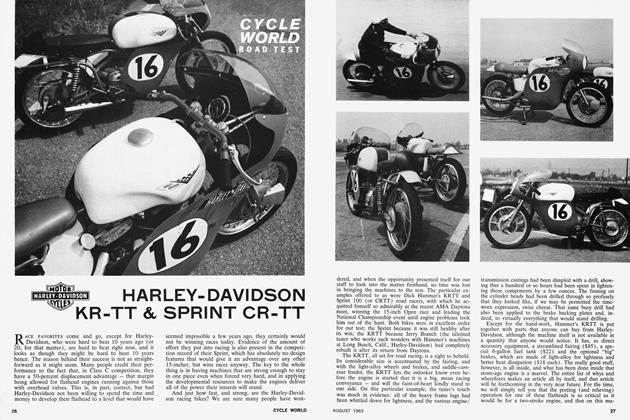
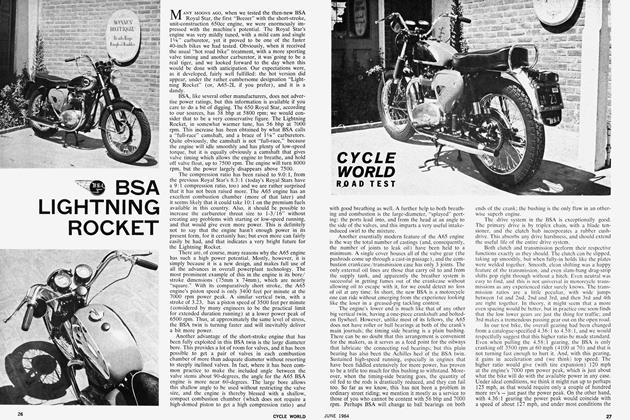
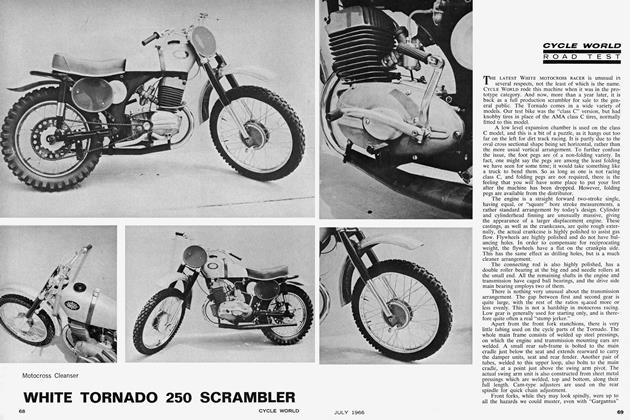
Honda Cr250m1
HONDA CR250M1
Cycle World Road Test
A fine design that reached the public a year too late to be competitive,
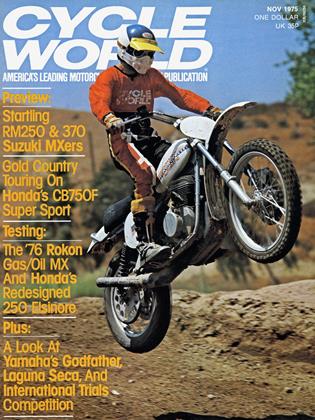
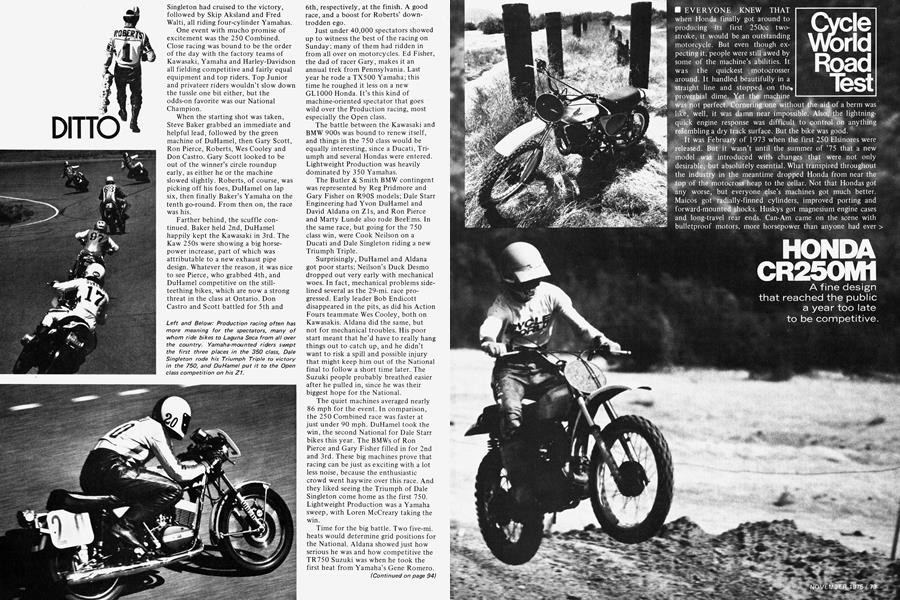
EVERYONE KNEW THAT when Honda finally got around to producing its first 250cc two-stroke, it would be an outstanding motorcycle. But even though expecting it, people were still awed by some of the machine’s abilities. It was the quickest motocrosser around. It handled beautifully in a straight line and stopped on the proverbial dime. Yet the machine
was not perfect. Cornering one without the aid of a berm was like, well, it was damn near impossible. Alsoftthe lightningquick engine response was difficult to control on anything resembling a dry track surface. But the bike was good.
It was February of 1973 when the first 250 Elsinores were released. But it wasn’t until the summer of ’75 that a new model was introduced with changes that were not only desirable, but absolutely essential. What transpired throughout the industry in the meantime dropped Honda from near the top of the motocross heap to the cellar. Not that Hondas got any worse, but everyone else’s machines got much better. Maicos got radially-finned cylinders, improved porting and forward-mounted shocks. Huskys got magnesium engine cases and long-travel rear ends. Can-Am came on the scene with bulletproof motors, more horsepower than anyone had ever > seen before, and adjustable steering geometry. CZ added a fifth gear and forward-mounted shocks. Montesa’s VR became an even sweeter machine in the V75 version with a better powerband and cantilevered gas/oil shocks. Bultaco got 8.5-in.travel forks and a sweet handling rear end, also with FMS. Yamaha’s monoshocker lit the world on fire, particularly after winning the 250cc World Motocross Championship. And through all this, Honda remained virtually inactive. It kept promising a new 250, one that would put it back on top. But in the end, it fell short.
The new CR250M comes in a very attractive red, black and white paint scheme with a little polished aluminum thrown in for good measure. The motor retains the fiat black appearance. Inside, the ports have received a little modifying. Port timing remains nearly identical, but volume has been increased, bend from the carb to the crankcase. But the external position of the intake port has been lowered this year, allowing for “straight shot” intake. The piston is still a two-ring affair with an etched, oil-retaining surface.
The transmission remains nearly identical. Shifting on the left side, it engages gear after gear with the patented Elsinore “snick-snick” movement. The shift lever and brake pedal are still malleable aluminum. Transmission ratios are right on the money. First gear is rather tall, but even so, second is the i nost successful for getting the machine off the line consistently well.
The exhaust pipe has received major revision. The first CR had low pipes. The new one has an up-overthat should make pipe life about 10 tindented expansion chambers.
Suspension travel has fteen improved only at the rear end. The front forks claim 7.1 in. of movement, which actually measures out to only 6.75. The rear axle travels 5.4 in. at maximum stroke of the finned, aluminum-bodied shock absorbers. Coming from a company that has some of the most successful racing machinery on this continent, it is a pity to see the production motocrosser lacking in so vital an area. It is known that the works bikes carry, fore and aft, 9 and 8 in. of travel respectively. The production machines fall far short of those figures.
The ride provided by the suspension has not changed much. Forks have too much compression damping, and, although rebound damping is good, they cause a harsh ride on rough tracks. Our arms pumped up quickly on the Honda. The rear^ shocks do not have sufficient rebound damping for the standard. 100-lb. springs. This causes the rear wheel to dance when power is not applied. Couple this tendency to bounce to the harsh compression action at the front end, and you can see why the bike is a handful when broking hard over severe bumps. In fact, any time that the suspension is asked to cope with something suddenly, it kicks back. When the obstacles.are smootheCin nature, such as wide, rolling whoopers, the ride is quite nice. In this world of gas/oil suspension, the standard Honda shocks are somewhat outdated. They should be fine for short 20-min. motos, but we doubt they’ll last under the strains of a 45-min. battle. For those who ride the longer events, we suggest replacing the shocks with. Red Wing HP Nitro units, Bilsteins, or the équivalent. If you do not wish to spring for the additional cost of replacement shocks, then go to slightly heavier oil (the shocks are rebuildable). We were really surprised to find how the new Honda steered. The first Elsinore exhibited incredible front wheel washout. But the new orte doesn’t have any. Not a trace. It steers so well, in fact, that you can take the inside line through just about any corner. If you’re used to riding an original ott’re going to have to learn all over àf we’re concerned, the Honda now has the steering stuff it underneath, drive out and square it off, any! want. « ■
The change-is the result of, and get this, increasing the rake one-half degree, out to 32 degrees, and reducing the trail down to 5.8 in. The steering head has been moved back approximately 18mm. There is also a 10mm shorter swinging arm. This not only helps the Honda get around corners better, but also aids traction via improved weight distribution.
Motor mounts sport an added brace this year. The engine-steady runs from the upper rear mount to the rear cylinder studs. The engine itself is lower in the frfhtè ajryl more truly centered. In the past, it was slightly off to the f§ new position requires the use of an offset rear sprocket ensure proper chain alignment.
The Honda retains its slim appearance and feel. In fact, the machine feels even lighter than its 214 lb. would lead you to believe. The saddle is well-padded and gently sloped. The fuel tank is narrow at the knees and blends perfectly with the seat. Capacity of the tank is 1.8 gal.
Engine power is strong, proving to be quite controllable despite the zappy throttle response available. The engine runs besi on its torque curve since it, like the previous CR, runs out of breath all at once. It’s pulling like the devil, and then suddenly no more. No gradual curtailing of power, no smooth decline. Honda riders learn to anticipate the end of the powerband and shift accordingly. When this is carried off successfully, the CR accelerates with the best of them.
The distributor provided us with a factory spark arrester/ silencer that bolts onto the exhaust tip. The unit slipped right into place and we then took our racer cow trailing. The CR steers well enough to be a neat play bike. The restrictive the additional silencer took away a little low-end also smoothed out the off-pipe/on-pipe transition, problem was the tall first gear. For trail riding, dropping 13-tooth countershaft sprocket would help. If you know i the area you'll be riding in has some exceptionally tight trails, > Desert tiders i11 want more top pres~n~y OUt~1S For theiii adding d t~c, cr~il4 b~i. tI~jdea1 answer Just don t ,ct stuck on~ai~jUlIi or the s m~jugh regeaicd tirst Log will ievet it Uon~da was late w~t~ the~ deIivory~ot tlit. new Elsl~e The wc$4 was baited an5 re~4y tn~re~tflan a yeai ago The~release of The~tke at the,~begwniu~ summer this year was t~hrn~etic We h~rd tI~t it~ w~e problems finding l~s th~X ro~u1d 1as~t 1Qn~enbu~gh W n~ that could tfle beattn~Tc Th~ end~ r~su~~*da, that is really at tb ride, b&~ause it doe~~~thi~raceeptabty although 4ittl~ectaZ~ula4y We~ re~mm~nd play bike (with the a~c4~sory sp~irk arrester l~st~1~d) We a~iso. r~~rnnithd it as a t~i9ice otOc~ew~ bese wits ow itial i4st of nalntenance, re1i4l~1~afl~d ener~ ruggedness $ut7or truly serious racrng~ the bike1ae~st~ffii~ut suspension Also we're sure iat if the t~W*~ wanted to, it ou1d once agaill ,na~e thea th i~the~aste$t O Iflc~tocrosser if L1~nda Is to yeeoup tbe position a~ leader of the pack, th~*th~on~y thio~ l~eft for it to dq~ionsidering what the op~~zon s done~ trio rel~ase Works R~pliut~ In that i~espect). the CR2~OM is very nice stepping stone Nothing less aqthtng r~re ;
HONDA
CR250M1
$1325
SUSPENSION DYNO TEST
Remarks: CR forks have slightly too much compression damping, which will make your forearms tired. Rebound damping is acceptable. A lighter oil such as ATF would bring compression damping down to an acceptable level, but then the forks would top. Travel in these forks caflnot be increased safely.
Remarks: Compression damping is slightly light, so heavier riders may experience rear-end bottoming on the Honda. Rebound damping is marginally too light for the 100-lb. spring fitted. Pitching and/or loss of rear-wheel traction in bumpy turns will result. A more viscous oil than standard should help both compression and rebound damping. Use of such an oil is possible since the shocks are rebuildable.
Tests performed at Number One Products