Leanings
Adventures in Retro-Touring
LEANINGS
PETER EGAN
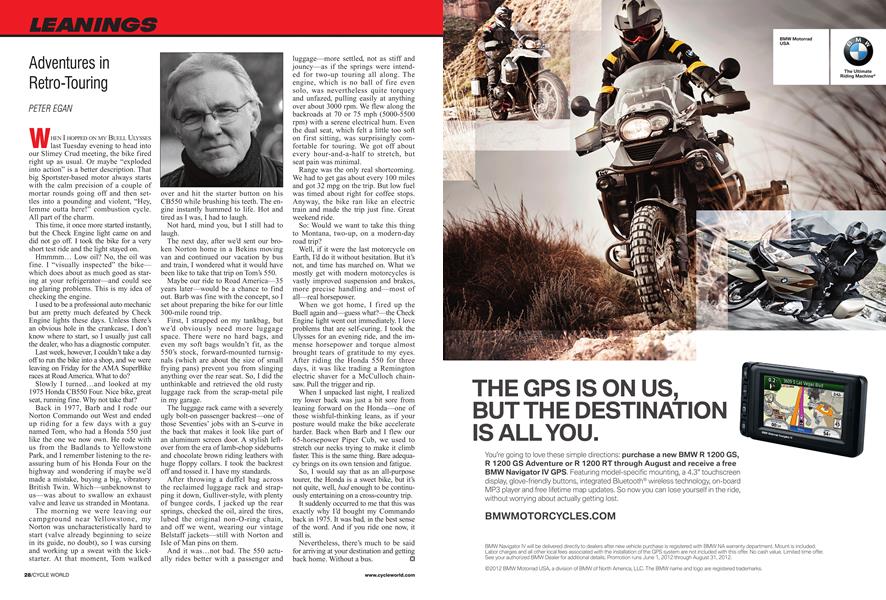
WHEN I HOPPED ON MY BUELL ULYSSES last Tuesday evening to head into our Slimey Crud meeting, the bike fired right up as usual. Or maybe “exploded into action” is a better description. That big Sportster-based motor always starts with the calm precision of a couple of mortar rounds going off and then settles into a pounding and violent, “Hey, lemme outta here!” combustion cycle. All part of the charm.
This time, it once more started instantly, but the Check Engine light came on and did not go off. I took the bike for a very short test ride and the light stayed on.
Hmmmm... Low oil? No, the oil was fine. I “visually inspected” the bike— which does about as much good as staring at your refrigerator—and could see no glaring problems. This is my idea of checking the engine.
I used to be a professional auto mechanic but am pretty much defeated by Check Engine lights these days. Unless there’s an obvious hole in the crankcase, I don’t know where to start, so I usually just call the dealer, who has a diagnostic computer.
Last week, however, I couldn’t take a day off to run the bike into a shop, and we were leaving on Friday for the AMA SuperBike races at Road America. What to do?
Slowly I turned...and looked at my 1975 Honda CB550 Four. Nice bike, great seat, running fine. Why not take that?
Back in 1977, Barb and I rode our Norton Commando out West and ended up riding for a few days with a guy named Tom, who had a Honda 550 just like the one we now own. He rode with us from the Badlands to Yellowstone Park, and I remember listening to the reassuring hum of his Honda Four on the highway and wondering if maybe we’d made a mistake, buying a big, vibratory British Twin. Which—unbeknownst to us—was about to swallow an exhaust valve and leave us stranded in Montana.
The morning we were leaving our campground near Yellowstone, my Norton was uncharacteristically hard to start (valve already beginning to seize in its guide, no doubt), so I was cursing and working up a sweat with the kickstarter. At that moment, Tom walked over and hit the starter button on his CB550 while brushing his teeth. The engine instantly hummed to life. Hot and tired as I was, I had to laugh.
Not hard, mind you, but I still had to laugh.
The next day, after we’d sent our broken Norton home in a Bekins moving van and continued our vacation by bus and train, I wondered what it would have been like to take that trip on Tom’s 550.
Maybe our ride to Road America—35 years later—would be a chance to find out. Barb was fine with the concept, so I set about preparing the bike for our little 300-mile round trip.
First, I strapped on my tankbag, but we’d obviously need more luggage space. There were no hard bags, and even my soft bags wouldn’t fit, as the 550’s stock, forward-mounted turnsignals (which are about the size of small frying pans) prevent you from slinging anything over the rear seat. So, I did the unthinkable and retrieved the old rusty luggage rack from the scrap-metal pile in my garage.
The luggage rack came with a severely ugly bolt-on passenger backrest—one of those Seventies’ jobs with an S-curve in the back that makes it look like part of an aluminum screen door. A stylish leftover from the era of lamb-chop sideburns and chocolate brown riding leathers with huge floppy collars. I took the backrest off and tossed it. I have my standards.
After throwing a duffel bag across the reclaimed luggage rack and strapping it down, Gulliver-style, with plenty of bungee cords, I jacked up the rear springs, checked the oil, aired the tires, lubed the original non-O-ring chain, and off we went, wearing our vintage Belstaff jackets—still with Norton and Isle of Man pins on them.
And it was...not bad. The 550 actually rides better with a passenger and luggage—more settled, not as stiff and jouncy—as if the springs were intended for two-up touring all along. The engine, which is no ball of fire even solo, was nevertheless quite torquey and unfazed, pulling easily at anything over about 3000 rpm. We flew along the backroads at 70 or 75 mph (5000-5500 rpm) with a serene electrical hum. Even the dual seat, which felt a little too soft on first sitting, was surprisingly comfortable for touring. We got off about every hour-and-a-half to stretch, but seat pain was minimal.
Range was the only real shortcoming. We had to get gas about every 100 miles and got 32 mpg on the trip. But low fuel was timed about right for coffee stops. Anyway, the bike ran like an electric train and made the trip just fine. Great weekend ride.
So: Would we want to take this thing to Montana, two-up, on a modern-day road trip?
Well, if it were the last motorcycle on Earth, I’d do it without hesitation. But it’s not, and time has marched on. What we mostly get with modern motorcycles is vastly improved suspension and brakes, more precise handling and—most of all—real horsepower.
When we got home, I fired up the Buell again and—guess what?—the Check Engine light went out immediately. I love problems that are self-curing. I took the Ulysses for an evening ride, and the immense horsepower and torque almost brought tears of gratitude to my eyes. After riding the Honda 550 for three days, it was like trading a Remington electric shaver for a McCulloch chainsaw. Pull the trigger and rip.
When I unpacked last night, I realized my lower back was just a bit sore from leaning forward on the Honda—one of those wishful-thinking leans, as if your posture would make the bike accelerate harder. Back when Barb and I flew our 65-horsepower Piper Cub, we used to stretch our necks trying to make it climb faster. This is the same thing. Bare adequacy brings on its own tension and fatigue.
So, I would say that as an all-purpose tourer, the Honda is a sweet bike, but it’s not quite, well, bad enough to be continuously entertaining on a cross-country trip.
It suddenly occurred to me that this was exactly why I’d bought my Commando back in 1975. It was bad, in the best sense of the word. And if you ride one now, it still is.
Nevertheless, there’s much to be said for arriving at your destination and getting back home. Without a bus. □