Bmw R1200rt
The Gentleman's Express? Your Mama!
BMW R1200RT
CW RIDING IMPRSSION
STEVE ANDERSON
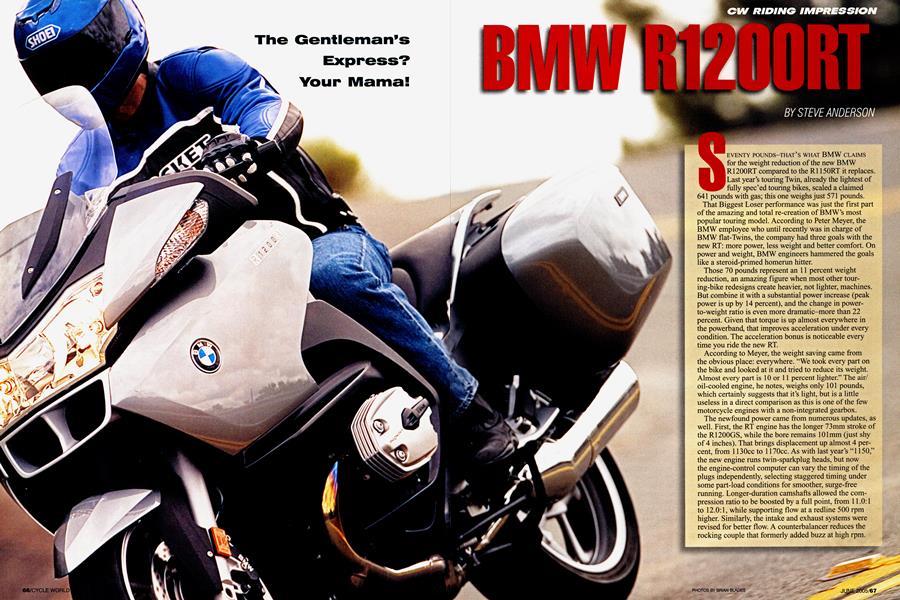
SEVENTY POUNDS—THAT’S WHAT BMW CLAIMS for the weight reduction of the new BMW R1200RT compared to the R1 150RT it replaces. Last year’s touring Twin, already the lightest of fully spec’ed touring bikes, scaled a claimed 641 pounds with gas; this one weighs just 571 pounds.
That Biggest Loser performance was just the first part of the amazing and total re-creation of BMW’s most popular touring model. According to Peter Meyer, the BMW employee who until recently was in charge of BMW flat-Twins, the company had three goals with the new RT: more power, less weight and better comfort. On and weight, BMW engineers hammered the goals like a steroid-primed homerun hitter.
Those 70 pounds represent an 11 percent weight reduction, an amazing figure when most other touring-bike redesigns create heavier, not lighter, machines. But combine it with a substantial power increase (peak power is up by 14 percent), and the change in powerto-weight ratio is even more dramatic-more than 22 percent. Given that torque is up almost everywhere in the powerband, that improves acceleration under every condition. The acceleration bonus is noticeable every time you ride the new RT.
According to Meyer, the weight saving came from the obvious place: everywhere. “We took every part on the bike and looked at it and tried to reduce its weight. Almost every part is 10 or 11 percent lighter.” The air/ oil-cooled engine, he notes, weighs only 101 pounds, which certainly suggests that it’s light, but is a little useless in a direct comparison as this is one of the few motorcycle engines with a non-integrated gearbox.
The newfound power came from numerous updates, as well. First, the RT engine has the longer 73mm stroke of the R1200GS, while the bore remains 101mm (just shy of 4 inches). That brings displacement up almost 4 percent, from 1130cc to 1170cc. As with last year’s “1150,” the new engine runs twin-sparkplug heads, but now the engine-control computer can vary the timing of the plugs independently, selecting staggered timing under some part-load conditions for smoother, surge-free running. Longer-duration camshafts allowed the compression ratio to be boosted by a full point, from 11.0:1 to 12.0:1, while supporting flow at a redline 500 rpm higher. Similarly, the intake and exhaust systems were revised for better flow. A counterbalancer reduces the rocking couple that formerly added buzz at high rpm. Riding in the twisties, you find the engine behaves like the high-tech Twin it has become.
The powerband stretches broadly, with power available from under 3000 rpm. A reasonable amount of flywheel dampens engine response slightly, though far, far less than on classic Boxers. The flywheel makes the new engine less hyper than an inline-Four or the nearinertia-free Suzuki V-Twin while also smoothing engine response, especially during on/off throttle transitions. Engine power builds quickly above 4000 rpm, with the best power coming above 6000-indeed, the engine is still pulling so hard at its redline that it’s easy to bounce off the soft rev-limiter. Still, it’s an engine that always lets you know it’s a Twin. While the new counterbalancer cuts the worst buzzing, the RT powerplant is far from vibration-free, and particularly in the middle of the rev range, the handlebars vibrate moderately. Get on the throttle at too low an rpm, and the engine shudders and pulls weakly. No Twin has as broad an operating range as the best Fours.
But perhaps the biggest improvement is the smooth, light shifting provided by the new gearbox. The same basic unit as used on the GS, the new six-speed box has rejuggled ratios, with the fifth and sixth cogs close together as typical on a sportbike, rather than the wide-ratio jump used to provide relaxed cruising on the GS with its short final-drive gearing. Automotive-like helical gears reduce noise but generate side forces, and must be locked in place on their shafts. That requires a shifting mechanism relying on dog rings rather than sliding gears, making for a slightly longer gearbox. But the dog rings weigh a lot less than gears, and can be slid into place with a light, quick tap of
the gearshift pedal. This new BMW, along with the GS, is the best-shifting Boxer we’ve ever encountered.
The new chassis is closely related to that of the GS, with the engine remaining the main structural member. The frame is really a series of tubular brackets; one carries the steering head and another provides the structure to carry rider, passenger and luggage at the rear of the machine. The front suspension is BMW’s Telelever, with telescopic forks carried not by a pair of triple-clamps, but by a lower A-arm and by an upper clamp fitted with handlebars. This gives more direct steering than the twin A-arm Hossack suspension BMW chose for the K1200 range, but theoretically offers a little more friction. The rear suspension is the updated Paralever design as introduced on the GS.
The new chassis combined with the light weight make the 1200RT an exceptionally effective backroad carver. The suspension is slightly soft, and if you roll the bike really hard into a corner, you can feel it unload and then over-compress as it settles in. But the neutral steering, upright riding position and reduced weight keep everything well under control, and handling is far closer to sportbike than luxury tourer. You’ll never, ever, even for the briefest moment, think of the Honda Gold Wing and this BMW as two of a kind. Even the brakes are powerful, with the partial integrated anti-lock system providing exceptionally strong response with a front lever squeeze (activating all three discs as necessary), while the rear pedal now activates the rear brake only. The last appears to answer near-universal complaints from press and customers; only the K1200LT retains the full integrated ABS system. > The riding position is one of the few things that BMW retained from the previous RT, and for good reason. The handlebar remains exactly the same bend, and it still positions the rider fully, comfortably upright, with plenty of leverage for steering. The adjustable, twin-height seat allows a selection that provides adequate legroom for a broad range of riders (and a thinner seat is optional for shorter riders). Only the seat itself was the subject of any negativity, with at least one rider complaining after a couple of hours in the saddle. Other riders found it perfectly agreeable.
The new fairing does an exceptional job of keeping wind, weather and engine heat from the rider’s legs and torso.
The larger windscreen is again electrically adjustable, and the adjustment is no gimmick. At its lowest level, it allows clean, non-turbulent air to strike the rider’s helmet, while shielding most of the blast from his chest. In its highest position, it provides riders 5-foot-10 and under a very nice, quiet dead-air pocket, as long as they’re willing to look just over or slightly through the windscreen. With the windscreen fully upright, taller riders have to duck down to this level, or otherwise catch some noisy vortex shedding from the top of the screen; they’ll likely want a taller screen.
The RT is far from lacking in luxury features. It comes standard with heated handgrips, sidebags, cruise control and so-called Electronic Suspension Adjustment. The latter
allows adjustment of preload and damping while on the move. BMW made the decision to make it standard just days before we received our testbike, which was not soequipped. Consequently, that’s one feature we can’t comment on. We can say, however, the heated grips and seat (an option) can make a cool night ride a pleasure rather than an endurance test, that the saddlebags mount and unmount readily and have latching mechanisms that work even under gloved hands, and that the cruise control is easy to use and smoothly holds speed.
We can tell you, too, that the new RT is, overall, a spectacular luxury tourer than also can do a fair imitation of a sportbike. It has a long list of options that we have yet to sample, including top boxes in two sizes that can be keyed to work with the single key that works all other locks, a GPS navigation unit, and a tankbag with a hard bottom designed to mate perfectly with the aluminum rails atop the gas tank. The optional CD player/radio was fitted to our testbike, and was loud enough to be heard on the highway; the handlebar switches controlled it simply, though the sheer multiplicity of buttons took some getting used to (separate switches for heat, radio, cruise control and trip computer).
What we can’t tell you is whether the new RT justifies its $18,240 price. Adding the radio, heated seat and top box pushes that to $20,000, more or less, which makes the RT one expensive motorcycle. But that’s thinking about it as a single machine. If you consider you’re getting both a luxury tourer and a sportbike at the same time, it might seem a positive bargain. Œ