Hot Oil Massage
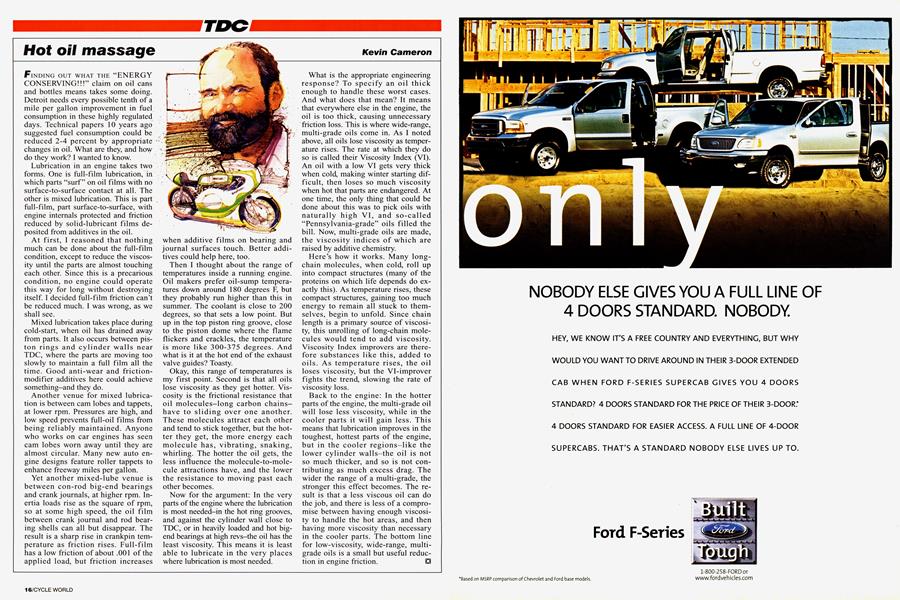
Hot oil massage
Kevin Cameron
TDC
FINDING OUT WHAT THE “ENERGY CONSERVING!!!” claim on oil cans and bottles means takes some doing. Detroit needs every possible tenth of a mile per gallon improvement in fuel consumption in these highly regulated days. Technical papers 10 years ago suggested fuel consumption could be reduced 2-4 percent by appropriate changes in oil. What are they, and how do they work? I wanted to know.
Lubrication in an engine takes two forms. One is full-film lubrication, in which parts “surf” on oil films with no surface-to-surface contact at all. The other is mixed lubrication. This is part full-film, part surface-to-surface, with engine internals protected and friction reduced by solid-lubricant films deposited from additives in the oil.
At first, I reasoned that nothing much can be done about the full-film condition, except to reduce the viscosity until the parts are almost touching each other. Since this is a precarious condition, no engine could operate this way for long without destroying itself. I decided full-film friction can’t be reduced much. I was wrong, as we shall see.
Mixed lubrication takes place during cold-start, when oil has drained away from parts. It also occurs between piston rings and cylinder walls near TDC, where the parts are moving too slowly to maintain a full film all the time. Good anti-wear and frictionmodifier additives here could achieve something-and they do.
Another venue for mixed lubrication is between cam lobes and tappets, at lower rpm. Pressures are high, and low speed prevents full-oil films from being reliably maintained. Anyone who works on car engines has seen cam lobes worn away until they are almost circular. Many new auto engine designs feature roller tappets to enhance freeway miles per gallon.
Yet another mixed-lube venue is between con-rod big-end bearings and crank journals, at higher rpm. Inertia loads rise as the square of rpm, so at some high speed, the oil film between crank journal and rod bearing shells can all but disappear. The result is a sharp rise in crankpin temperature as friction rises. Full-film has a low friction of about .001 of the applied load, but friction increases when additive films on bearing and journal surfaces touch. Better additives could help here, too.
Then I thought about the range of temperatures inside a running engine. Oil makers prefer oil-sump temperatures down around 180 degrees F, but they probably run higher than this in summer. The coolant is close to 200 degrees, so that sets a low point. But up in the top piston ring groove, close to the piston dome where the flame flickers and crackles, the temperature is more like 300-375 degrees. And what is it at the hot end of the exhaust valve guides? Toasty.
Okay, this range of temperatures is my first point. Second is that all oils lose viscosity as they get hotter. Viscosity is the frictional resistance that oil molecules-long carbon chainshave to sliding over one another. These molecules attract each other and tend to stick together, but the hotter they get, the more energy each molecule has, vibrating, snaking, whirling. The hotter the oil gets, the less influence the molecule-to-molecule attractions have, and the lower the resistance to moving past each other becomes.
Now for the argument: In the very parts of the engine where the lubrication is most needed-in the hot ring grooves, and against the cylinder wall close to TDC, or in heavily loaded and hot bigend bearings at high revs-the oil has the least viscosity. This means it is least able to lubricate in the very places where lubrication is most needed.
What is the appropriate engineering response? To specify an oil thick enough to handle these worst cases. And what does that mean? It means that everywhere else in the engine, the oil is too thick, causing unnecessary friction loss. This is where wide-range, multi-grade oils come in. As I noted above, all oils lose viscosity as temperature rises. The rate at which they do so is called their Viscosity Index (VI). An oil with a low VI gets very thick when cold, making winter starting difficult, then loses so much viscosity when hot that parts are endangered. At one time, the only thing that could be done about this was to pick oils with naturally high VI, and so-called “Pennsylvania-grade” oils filled the bill. Now, multi-grade oils are made, the viscosity indices of which are raised by additive chemistry.
Here’s how it works. Many longchain molecules, when cold, roll up into compact structures (many of the proteins on which life depends do exactly this). As temperature rises, these compact structures, gaining too much energy to remain all stuck to themselves, begin to unfold. Since chain length is a primary source of viscosity, this unrolling of long-chain molecules would tend to add viscosity. Viscosity Index improvers are therefore substances like this, added to oils. As temperature rises, the oil loses viscosity, but the VI-improver fights the trend, slowing the rate of viscosity loss.
Back to the engine: In the hotter parts of the engine, the multi-grade oil will lose less viscosity, while in the cooler parts it will gain less. This means that lubrication improves in the toughest, hottest parts of the engine, but in the cooler regions-like the lower cylinder walls-the oil is not so much thicker, and so is not contributing as much excess drag. The wider the range of a multi-grade, the stronger this effect becomes. The result is that a less viscous oil can do the job, and there is less of a compromise between having enough viscosity to handle the hot areas, and then having more viscosity than necessary in the cooler parts. The bottom line for low-viscosity, wide-range, multigrade oils is a small but useful reduction in engine friction. □