Paperweights of the Gods
Paperweights of the gods
Peter Egan
LEANINGS
SITTING UP LATE IN THE GARAGE THE other night, I was having a beer and gazing at the evening’s handiwork. I’d just installed a newly rebuilt Miller generator in the Vincent and was basking in that warm glow of satisfaction one always feels when such a task is completed without breaking off a cooling fin, dropping the gas tank upside down on the floor or stabbing yourself in the center of the forehead with a screwdriver.
The first tenet of the Hippocratic Oath, “First, do no harm,” works for mechanics as well as doctors.
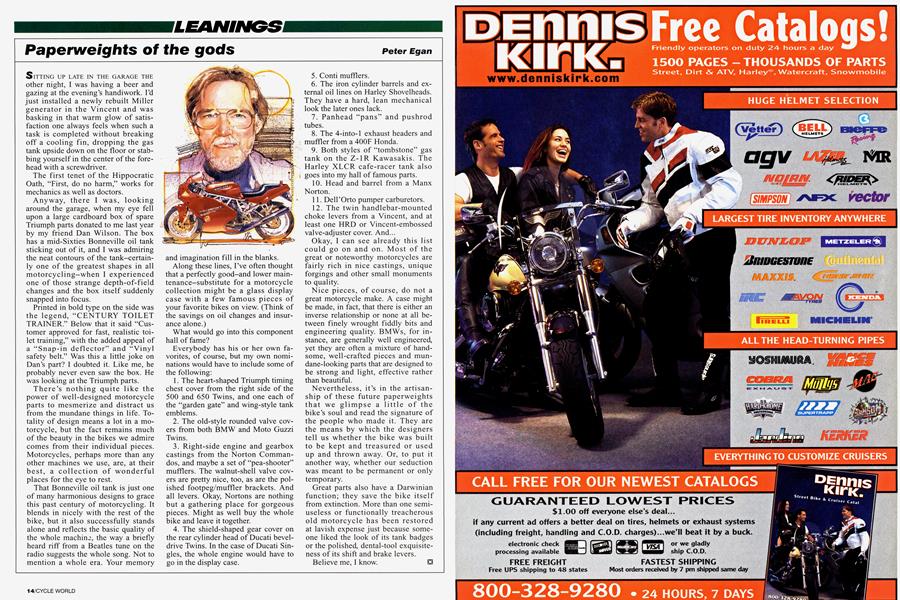
Anyway, there I was, looking around the garage, when my eye fell upon a large cardboard box of spare Triumph parts donated to me last year by my friend Dan Wilson. The box has a mid-Sixties Bonneville oil tank sticking out of it, and I was admiring the neat contours of the tank-certainly one of the greatest shapes in all motorcycling-when I experienced one of those strange depth-of-field changes and the box itself suddenly snapped into focus.
Printed in bold type on the side was the legend, “CENTURY TOILET TRAINER.” Below that it said “Customer approved for fast, realistic toilet training,” with the added appeal of a “Snap-in deflector” and “Vinyl safety belt.” Was this a little joke on Dan’s part? I doubted it. Like me, he probably never even saw the box. He was looking at the Triumph parts.
There’s nothing quite like the power of well-designed motorcycle parts to mesmerize and distract us from the mundane things in life. Totality of design means a lot in a motorcycle, but the fact remains much of the beauty in the bikes we admire comes from their individual pieces. Motorcycles, perhaps more than any other machines we use, are, at their best, a collection of wonderful places for the eye to rest.
That Bonneville oil tank is just one of many harmonious designs to grace this past century of motorcycling. It blends in nicely with the rest of the bike, but it also successfully stands alone and reflects the basic quality of the whole machine, the way a briefly heard riff from a Beatles tune on the radio suggests the whole song. Not to mention a whole era. Your memory and imagination fill in the blanks.
Along these lines, I’ve often thought that a perfectly good-and lower maintenance-substitute for a motorcycle collection might be a glass display case with a few famous pieces of your favorite bikes on view. (Think of the savings on oil changes and insurance alone.)
What would go into this component hall of fame?
Everybody has his or her own favorites, of course, but my own nominations would have to include some of the following:
1. The heart-shaped Triumph timing chest cover from the right side of the 500 and 650 Twins, and one each of the “garden gate” and wing-style tank emblems.
2. The old-style rounded valve covers from both BMW and Moto Guzzi Twins.
3. Right-side engine and gearbox castings from the Norton Commandos, and maybe a set of “pea-shooter” mufflers. The walnut-shell valve covers are pretty nice, too, as are the polished footpeg/muffler brackets. And all levers. Okay, Nortons are nothing but a gathering place for gorgeous pieces. Might as well buy the whole bike and leave it together.
4. The shield-shaped gear cover on the rear cylinder head of Ducati beveldrive Twins. In the case of Ducati Singles, the whole engine would have to go in the display case.
5. Conti mufflers.
6. The iron cylinder barrels and external oil lines on Harley Shovelheads. They have a hard, lean mechanical look the later ones lack.
7. Panhead “pans” and pushrod tubes.
8. The 4-into-l exhaust headers and muffler from a 400F Honda.
9. Both styles of “tombstone” gas tank on the Z-1R Kawasakis. The Harley XLCR cafe-racer tank also goes into my hall of famous parts.
10. Head and barrel from a Manx Norton.
11. Dell’Orto pumper carburetors.
12. The twin handlebar-mounted choke levers from a Vincent, and at least one HRD or Vincent-embossed valve-adjuster cover. And...
Okay, I can see already this list could go on and on. Most of the great or noteworthy motorcycles are fairly rich in nice castings, unique forgings and other small monuments to quality.
Nice pieces, of course, do not a great motorcycle make. A case might be made, in fact, that there is either an inverse relationship or none at all between finely wrought fiddly bits and engineering quality. BMWs, for instance, are generally well engineered, yet they are often a mixture of handsome, well-crafted pieces and mundane-looking parts that are designed to be strong and light, effective rather than beautiful.
Nevertheless, it’s in the artisanship of these future paperweights that we glimpse a little of the bike’s soul and read the signature of the people who made it. They are the means by which the designers tell us whether the bike was built to be kept and treasured or used up and thrown away. Or, to put it another way, whether our seduction was meant to be permanent or only temporary.
Great parts also have a Darwinian function; they save the bike itself from extinction. More than one semiuseless or functionally treacherous old motorcycle has been restored at lavish expense just because someone liked the look of its tank badges or the polished, dental-tool exquisiteness of its shift and brake levers.
Believe me, I know. □