The Sporting Generalists
THE SPORTING GENERALISTS
THE OPEN CLASS
They’re the quickest and the fastest. Are they also the best?
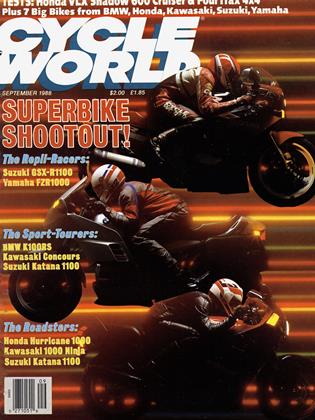
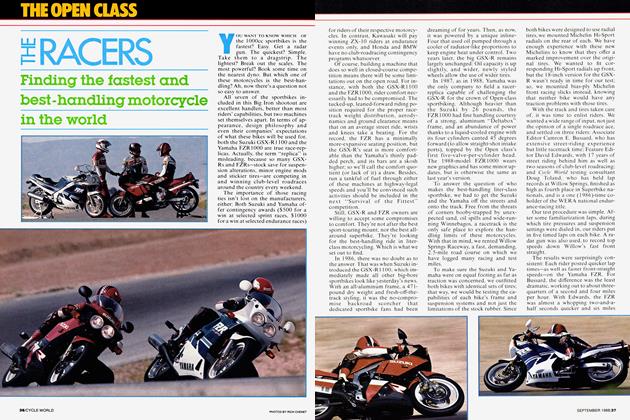
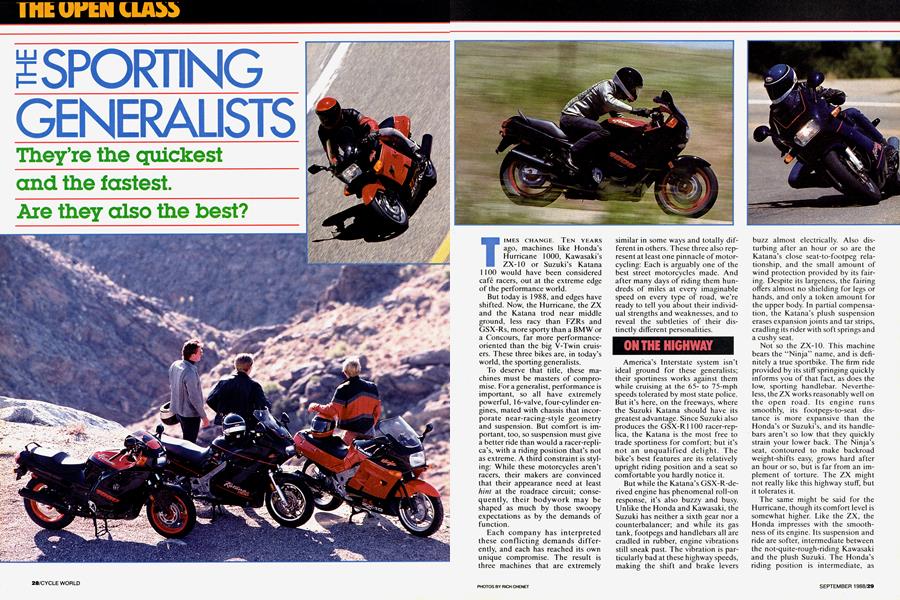
TIMES CHANGE. TEN YEARS ago, machines like Honda’s Hurricane 1000, Kawasaki’s ZX-10 or Suzuki’s Katana 1100 would have been considered café racers, out at the extreme edge of the performance world. But today is 1988, and edges have shifted. Now, the Hurricane, the ZX and the Katana trod near middle ground, less racy than FZRs and GSX-Rs, more sporty than a BMW or a Concours, far more performance-oriented than the big V-Twin cruisers. These three bikes are, in today’s world, the sporting generalists.
To deserve that title, these machines must be masters of compromise. For a generalist, performance is important, so all have extremely powerful, 16-valve, four-cylinder engines, mated with chassis that incorporate near-racing-style geometry and suspension. But comfort is important, too, so suspension must give a better ride than would a racer-replica’s, with a riding position that’s not as extreme. A third constraint is styling: While these motorcycles aren’t racers, their makers are convinced that their appearance need at least hint at the roadrace circuit; consequently, their bodywork may be shaped as much by those swoopy expectations as by the demands of function.
Each company has interpreted these conflicting demands differently, and each has reached its own unique compromise. The result is three machines that are extremely
similar in some ways and totally different in others. These three also represent at least one pinnacle of motorcycling: Each is arguably one of the best street motorcycles made. And after many days of riding them hundreds of miles at every imaginable speed on every type of road, we’re ready to tell you about their individual strengths and weaknesses, and to reveal the subtleties of their distinctly different personalities.
ON THE HIGHWAY
America’s Interstate system isn’t ideal ground for these generalists; their sportiness works against them while cruising at the 65to 75-mph speeds tolerated by most state police. But it’s here, on the freeways, where the Suzuki Katana should have its greatest advantage. Since Suzuki also produces the GSX-R1 100 racer-replica, the Katana is the most free to trade sportiness for comfort; but it’s not an unqualified delight. The bike’s best features are its relatively upright riding position and a seat so comfortable you hardly notice it.
But while the Katana’s GSX-R-derived engine has phenomenal roll-on response, it’s also buzzy and busy. Unlike the Honda and Kawasaki, the Suzuki has neither a sixth gear nor a counterbalancer; and while its gas tank, footpegs and handlebars all are cradled in rubber, engine vibrations still sneak past. The vibration is particularly bad at these highway speeds, making the shift and brake levers buzz almost electrically. Also disturbing after an hour or so are the Katana’s close seat-to-footpeg relationship, and the small amount of wind protection provided by its fairing. Despite its largeness, the fairing offers almost no shielding for legs or hands, and only a token amount for the upper body. In partial compensation, the Katana’s plush suspension erases expansion joints and tar strips, cradling its rider with soft springs and a cushy seat.
Not so the ZX-10. This machine bears the “Ninja” name, and is definitely a true sportbike. The firm ride provided by its stiff springing quickly informs you of that fact, as does the low, sporting handlebar. Nevertheless, the ZX works reasonably well on the open road. Its engine runs smoothly, its footpegs-to-seat distance is more expansive than the Honda’s or Suzuki’s, and its handlebars aren’t so low that they quickly strain your lower back. The Ninja’s seat, contoured to make backroad weight-shifts easy, grows hard after an hour or so, but is far from an implement of torture. The ZX might not really like this highway stuff, but it tolerates it.
The same might be said for the Hurricane, though its comfort level is somewhat higher. Like the ZX, the Honda impresses with the smoothness of its engine. Its suspension and ride are softer, intermediate between the not-quite-rough-riding Kawasaki and the plush Suzuki. The Honda’s riding position is intermediate, as
well. Its legroom is as cramped as the Katana's, but its handgrip location is slightly lower than the Suzuki's. demanding an amount of forward lean that is sporty but still quite acceptable. The Honda’s fully enclosing bodywork shields most of the lower body from the wind, but leaves head and upper torso in clean airflow. Its seat is acceptable for an hour or so. then becomes less comfortable with increasing time.
Neither of these three motorcycles would be ideal for riding cross-country on Interstate 80. but all can cope with a several-hundred-mile dav cm such roads. Under those conditions, the Suzuki would be marginally the best, with the Honda a close second, the Kawasaki following narrowly behind in third.
ON CITY STREETS
Around tow n. Suzuki's Katana has a serious problem; Its jetting is so lean that at least 1 0 minutes of warmup are required before it will idle without the choke. That's a shame, because otherwise, the Suzuki is a delight running short errands. Its torquey engine and smooth-shifting gearbox are rewarding to use. and the bike feels lower than the other machines. w ith its 1 6-inch front tire providing light steering. Still, when you have to maneuver it in a parking lot. the 55 1-pound Katana feels far from being a lightweight.
By a small margin, the Hurricane is the lightest of this group, but in the city you would never guess as much. Its taller seat and high center of gravite make it slightly clumsy at very low speeds, but otherwise it adapts well to an urban environment. Its engine warms up quickly, and its relatively narrow-section tires give very linear steering. Here, too, the Hurricane’s ethereally smooth engine and controls are satisfying; every contact between rider and machine is reassuring! v precise.
The Kawasaki is equally precise, and its walking-speed handling is actually a notch up on the Hurricane’s, probably because it carries its 541 pounds slightlv lower. Again, its engine adapts well to the city, encouraging short-shif ting and low-rpm use. But in city traffic, the Kawasaki’s front brake borders on the /oo-powerful. Adequate for a 165-mph machine on a racetrack, the ZX's front brake demands a light touch until you're thoroughly acclimated to it. In return, the stopping distances it can provide an expert are the best we've ever measured.
In city riding, all three machines are penalized slightly by their size and weight, and near equally rewarded by their powerful engines. Only the Suzuki's lean jetting is a serious problem for everyone, though the Honda's highish seat and center of' gravity might make life difficult for the shorter of inseam.
ON FAST AND TWISTY ROADS
These machines were really built for two-lane blacktop, the kind that twists and spirals through wooded hills or snakes alongside a river bottom or w inds its way up and around a mountain. On those sorts of roads, these machines are a delight.
The Katana will keep you happiest. though, if you don’t push too hard. Ride it smoothly at about eighttenths and it bends easily into corners. then pulls hard out of them thanks to its torquey engine. There’s little need to stir the shift pedal. Push harder, however, and the Katana misbehaves. Its soft suspension lets the undercarriage bash into the ground rather easily, and allows the big Suzuki to move around enough in bumpy corners to upset its handling. Also disturbing are the steering inconsistencies brought about by the fat. 16inch tires as they hit bumps or as the bike shifts its weight; even rolling off the throttle in a corner causes the Katana to sit up slightly.
At the opposite extreme is the Kawasaki. Its firm springing and wide, radial tires make it as precise as a laser gunsight. Pick your line through a corner and the Kawasaki zaps it. feeling as planted and secure as if you had four w heels instead of two.
If the Kawasaki has a handling quirk, it is the bike’s reaction to midcorner braking (as might be required in a decreasing-radius turn). Pouching the brakes then tends to make the ZX sit up, and compensation requires a conscious and forceful increase in steering torque. You learn quickly that cornering and braking work together w ith the Kawasaki only if you do both very smoothly.
You also quickly learn that the Kawasaki’s throttle requires smoothness and restraint in corners. This ZX-10 is easily the most powerful stock motorcycle we’ve ever tested, posting the fastest production-bike quartermile in our history. It’s an exceptional engine, torquey in the midrange and stunning on the top end. All it asks is that you use it carefully, and roll the throttle on when leaving the turn. Do that, and nothing will exit a corner harder.
But the Hurricane will be close behind. Not quite as powerful as the ZX, it shares the Kawasaki’s engine character: strong in the mid-range, stronger yet on top.
But unlike the ZX, the Hurricane has tires and wheels biased toward linear handling response rather than ultimate cornering traction. The relativelv tall and narrow tires on the
J
Hurricane make it absolutely predictable, the only bike of this bunch that easily allows you to brake hard while leaned over.
On a smooth road with predictable, constant-radius corners, the ZX has the advantage; but on a sneaky road that you've never seen before, the easier bike to ride w ill be the more forgiving Honda. As for the Suzuki, it needs firmer, better-damped suspension to stay close to either.
THE BOTTOM LINE
You have to be jaded indeed not to find each of these three motorcycles appealing. All are exceptional; a rational argument could easily be made for buying any one.
But it might be most difficult to build that argument for the Katana if you had recently ridden the Kawasaki or the Honda. Less clearly focused than the other two (Was Suzuki’s only goal with this machine to produce an FJ 1200 Yamaha bearing the Suzuki name?), the Katana could use improvements in vibration control, in fairing protection, in suspension rates, in carburetor jetting, in gear ratios or the number of gearbox speeds. The Katana is a terrific bike, but it suffers in comparison.
The Kawasaki, though, is so performance-intense that those who
must have such motorcycles already know' about it. It’s the fastest, quickest. best-stopping streetbike we've ever tested. In exchange for those superlatives. it requires less sacrifice than FZRs or GSX-Rs —in other words, it’s the Open class’s most rational sportbike.
That leaves the Hurricane. It's al-
most as quick, fast and quick-stopping as the Kawasaki, while being almost as comfortable and plush-riding as the Suzuki. And it oilers better real-world handling than either. Thus, it's the true generalist of this paek. With the Hurricane 1000. Honda has simply built the best allaround sportbike in the world. ¡o]