The Racers
THE RACERS
THE OPEN CLASS
Finding the fastest and best-handling motorcycle in the world
YOU WANT TO KNOW WHICH OF the l000cc sportbikes is the fastest? Easy. Get a radar gun. The quickest? Simple. Take them to a dragstrip. The lightest? Break out the scales. The most powerful? Book some time on the nearest dyno. But which one of these motorcycles is the best-handling? Ah, now there’s a question not so easy to answer.
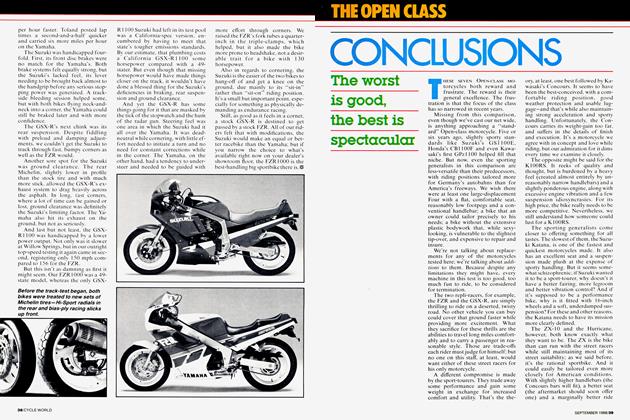
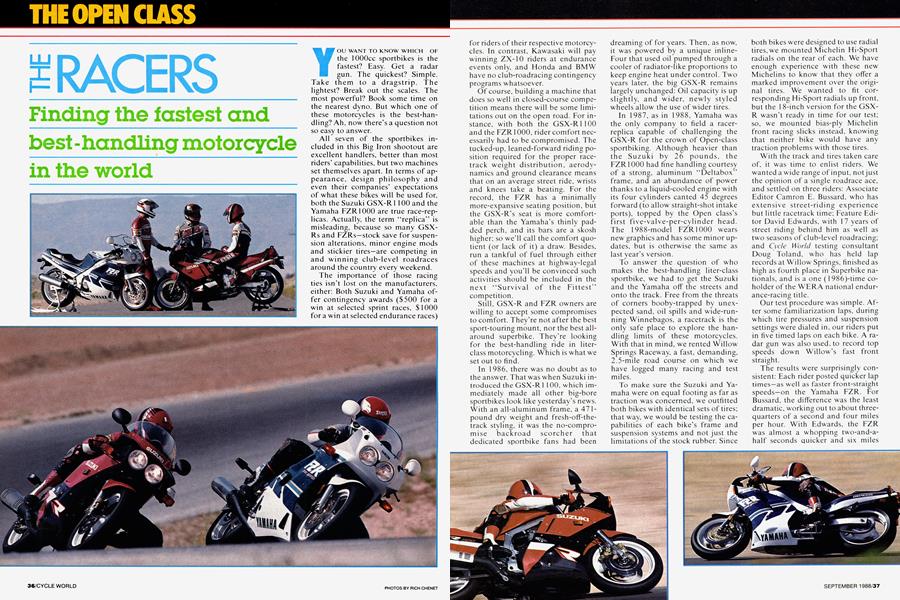
All seven of the sportbikes included in this Big Iron shootout are excellent handlers, better than most riders’ capabilities, but two machines set themselves apart. In terms of appearance, design philosophy and even their companies’ expectations of what these bikes will be used for, both the Suzuki GSX-R 1 100 and the Yamaha FZR1000 are true race-replicas. Actually, the term “replica” is misleading, because so many GSXRs and FZRs—stock save for suspension alterations, minor engine mods and stickier tires—are competing in and winning club-level roadraces around the country every weekend.
The importance of those racing ties isn’t lost on the manufacturers, either: Both Suzuki and Yamaha offer contingency awards ($500 for a win at selected sprint races, $1000 for a win at selected endurance races) for riders of their respective motorcycles. In contrast, Kawasaki will pay winning ZX-10 riders at endurance events only, and Honda and BMW have no club-roadracing contingency programs whatsoever.
Of course, building a machine that does so well in closed-course competition means there will be some limitations out on the open road. For instance, with both the GSX-R 1100 and the FZR1000, rider comfort necessarily had to be compromised. The tucked-up, leaned-forward riding position required for the proper racetrack weight distribution, aerodynamics and ground clearance means that on an average street ride, wrists and knees take a beating. For the record, the FZR has a minimally more-expansive seating position, but the GSX-R's seat is more comfortable than the Yamaha’s thinly padded perch, and its bars are a skosh higher; so we’ll call the comfort quotient (or lack of it) a draw. Besides, run a tankful of fuel through either of these machines at highway-legal speeds and you’ll be convinced such activities should be included in the next “Survival of the Fittest” competition.
Still, GSX-R and FZR owners are willing to accept some compromises to comfort. They’re not after the best sport-touring mount, nor the best allaround superbike. They’re looking for the best-handling ride in literclass motorcycling. Which is what we set out to find.
In 1986, there was no doubt as to the answer. That was when Suzuki introduced the GSX-R 1 100, which immediately made all other big-bore sportbikes look like yesterday’s news. With an all-aluminum frame, a 471pound dry weight and fresh-off-thetrack styling, it was the no-compromise backroad scorcher that dedicated sportbike fans had been
dreaming of for years. Then, as now, it was powered by a unique inlineFour that used oil pumped through a cooler of radiator-like proportions to keep engine heat under control. Two years later, the big GSX-R remains largely unchanged: Oil capacity is up slightly, and wider, newly styled wheels allow the use of wider tires.
In 1987, as in 1988, Yamaha was the only company to field a racerreplica capable of challenging the GSX-R for the crown of Open-class sportbiking. Although heavier than the Suzuki by 26 pounds, the FZR1000 had fine handling courtesy of a strong, aluminum “Deltabox” frame, and an abundance of power thanks to a liquid-cooled engine with its four cylinders canted 45 degrees forward (to allow straight-shot intake ports), topped by the Open class's first five-valve-per-cylinder head. The 1988-model FZR1000 wears new graphics and has some minor updates, but is otherwise the same as last year’s version.
To answer the question of who makes the best-handling liter-class sportbike, we had to get the Suzuki and the Yamaha off the streets and onto the track. Free from the threats of corners booby-trapped by unexpected sand, oil spills and wide-running Winnebagos, a racetrack is the only safe place to explore the handling limits of these motorcycles. With that in mind, we rented Willow Springs Raceway, a fast, demanding, 2.5-mile road course on which we have logged many racing and test miles.
To make sure the Suzuki and Yamaha were on equal footing as far as traction was concerned, we outfitted both bikes with identical sets of tires; that way, we would be testing the capabilities of each bike’s frame and suspension systems and not just the limitations of the stock rubber. Since both bikes were designed to use radial tires, we mounted Michelin Hi-Sport radiais on the rear of each. We have enough experience with these new Michelins to know that they offer a marked improvement over the original tires. We wanted to fit corresponding Hi-Sport radiais up front, but the 1 8-inch version for the GSXR wasn’t ready in time for our test; so, we mounted bias-ply Michelin front racing slicks instead, knowing that neither bike would have any traction problems with those tires.
With the track and tires taken care of, it was time to enlist riders. We wanted a wide range of input, not just the opinion of a single roadrace ace, and settled on three riders: Associate Editor Camron E. Bussard, who has extensive street-riding experience but little racetrack time; Feature Editor David Edwards, with 17 years of street riding behind him as well as two seasons of club-level roadracing; and Cycle World testing consultant Doug Toland, who has held lap records at Willow Springs, finished as high as fourth place in Superbike nationals, and is a one ( 1986)-time coholder of the WER A national endurance-racing title.
Our test procedure was simple. After some familiarization laps, during which tire pressures and suspension settings were dialed in, our riders put in five timed laps on each bike. A radar gun was also used, to record top speeds down Willow’s fast front straight.
The results were surprisingly consistent: Each rider posted quicker lap times—as well as faster front-straight speeds—on the Yamaha FZR. For Bussard, the difference was the least dramatic, working out to about threequarters of a second and four miles per hour. With Edwards, the FZR was almost a whopping two-and-ahalf seconds quicker and six miles
per hour faster. Toland posted lap times a second-and-a-half quicker and carried six more miles per hour on the Yamaha.
The Suzuki was handicapped fourfold. First, its front disc brakes were no match for the Yamaha’s. Both brake systems felt equally strong, but the Suzuki's lacked feel, its lever needing to be brought back almost to the handgrip before any serious stopping power was generated. A trackside bleeding session helped some, but with both bikes flying neck-andneck into a corner, the Yamaha could still be braked later and with more confidence.
The GSX-R’s next chink was its rear suspension. Despite fiddling with preload and damping adjustments, we couldn't get the Suzuki to track through fast, bumpy corners as well as the FZR would.
Another sore spot for the Suzuki was ground clearance. The rear Michelin, slightly lower in profile than the stock tire and with much more stick, allowed the GSX-R's exhaust system to drag heavily across the asphalt. In long, fast corners, where a lot of time can be gained or lost, ground clearance was definitely the Suzuki's limiting factor. The Yamaha also hit its exhaust on the ground, but not as seriously.
And last but not least, the GSXR 1 100 was handicapped by a lower power output. Not only was it slower at Willow Springs, but in our outright top-speed testing it again came in second, registering only 150 mph compared to 1 56 for the FZR.
But this isn’t as damning as first it might seem. Our FZR1000 was a 49state model, whereas the only GSX-
R 1 100 Suzuki had left in its test pool was a California-spec version, encumbered by having to meet that state's tougher emissions standards. By our estimate, that plumbing costs a California GSX-R 1100 some horsepower compared with a 49stater. But even though that missing horsepower would have made things closer on the track, it wouldn't have done a blessed thing for the Suzuki’s deficiencies in braking, rear suspension and ground clearance.
And yet the GSX-R has some things going for it that are masked by the tick of the stopwatch and the hum of the radar gun. Steering feel was one area in which the Suzuki had it all over the Yamaha. It was deadneutral while cornering, with little effort needed to initiate a turn and no need for constant corrections while in the corner. The Yamaha, on the other hand, had a tendency to understeer and needed to be guided with more effort through corners. We raised the FZR’s fork tubes a quarterinch in the triple-clamps, which helped, but it also made the bike more prone to headshake, not a desirable trait for a bike with 130 horsepower.
Also in regards to cornering, the Suzuki is the easier of th.e two bikes to hang-off of and get a knee on the ground, due mainly to its “sit-in” rather than “sit-on” riding position. It’s a small but important point, especially for something as physically demanding as endurance racing.
Still, as good as it feels in a corner, a stock GSX-R is destined to get passed by a stock FZR. All of our riders felt that with modifications, the Suzuki would make an equal or better racebike than the Yamaha; but if you narrow the choice to what's available right now on your dealer’s showroom floor, the FZR1000 is the best-handling big sportbike there is. ®