The Sport Tourers
THE SPORT TOURERS
THE OPEN CLASS
For those times when the shortest route between two points is the one to avoid
TOURING, IN THE TRADITIONal American sense, is based on the idea of reaching a destination. You first decide where you want to go, then figure out the quickest way to get there. But sport-touring is an altogether different way of travel, one that has little to do with where you’re going and a lot to do with getting there on the most exciting and challenging roads possible. In other words, sport-touring is based on a riding attitude rather than a destination. And implicit in that attitude is the belief that the shortest distance between two points is the last route you’re likely to choose.
You don’t need a specialized motorcycle to go sport-touring. In fact, if you have the right frame of mindthe right attitude—almost anything with two wheels and an engine will do. But obviously, a sport-touring bike is better-suited to the task; and to be a proper sport-tourer, a motorcycle needs a balance between providing adequate comfort and luggage capacity for long days in the saddle, while also delivering near-sportbikelevels of engine performance and handling on the twistier sections of the journey.
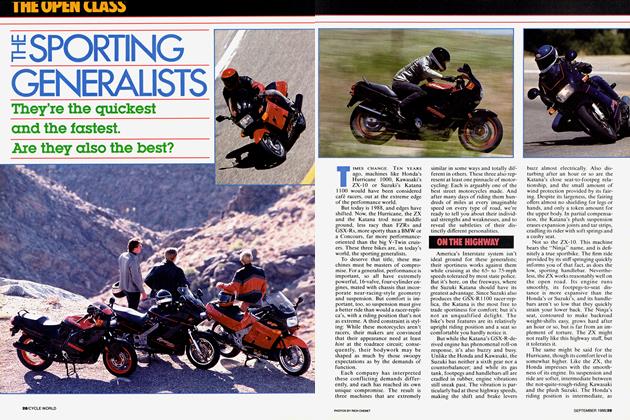
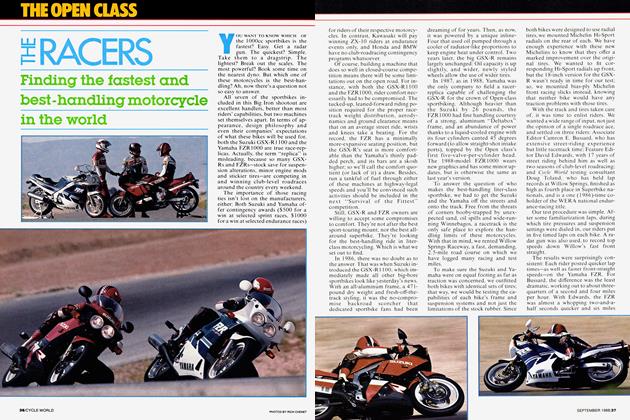
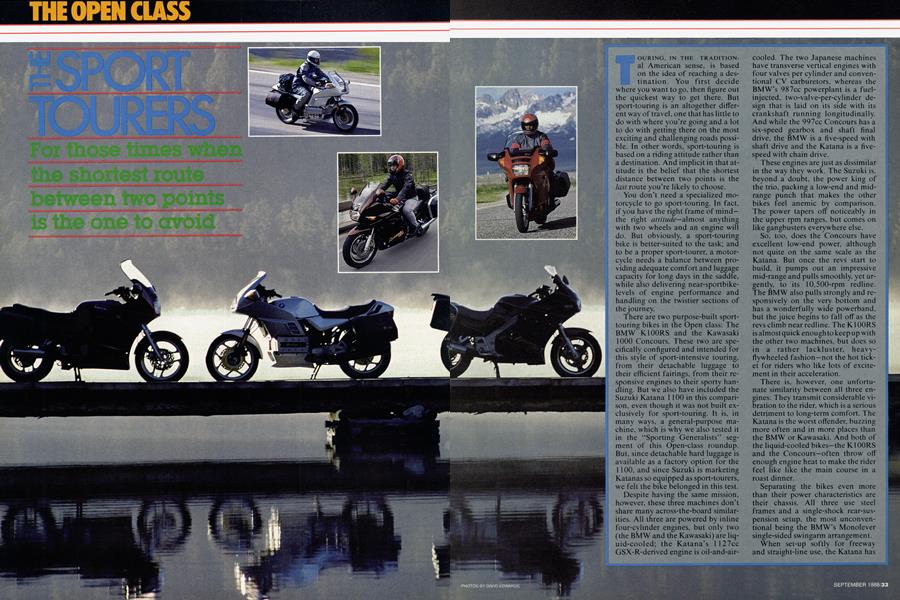
There are two purpose-built sporttouring bikes in the Open class: The BMW K100RS and the Kawasaki 1000 Concours. These two are specifically configured and intended for this style of sport-intensive touring, from their detachable luggage to their efficient fairings, from their responsive engines to their sporty handling. But we also have included the Suzuki Katana 1100 in this comparison, even though it was not built exclusively for sport-touring. It is, in many ways, a general-purpose machine, which is why we also tested it in the “Sporting Generalists” segment of this Open-class roundup. But, since detachable hard luggage is available as a factory option for the 1100, and since Suzuki is marketing Katanas so equipped as sport-tourers, we felt the bike belonged in this test.
Despite having the same mission, however, these three machines don’t share many across-the-board similarities. All three are powered by inline four-cylinder engines, but only two (the BMW and the Kawasaki) are liquid-cooled; the Katana's 1127cc GSX-R-derived engine is oil-and-aircooled. The two Japanese machines have transverse vertical engines with four valves per cylinder and conventional CV carburetors, whereas the BMW's 987cc powerplant is a fuelinjected, two-valve-per-cylinder design that is laid on its side with its crankshaft running longitudinally. And while the 997cc Concours has a six-speed gearbox and shaft final drive, the BMW is a five-speed with shaft drive and the Katana is a fivespeed with chain drive.
These engines are just as dissimilar in the way they work. The Suzuki is, beyond a doubt, the power king of the trio, packing a low-end and midrange punch that makes the other bikes feel anemic by comparison. The power tapers off noticeably in the upper rpm ranges, but comes on like gangbusters everywhere else.
So, too, does the Concours have excellent low-end power, although not quite on the same scale as the Katana. But once the revs start to build, it pumps out an impressive mid-range and pulls smoothly, yet urgently, to its 10,500-rpm redline. The BMW also pulls strongly and responsively on the very bottom and has a wonderfully wide powerband, but the juice begins to fall off as the revs climb near redline. The K100RS is almost quick enough to keep up with the other two machines, but does so in a rather lackluster, heavyflywheeled fashion—not the hot ticket for riders who like lots of excitement in their acceleration.
There is. however, one unfortunate similarity between all three engines: They transmit considerable vibration to the rider, which is a serious detriment to long-term comfort. The Katana is the worst offender, buzzing more often and in more places than the BMW or Kawasaki. And both of the liquid-cooled bikes—the K100RS and the Concours—often throw off enough engine heat to make the rider feel like like the main course in a roast dinner.
Separating the bikes even more than their power characteristics are their chassis. All three use steel frames and a single-shock rear-suspension setup, the most unconventional being the BMW’s Monolever single-sided swingarm arrangement.
When set-up softly for freeway and straight-line use, the Katana has a plush, Cadillac-like ride that the other bikes can’t match. The Concours, with its air-adjustable front fork and rear shock, is not far behind, offering a ride that is just a tad firmer than the Katana’s. The KIOORS, with a new, stiffer fork much like that on the BMW K75S, rides tautly up front without being harsh; the rear spring is quite stiff for ’88, mostly to help reduce the up-and-down chassis movement caused by shaft-drive torque-reaction, but it also results in a slightly choppy ride at the rear no matter where the preload is set.
When adjusted to firmer settings for sporty riding on tighter, windier roads, the BMW reaches its handling limits first. Even though it has the lowest center of gravity, it often feels the most top-heavy, and requires more and more steering effort as speeds increase. Most of this is due to the bike’s comparatively slow steering geometry and its narrow handlebar, which offers little leverage.
The Katana, on the other hand, turns almost effortlessly until the roads become really tight and the speeds are slower, at which point the bike’s 550-pound weight handicaps its cornering abilities. And in long, fast sweepers, both bikes tend to wallow and move around, often enough to be rather disconcerting; and when the going gets rougher, or when the brakes are trailed while the bike is leaned over, the Katana tries to sit up, no doubt due to its wide, 16-inch front tire.
Under these same circumstances, the Concours is the only one of the three that fails to lose its composure. It consistently tracks through all sorts of turns with ease, even when stuffed into them quite aggressively. Although nearly 80 pounds heavier than the Katana, it corners with less effort, partly due to its relatively skinny front tire, and partly due to its high, wide handlebars that are nearly an inch-and-a-half taller (and further rearward) than those on the original ’86 Concours.
Those bars also have made the Concours so much more ergonomically acceptable than earlier versions that the bike now is the most comfortable machine in its class. That comfort starts with the fairing, which offers the best overall wind-protection from head to toe. There does seem to be a small pocket of turbulence behind the windscreen that causes riders of around 5-feet-IO in height to complain about wind noise and helmet buffeting; but riders who are either taller or shorter than that said they loved sitting behind the Concours’s massive windscreen. In addition, the fairing has two small storage pouches, a convenience the other bikes lack.
Like the Concours, the BMW has a well-designed fairing that offers good overall rider protection. Its pop-off mirrors/turnsignals not only allow you to see what’s behind you, they also furnish hand protection from the elements. Its biggest glitch is the windscreen, which deflects turbulent air directly at the rider’s head and is too short to tuck completely behind.
Then there’s the Katana’s fairing, which is more of an exercise in styling than in function. It is molded so closely around the frame and engine that the rider doesn’t get nearly the amount of body protection that the other fairings provide. Also, its electrically adjustable windscreen fails to be of much use. No matter where the screen is adjusted, the rider is subject to at least as much turbulence and noise as he is on the BMW, but with less protection.
While the Katana rider is trying to find a quiet spot on the bike, at least he can rest on a wide, intelligently shaped and padded seat that is one of the best in the business. By comparison, the Kawasaki’s wide, flat seat is hard, and the BMW’s at times feels like little more than an upholstered board. But the BMW partially compensates for its hard seat by having the best lower-body ergonomics of the bunch, with nearly perfect seatto-footpeg spacing. And although the handlebar is too narrow, the reach to the K-bike’s foam-rubber handgrips is just about right. Not so the Concours, which makes you stretch over its long gas tank to reach the bars; and the Katana forces you to crank about as much bend in your knees as some pure sportbikes do.
So, as you can see, none of these bikes is perfect. The Katana promises much with its locomotive-class engine, fabulous seat and compliant suspension; and it is nicely finished, with high-quality body pieces and saddlebags that fit properly. But the bulky saddlebag-mounting brackets have to remain on the bike when the bags are off, making an otherwise attractive motorcycle look much uglier. Worse yet, the bike’s wallow-prone handling, cramped legroom, bothersome vibration, ineffective fairing and near-worthless windscreen combine to make the Katana rank thirdbest among these three sport-tourers.
In second place is the BMW, which falls behind the other bikes in most areas of outright performance, but still comports itself well enough to be a competent sport-touring mount. It also is the most integrated-looking motorcycle of the trio, and its unique
appearance, high-quality finish and obvious craftsmanship give it a special charm the other two machines simply don’t have.
Be that as it may, the best over-thecounter Open-class sport-tourer on the market is the Concours. It is the most comfortable and best-handling, and it gives up little in performance to the Katana. What complaints we do have concern the bike’s ponderous weight and size, and the embarrassingly poor quality of much of the bodywork. The inner fairing pieces are flimsy and ill-fitting, and parts of the outer panels bulge where they don’t fit together properly. And there are numerous little pieces that look like complete afterthoughts. Kawasaki gets a brownie point for including saddlebags as standard equipment (those on the other bikes are expensive options), but then loses that point for designing bags that lack much style or polish, looking instead like large plastic lunchboxes.
Because of things like that, we can’t help but wish the Concours were better; it doesn’t deliver nearly as much as it promises. But even with its drawbacks, the Concours still will let you ride for days over the twistiest roads you can find with more comfort and speed than any other bike on the market.
Right now, nobody does it better. E9