Still Racing After All These Years
Still Racing After All These Years
Battle-Scarred Gary Nixon Pits Himself And An Outmoded Bike Against Formula 750 And The Rest Of The World
Joe Scalzo
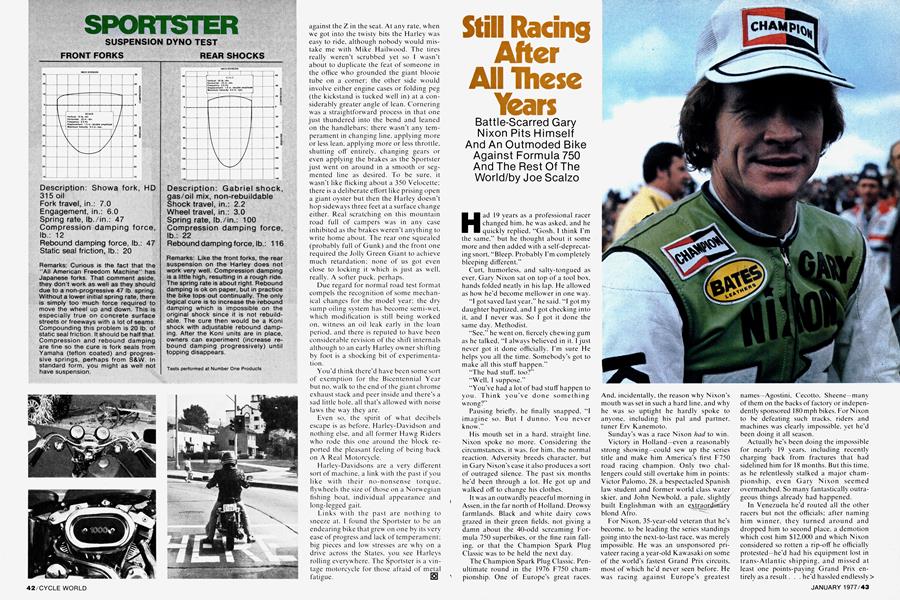
Had 19 years as a professional racer changed him, he was asked, and he quickly replied. "Gosh. I think I'm the same," but he thought about it some more and then added with a self-deprecating snort, "Bleep. Probably I'm completely bleeping different."
Curt, humorless, and salty-tongued as ever. Gary Nixon sat on top of a tool box, hands folded neatly in his lap. He allowed as how he'd become mellower in one way.
“I got saved last year,” he said. “I got my daughter baptized, and I got checking into it. and I never was. So I got it done the same day. Methodist.
“See,” he went on, fiercely chewing gum as he talked. “I always believed in it. I just never got it done officially. I’m sure He helps you all the time. Somebody’s got to make all this stuff happen.”
“The bad stuff, too?”
“Well, I suppose.”
“You've had a lot of bad stuff happen to you. Think you’ve done something wrong?”
Pausing briefly, he finally snapped, “I imagine so. But I dunno. You never know.”
His mouth set in a hard, straight line, Nixon spoke no more. Considering the circumstances, it was, for him, the normal reaction. Adversity breeds character, but in Gary Nixon’s case it also produces a sort of outraged silence. The past six months he’d been through a lot. He got up and walked off’to change his clothes.
It was an outwardly peaceful morning in Assen, in the far north of Holland. Drowsy farmlands. Black and white dairy cows grazed in their green fields, not giving a damn about the 40-odd screaming Formula 750 superbikes, or the fine rain falling, or that the Champion Spark Plug Classic was to be held the next day.
The Champion Spark Plug Classic. Penultimate round in the 1976 F750 championship. One of Europe's great races. And. incidentally, the reason why Nixon’s mouth was set in such a hard line, and why he was so uptight he hardly spoke to anyone, including his pal and partner, tuner Erv Kanemoto.
Sunday’s was a race Nixon had to win.
Victory in Holland—even a reasonably strong showing—could sew up the series title and make him America’s first F750 road racing champion. Only two challengers could still overtake him in points: Victor Palomo, 28, a bespectacled Spanish law student and former world class water skier, and John Newbold, a pale, slightly built Englishman with an extraordinary blond Afro.
For Nixon, 35-year-old veteran that he’s become, to be leading the series standings going into the next-to-last race, was merely impossible. He was an unsponsored privateer racing a year-old Kawasaki on some of the world’s fastest Grand Prix circuits, most of which he’d never seen before. He was racing against Europe’s greatest names—Agostini. Cecotto, Sheene—many of them on the backs of factory or independently sponsored 180mph bikes. For Nixon to be defeating such tracks, riders and machines was clearly impossible, yet he'd been doing it all season.
Actually he’s been doing the impossible for nearly 19 years, including recently charging back from fractures that had sidelined him for 18 months. But this time, as he relentlessly stalked a major championship, even Gary Nixon seemed overmatched. So many fantastically outrageous things already had happened.
In Venezuela he’d routed all the other racers but not the officials: after naming him winner, they turned around and dropped him to second place, a demotion which cost him $12.000 and which Nixon considered so rotten a rip-off he officially protested—he’d had his equipment lost in trans-Atlantic shipping, and missed at least one points-paying Grand Prix entirely as a result. . . he’d hassled endlessly > with tightfisted promoters who tried paying him the bare minimum starting money . . . he’d experienced flukey but persistent mechanical breakdowns on a scale he and Kanemoto never had racing in the U.S. . . . and last, after traveling 50.000 air miles to race in six countries on three continents. Nixon had spent almost $25,000 including $1,200 for a new Kawasaki frame. Even if he won the series championship and everything that w'ent with it. there was no way he’d recover all his expenses.
“I want to be world champion.” he’d said slowly, intensely, “it’s something I always promised myself. But, bleep. I can’t take all this bad stuff that’s been going down.”
And now in Holland, in the F750 tour’s next-to-last race, the bad stuff resumed. It began on the third rainy Assen practice lap when the redheaded series point leader veered off the track, engine shut off'. He rolled for the narrow pit lane and covered garages where Erv Kanemoto was waiting, worried.
There’d already been so many mechanical failures during the year, the 33-year old Kanemoto automatically feared the worst.
“The clip holding one of carburetor slides broke,” called Nixon, stepping off the bike wearing green and white Kawasaki leathers, white helmet, and red boots wrapped in silver tape w'here the soles had ground through.
“Oh.” replied Kanemoto. sensing a minor problem quickly repaired.
“But what if it got sucked through the engine?” Nixon asked, pulling off his helmet. His hair seemed redder than ever in the rain.
“No, I don’t think it could get in there,” said Kanemoto.
“But w'hat if it did?”
At an earlier F750 round in France a chain snapped and one of the links got inside the engine and blew' it up. Nixon hadn’t forgotten.
While Kanemoto’s face glazed with thought, Nixon hunched down, using a rag to dry the oversized rear tire. Then he stood up and walked to the pit wall and sat down. The marvelously self-efficient Kanemoto sw'armed over the Kawasaki, checking brakes, spark plugs, setting chain tension and generally accomplishing singlehandedly what other teams employ three or four mechanics to do.
“Look at Erv.” Nixon, gestured, “All year he’s been working his ass off like that. And he’s got no money to show' for it.” Nixon and Kanemoto divide all prize monies 50-50. but in ’76. unlike other seasons, there’d been little to split.
“Ready. Gary?” Kanemoto called.
“You sure that clip isn’t in there?” Nixon asked.
The answer w'as yes and Nixon, his helmet on again, slowdy swung a leg over the saddle and went out for more practicing.
He w'as not impressive. He wasn’t riding especially well. All his lap times were slow. Worse, they seemed erratic—as much as 11 seconds apart. Nixon's outdated upright cornering technique clashed with the style of the acrobatic knee draggers like Pat Hennen, the other American in the F750 series.”1 almost ran into the back of Nixon a couple of times,” said Hennen. “This place must confuse him. He’s not on the gas like he should be.”
Nixon was soon in the pits again and Kanemoto worked hard changing the gearing.
“Who was that blue and white Yamaha just blewr me off?” Nixon shouted to the tuner.
“Palomo?”
“No. it wasn’t him. I don’t know w'ho it was. But there I was screwing with this one guy, when somebody else comes up and blows me off.”
“You like the track?”
“Yeah. Sure. If I can ever learn where the bleep I’m going.” Assen’s Circuit Van Drenthe is nearly five miles long.
Later Nixon w'alked to the makeshift tent Kanemoto had set up in the pits. Seated on a stack of tires w ith a cigarette going. Nixon had a cup of coffee in one hand and pencil and pad of paper in his lap. He sketched a map of the circuit. Frowning, he silently studied it.
His lap times later in the day didn’t improve.
Sensing that his rider w'as going to go no faster. Kanemoto suggested they stop.
“We don’t want to over-practice the bike, wear it out.” he explained. “That would be like gambling with the rent money.”
“Uh huh.” said Nixon. He didn’t relish more laps on the soaking wet track either.
“We didn’t set no fast time, but think we can do it all day,” Nixon later told Phil Read, like Nixon a revered racing name and. at 37. one of the few active Grand Prix riders older than Nixon.
Read nodded sympathetically. His fourcylinder Yamaha had been six seconds a lap faster than Nixon’s Kawasaki.
Nor evening was Nixon at the more hotel talkative in downtown that Assen where Champion was hosting a party honoring the riders and teams. Among the honorées was Johnny Cecotto, the day’s fastest qualifier. The high-strung 19 year old distinguished himself by scooping up a handful of nuts from the hors d’oeuvres table, pulling a horrified face at the taste, then spitting them out while cursing with great enthusiasm in Italian.
“He took me for a ride once in his Ferrari down in France,” Nixon said, grinning. “Shoo. Fastest bleeping car guy I ever rode with.”
Well-w'ishers approached his table, respectfully wishing him luck in many languages. Nixon could become series champion the following day and everyone knew it. Everyone knew about his poor lap times, too.
“I miss being home,” he said suddenly. “Erv’n me are both homesick as hell. All this traveling back and forth—it’s hell. To make money, you gotta do it. but, well. I’d just soon be home playing with my two kids. Nice little guy, neat little chick. I got.
“We weren’t leading this thing now', we would be home,” he said, almost sounding like he wished he wasn’t leading it. “but now that we are leading it, w;e gotta go for it. We w'in it, hopefully we’ll get a big sponsor, come back next year and really do some business. Wouldn't be bad, Erv and me get to be world champions tomorrow.”
The thought seemed to cheer him up.
“You know, we get to be world champions, then we can walk into some company and say ’Hey, we’re world champions. how' about sponsoring us?”
Mockingly, he recalled his unsuccessful earlier attempts to find a sponsor: “I walked in on these big companies and I said. ’Hey. I’ve had two broken arms, and they've been broken again, and I ain’t raced in a year and a half but once, so would you give Erv and me a hundred thousand bucks to sponsor us in Europe?’ Sure, that really went over bleeping big. Oh. yeah, it did.”
And suddenly he was oft', denouncing in a low' but intense voice the rip-off in Venezuela. He also denounced the European race promoter who’d offered him a whole $ 100 to come to his race, and the big tire company that wouldn’t give him tires unless he changed his riding style, on and on. dredging up the w'hole outrageous, impossible year.
Told that he should relax a bit and not get so worked up, Nixon looked briefly indignant. His voice softened and he almost smiled.
“Aw,” he said, “I’m just getting my race face on. Tomorrow I know' what we gotta do, and I just gotta go out and do it.” He became intense again. “I just got my race face on. is all.”
Yes, he certainly did.
It was obvious that Gary Nixon hadn't changed after 19 years, not really. To achieve a superior performance in a race, he still had to put on a race face that turned him into an emotional, outraged wreck. Outrage has always been a highly useful propellant for Nixon. In 1967, when he was in the running for his first American title, he felt outraged at having to go in the season’s final race with the impossible handicap of a broken thumb. He nerved himself up to ride perfectly in spite of the thumb and became champion. He used the same technique in 1968’s final and dramatic race: outraged at the unfairness of having to take on a swarming Harley-Davidson team that had outnumbered him six to one all year, he turned the tables on the six and won another U.S. championship.
A decade later, on this rainy night in Holland. Nixon was again getting on his race face.
Rain staining poured the down gray in raceway the morning, black, collecting in puddles along the straightaways. Nixon practiced carefully in the vile weather wearing a black nylon coat over his leathers, and with white sweat socks wrapped in cellophane inside his boots. By one o’clock the rain had stopped. Assen was dry, but the skies remained gray and menacing.
Lined up on a rear row of the grid for the first 100 kilometer heat, it took Nixon a long time to draw on his skin-tight gloves. With him on the line were Swiss, English, French. Italian and Spanish riders. Nixon watched race officials yank the works Yamaha of Giacomo Agostini off the front row because the 15-time world champion couldn’t find a clean lens for his helmet. Thirty thousand people had come to the race, many of them to see Agostini, but officials would not hold up the race for him or any rider. The Italian was still protesting when the green flag flapped and off roared the 40-bike pack amidst exhaust smoke and ear-ripping noise.
Up through the smoke shot a streak of Kawasaki green—Nixon had made a wonderful start.
But the movement of the starter's hand had seemingly precipitated something else.
Rain.
Erv Kanemoto felt the drops striking his bare head, looked skyward and said, “Shoot”—or a word to that effect.
Because Nixon, thinking the wet weather was gone forever, had gambled on using treadless slick tires, fast in the dry but useless and dangerous in the rain.
The distant roar building from the far end of the circuit announced the arrival of the pack, with Cecotto’s cannon of a Yamaha getting to the chicane corner first. Swerving, skidding, and finally crashing, Cecotto and the bike struck the ground and the gas tank broke and began blazing on impact. Cecotto jumped up unharmed.
Straight through the flames came Phil Read, leading the race, then a Dutch rider, and then—no, it couldn’t be. he couldn’t have made up such ground on the opening lap—Nixon.
It was Nixon. In five miles he’d shot past 14 bikes and was nearly challenging for the lead. He had done it on a track that had baffled him completely except when it counted. Now he was riding with a marvelous sense of purpose.
“C’mon. Gary!” cried Kanemoto, who had always had faith in his rider and did not seem surprised.
Yet even as he stood in the pits flashing signals, Kanemoto was getting soaked to the skin and knew Nixon could not continue at that pace on a tire without tread.
“Maybe,” the tuner said, “it’s not raining so hard on the back part of the track as it is here.”
Unfortunately it was. This was a day when all of Holland seemed to be storming and now Nixon, fighting the swerves and lurches of his 120 horsepower mount began falling back. More rain beat down. The leaders with their rain tires were getting away from the American, and challengers from the back gaining on him.
They all passed Nixon. They went by in a blast of angry spray that left Nixon grappling with his stubby handlebars, struggling for control. Eventually he finished 20th. Read had lapped him.
Afterwards there was not much to say. It had been Nixon’s decision to go with a slick tire.
“That was the worst mistake I ever made,” he said. “Ever.”
Kanemoto was checking out the bike because Nixon had reported a balky low' gear.
“The worst mistake I ever made,” Nixon repeated, berating himself.
There w'as another 100 kilometer heat to be run. a last opportunity to score points. Nixon started w'ith a rain tire this time. No rain fell. The track, once shiney with water, dried. Riders with slicks had the advantage.
Even so, Nixon was briefly impressive. Once as far back as 18th, he became interested and climbed to tenth, then ninth.
The Kawasaki’s gear-shift shaft broke. It broke right where it comes out of the box. Nixon eased the shiftless bike into the pits. Kanemoto locked it in third gear then sent Nixon back out to cruise to the finish. Looking wistfully at the hand he’d hurt during the emergency stop, Kanemoto said. “That’s another first. We’ve never, ever, had a shaft break like that before.”
The long stop dropped Nixon totally out of contention. He earned not a single championship point for the wet day.
“Boy,” Kanemoto said as the Champion Classic ended. “What a day.”
Usually unflappable, the tuner was at last showing fatigue, didn't care who knew it. “You know what this world championship thing has been like?” he asked, walking toward the infield pits. “It’s like a fist fight. Nobody wants to get into a fight. But when you can’t avoid it. and once you get started, you don’t dare stop until you’ve won.”
He found Nixon in the pits being accosted by a drunken Dutch fan.
“American riders are okay,” said the drunk, reeling slightly. “But I think the English are much better.”
“A lot of places this year they’ve been better than me,” Nixon agreed. He was feeling very down. Eventually the drunk left, but not before asking for and getting Nixon’s autograph.
Nixon’s race face was put away now and he was feeling tired. His face was white. He said he felt cold.
“Did you hear the overall results, Gary?” asked Kanemoto.
Nixon shook his head no.
“Newbold finished third.”
“Son of a gun.”
“And Palomo was the overall winner.”
Nixon took the bad news fairly well. “Hm. Well, that's about the worst thing that could have happened, isn't it?” No one answered. “We came here having two bleeping guys to beat, just two, and the bleepers beat us. Palomo must be leading the bleeping points too.”
“Yeah,” Kanemoto shrugged. “But only by a few.”
There was one points-paying'race still to come, in two weeks at Hockenheim in West Germany.
“What's Hockingheim like?” Nixon asked Barry Ditchburn. the chunky Briton.
“Long, long straightaways,” Ditchburn replied. “Yamaha sort of track.”
Nixon smiled, but not a pleasant smile. “Oh. great,” he said.
So his quest for a series championship was prolonged. In Europe as well as America, it was obvious that Gary Nixon still couldn’t win a championship without squeezing the last drop of emotion out of it, without turning himself and those around him into nervous wrecks in the very last race.
(Ed. Note: Two weeks later at Hockenheim, Nixon finished seventh in one 100-kilometer segment, then in typical all-out fashion won the second. His point total was 59, two less than Palomo's 61, and the Spaniard seemed to have beaten him for the championship. But Nixon still had one hope, his appeal of the official Venezuelan finish. The hearing took place and Nixon lost. If you assume Nixon feels abused, outraged and embittered, you'd be right.
More From This Issue
-
 Departments
Round Up
January 1977 -
 Letters
Letters
January 1977 -
 Departments
Feed Back
January 1977 -
 Technical
Troubleshooting Carburetors: Rebuilding And Tuning Singles
January 1977 -
 Competition
51st International Six Days Trials
January 1977 -
 Features
"We Saw Nothing, I Tell You..... Nothing!"
January 1977