51st International Six Days Trials
51st International Six Days Trials
How We Spent All Year Practicing In Mud And Bad Roads And The ISDT Became Sunshine And Motocross
Story And Photos
Joe Parkhurst
You’re kidding. Guys ride two hundred miles every day for six days? Every night their bikes are locked up so they can't work on them? They can work only with tools they can carry on the bike? Broken parts (except for tires and tubes) can't be replaced unless they were carried on the bike?
Okay. What do they get for suffering through all of this and hundreds of other problems and handicaps? They get medals?!
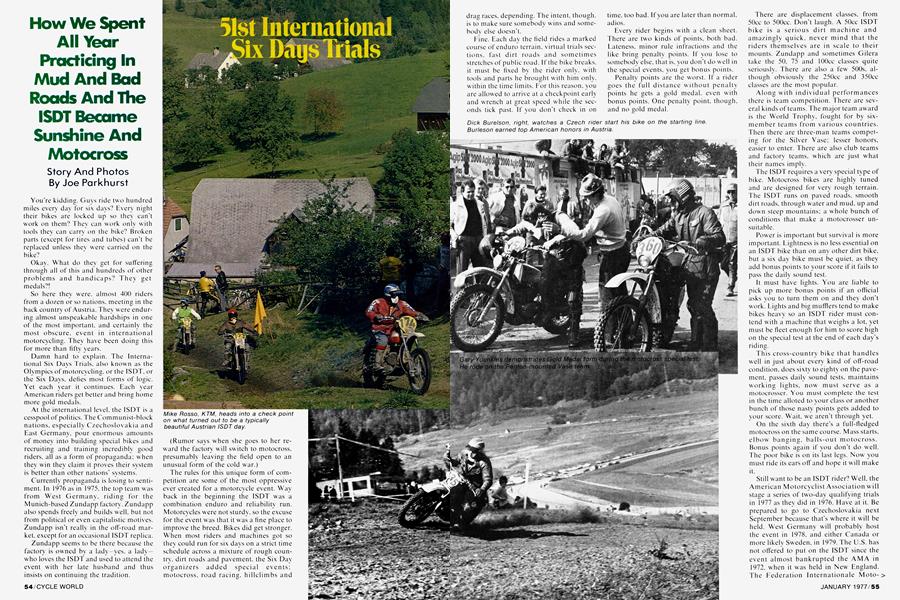
So here they were, almost 400 riders from a dozen or so nations, meeting in the back country of Austria. They were enduring almost unspeakable hardships in one of the most important, and certainly the most obscure, event in international motorcycling. They have been doing this for more than fifty years.
Damn hard to explain. The International Six Days Trials, also known as the Olympics of motorcycling, or the ISDT. or the Six Days, defies most forms of logic. Yet each year it continues. Each year American riders get better and bring home more gold medals.
At the international level, the ISDT is a cesspool of politics. The Communist-block nations, especially Czechoslovakia and East Germany, pour enormous amounts of money into building special bikes and recruiting and training incredibly good riders, all as a form of propaganda; when they win they claim it proves their system is better than other nations’ systems.
Currently propaganda is losing to sentiment. In 1976 as in 1975. the top team was from West Germany, riding for the Munich-based Zundapp factory. Zundapp also spends freely and builds well, but not from political or even capitalistic motives. Zundapp isn’t really in the off-road market. except for an occasional ISDT replica.
Zundapp seems to be there because the factory is owned by a lady—yes. a lady— who loves the ISDT and used to attend the event with her late husband and thus insists on continuing the tradition.
(Rumor says when she goes to her reward the factory will switch to motocross, presumably leaving the field open to an unusual form of the cold war.)
The rules for this unique form of competition are some of the most oppressive ever created for a motorcycle event. Way back in the beginning the ISDT was a combination enduro and reliability run. Motorcycles were not sturdy, so the excuse for the event was that it was a fine place to improve the breed. Bikes did get stronger. When most riders and machines got so they could run for six days on a strict time schedule across a mixture of rough country. dirt roads and pavement, the Six Day organizers added special events; motocross, road racing, hillclimbs and drag races, depending. The intent, though, is to make sure somebody wins and somebody else doesn't.
Fine. Each day the held rides a marked course of enduro terrain, virtual trials sections. fast dirt roads and sometimes stretches of public road. If the bike breaks, it must be fixed by the rider only, with tools and parts he brought with him only, within the time limits. For this reason, you are allowed to arrive at a checkpoint early and wrench at great speed while the seconds tick past. If you don't check in on
time, too bad. If you are later than normal, adios.
Every rider begins with a clean sheet. There are two kinds of points, both bad. Lateness, minor rule infractions and the like bring penalty points. If you lose to somebody else, that is, you don't do well in the special events, you get bonus points.
Penalty points are the worst. If a rider goes the full distance without penalty points he gets a gold medal, even with bonus points. One penalty point, though, and no gold medal.
There are displacement classes, from 50ee to 500cc. Don’t laugh. A 50cc ISDT bike is a serious dirt machine and amazingly quick, never mind that the riders themselves are in scale to their mounts. Zundapp and sometimes Gilera take the 50, 75 and lOOec classes quite seriously. There are also a few 500s. although obviously the 250cc and 350cc classes are the most popular.
Along with individual performances there is team competition. There are several kinds of teams. The major team award is the World Trophy, fought for by sixmember teams from various countries. Then there are three-man teams competing for the Silver Vase; lesser honors, easier to enter. There are also club teams and factory teams, which are just what their names imply.
The ISDT requires a very special type of bike. Motocross bikes are highly tuned and are designed for very rough terrain. The ISDT runs on paved roads, smooth dirt roads, through water and mud. up and down steep mountains; a whole bunch of conditions that make a motocrosser unsuitable.
Power is important but survival is more important. Lightness is no less essential on an ISDT bike than on any other dirt bike, but a six day bike must be quiet, as they add bonus points to your score if it fails to pass the daily sound test.
It must have lights. You are liable to pick up more bonus points if an official asks you to turn them on and they don’t work. Lights and big mufflers tend to make bikes heavy so an ISDT rider must contend with a machine that weighs a lot, yet must be fleet enough for him to score high on the special test at the end of each day’s riding.
This cross-country bike that handles well in just about every kind of ofl'-road condition, does sixty to eighty on the pavement, passes daily sound tests, maintains working lights, now must serve as a motocrosser. You must complete the test in the time alloted to your class or another bunch of those nasty points gets added to your score. Wait, we aren't through yet.
On the sixth day there’s a full-fledged motocross on the same course. Mass starts, elbow' banging, balls-out motocross. Bonus points again if you don’t do well. The poor bike is on its last legs. Now you must ride its ears off and hope it will make it.
Still want to be an ISDT rider? Well, the American Motorcyclist Association will stage a series of two-day qualifying trials in Ï977 as they did in 1976. Have at it. Be prepared to go to Czechoslovakia next September because that’s where it will be held. West Germany will probably host the event in 1978. and either Canada or more likely Sweden, in 1979. The U.S. has not offered to put on the ISDT since the event almost bankrupted the AMA in 1972. when it was held in New' England. The Federation Internationale Moto-> cycliste, a clumsy organization at best, controls the whole thing, as they do all motorcycle sport in Europe. The rule book says the winning country this year gets to pick the location next year, but because the ISDT is so expensive to stage the honor usually goes to any country willing to bear it.
Among the many problems confronting the club putting it on is the location. It must of course be far from cities in order to find enough terrain to run on. At the same time the area must have enough hotels to house the riders, team managers, press, officiais, etc., within a reasonable distance. I have driven nearly 100 miles a day in past Six Days. The Austrian round was my 12th. not as a rider, (not by choice), but as a photographic journalist for CYCLE WORLD. Obviously I am as crazy as the ones who ride it.
The course must be properly marked for every day’s loops. Usually three courses are laid out, each run both ways during the week. Checks with accurate timing devices must be manned. Gas stops must be provided.
The fiercest battles are waged between the Jawa/CZ teams and the Zundapp boys. Jawa has won the ISDT often, probably more than any other factory. East German MZs and Simpsons are right in there too. Riders must zero each check to earn a Gold medal. America’s Malcolm Smith brought home his eighth, more than any other U.S. rider in the history of the trials.
Twenty nine of the 37 Americans entered this year brought home Golds, a fact partially attributed to the ease of the event: It did not rain, which was thought to be impossible. Al Eames. an AMA ISDT specialist and the American representative for the Six Days, said that because of the relative ease of the trials route and the perfect weather, “Reliability and cross-country speed took a back seat to motocross riding ability and a number of European countries still have the edge in that category”. Most riders complained about the ease of things and the special tests. No doubt the Americans would have fared better if the event had been more difficult and more emphasis had been placed on rider stamina and bike preparation.
America fielded both a Trophy and Vase team. The Vase team was considered to be the one most likely to succeed. John Penton. America’s staunchest ISDT supporter and distributor of the bike bearing his name, assembled his sons Jack and Tom, Dean Leimbach, and Carl Cranke. All rode Pentons, natch. They finished fourth behind the Czechs. West Germans and Italians. All took home Golds as well.
Our World Trophy team consisted of Lars Larsson on a KTM, Billy Uhl on a Hercules, Mike Hannon on a Bultaco, Jim Hollander on a Rokon. Kevin La Voie and Gary Youngkins on Pentons. All formidable riders but only Uh 1 had ISDT experience.
La Voie’s Penton destroyed a crankshaft bearing so the team garnered a few' thousand penalty points and ended up tenth. Lor three days they held fourth spot, not too shabby considering the strength of their opposition. West Germany took the coveted World Trophy, Czechoslovakia was second. East Germany third. Great Britain fourth then Austria. Belgium. Canada and Lrance. Club teams and Lactory teams also compete. An American Yamaha team, comprised of Chris Carter, David Ashley and John Eero, all on lT400s, won three golds.
On an individual basis the best American performance was given by Dick Burleson. of Antioch, Tennessee. He finished 4th in the 500cc class. This was his second time as best American, repeating his performance in the 1974 event in Italy. Jack and Tom Penton followed on an individual basis, then Carl Cranke. Jim Hollander, Lrank Gallo, Billy Uhl, Gary
Youngkins, Malcolm Smith and Dane Leimbach.
Over the years the scoring system has changed. The special tests formerly consisted of hillclimbs or timed runs through difficult terrain. Nearly everyone complained about the current special test. They didn't complain nearly as much as they would have if they had used the paved road race course test of a few years ago. It may have been humorous to observers, but racing dirt bikes with knobby tires on a super fast road course was dangerous. And dumb.
Scoring in the special test w^as based on what they called classification points meaning that points are related to how' a rider finishes in his displacement class on each day. It is rather complicated, but essentially the fastest rider through the test in each displacement category sets zero time. All other times in that class are measured against it. Europe’s best ISDT riders practice this sort of thing endlessly, making it difficult for American-style enduro and ISDT qualifier riders to do well. Many Americans who earned Golds admitted they were just barely hanging on in the tests.
Next year the Six Days will run again. It will rain, for sure. It will probably be tougher than this year bècause the Czechoslovakians favor difficult events. The Czechs are not above practicing endlessly on the terrain to be used either. Naughty, naughty, that’s against the rules. Nevertheless, they will be damn near impossible to beat for top Trophy and Vase honors.
The U.S. will again field a Trophy and Vase team. The Pentons, bikes and family, will more than likely be there. I will be there, masochist that I am. It will cost the riders, especially those not on one of the teams, a bundle. The AMA will establish another ISDT fund to help out, so buy your sticky, patch and pin and do your bit for patriotism at the level of motorcycling. As with the Olympics, the ISDT is a case of American non-paid amateurs competing against full time, salaried European professionals. Maybe someday more people will show interest and the Six Days will become the premier off-road event of the year. Maybe, even, a Japanese factory will decide that the Trophy is worth going after and will sponsor a full team and put American riders on it. It would be nice.
The ISDT then, is a professional event in Europe. To Americans it is a challenge, even fun. We do well because our riders are good, of course. They can be the best in the world, and as CYCLE WORLD has been saying for years, one day we will have one or two world champions in the U.S. In order to do this, we must compete on their turf, under their rules. They can’t be changed to suit our tastes. Americans continue to flock to the Six Days. As many enter as the rules will allow. Not all are like Malcolm Smith, successful businessmen with time and money at their disposal.
Americans have had enthusiasm for the ISDT for a long time. When the U.S. was given permission to stage the ISDT, three areas wanted the event. Texas wasn’t considered tough enough terrain. Some enthusiasts in Nevada couldn’t raise the money. Finally the New England Trail Riders Assn., a really dedicated group, worked with the AMA and made the event one of the best ever, although they spent all the money all involved parties could afford and then some. Perhaps it’s time to look at Las Vegas again.
A non-rider may have trouble understanding why people will work so hard and spend so much money in hopes of winning a little medal.
But all those who know what it’s like to gas it over rough country, and do it fast, won’t find the ISDT strange at all.
More From This Issue
-
 Departments
Round Up
January 1977 -
 Letters
Letters
January 1977 -
 Departments
Feed Back
January 1977 -
 Technical
Troubleshooting Carburetors: Rebuilding And Tuning Singles
January 1977 -
 Features
Still Racing After All These Years
January 1977 -
 Features
"We Saw Nothing, I Tell You..... Nothing!"
January 1977