Slower Longer Safe And Slow Then Dangerous
Because “slow in, fast out” is one of those sayings that needs a lot more explaining
Because “slow in, fast out” is one of those sayings that needs a lot more explaining
SLOWER LONGER SAFE AND SLOW THEN DANGEROUS
IGNITION
RIDE CRAFT
Because “slow in, fast out” is one of those sayings that needs a lot more explaining
Nick Ienatsch
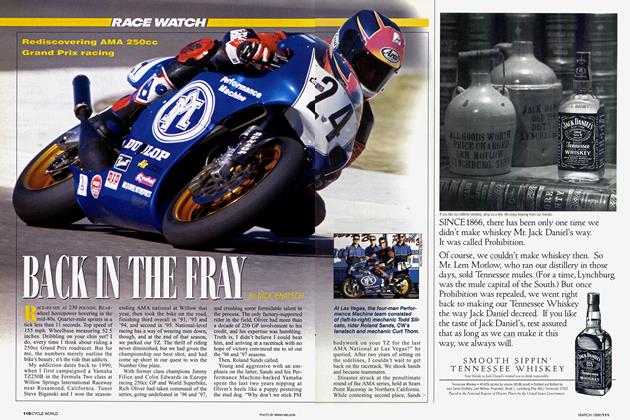
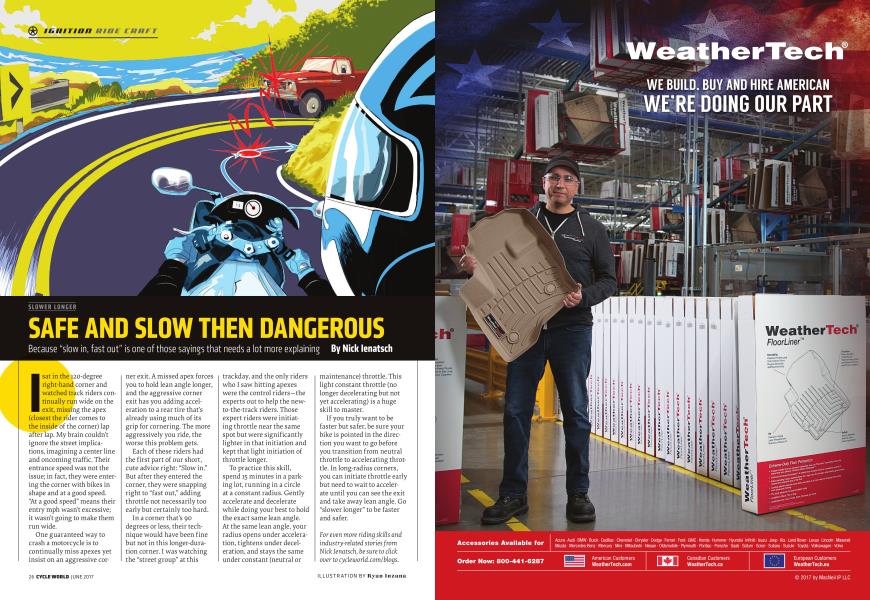
I sat in the 120-degree right-hand corner and watched track riders continually run wide on the exit, missing the apex (closest the rider comes to the inside of the corner) lap after lap. My brain couldn’t ignore the street implications, imagining a center line and oncoming traffic. Their entrance speed was not the issue; in fact, they were entering the corner with bikes in shape and at a good speed.
“At a good speed” means their entry mph wasn’t excessive; it wasn’t going to make them run wide.
One guaranteed way to crash a motorcycle is to continually miss apexes yet insist on an aggressive corner exit. A missed apex forces you to hold lean angle longer, and the aggressive corner exit has you adding acceleration to a rear tire that’s already using much of its grip for cornering. The more aggressively you ride, the worse this problem gets.
Each of these riders had the first part of our short, cute advice right: “Slow in.” But after they entered the corner, they were snapping right to “fast out,” adding throttle not necessarily too early but certainly too hard.
In a corner that’s 90 degrees or less, their technique would have been fine but not in this longer-duration corner. I was watching the “street group” at this trackday, and the only riders who I saw hitting apexes were the control riders—the experts out to help the newto-the-track riders. Those expert riders were initiating throttle near the same spot but were significantly lighter in that initiation and kept that light initiation of throttle longer.
To practice this skill, spend 15 minutes in a parking lot, running in a circle at a constant radius. Gently accelerate and decelerate while doing your best to hold the exact same lean angle.
At the same lean angle, your radius opens under acceleration, tightens under deceleration, and stays the same under constant (neutral or maintenance) throttle. This light constant throttle (no longer decelerating but not yet accelerating) is a huge skill to master.
If you truly want to be faster but safer, be sure your bike is pointed in the direction you want to go before you transition from neutral throttle to accelerating throttle. In long-radius corners, you can initiate throttle early but need to wait to accelerate until you can see the exit and take away lean angle. Go “slower longer” to be faster and safer.
For even more riding skills and industry-related stories from Nick lenatsch, be sure to click over to cycleworld.com/blogs.