A Very Upright Gentleman
A Very Upright Gentleman
UP FRONT
David Edwards
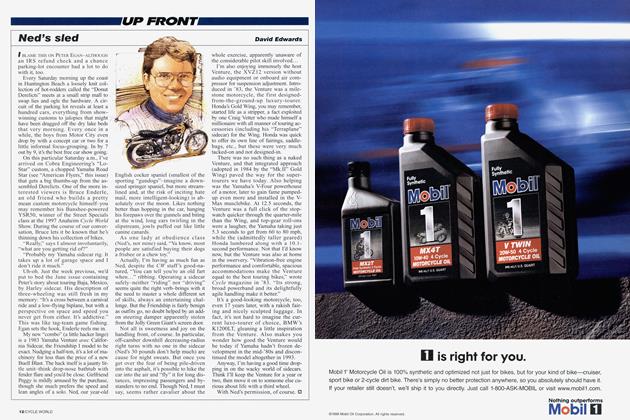
SUDDENLY, I WAS FEELING EMBARRASSingly under-informed. Even though two of my motorcycles are emblazoned with the man’s name, I realized I knew next to diddly about James Lansdowne Norton, the self-taught engineer who sold his first motorbike in 1902, a year before Harley and the Davidsons hung out their shingle.
The vehicle of my guilt was an excellent new book, Flat Tank Norton, by George Cohen. A physician for 30 years, Cohen gave up medicine to concentrate on riding, restoring, racing and writing about vintage Nortons-well, that and historic V32-scale slotcars. His 260-page work (available only at www.norton. uk.com, highly recommended) deals with Norton flat-tankers built through 1928 and is peppered with 600 photos and illustrations, most never before published.
Cohen takes us back to a time when motorcycles were just emerging as viable transportation, competing usually unsuccessfully with the horse and pedal bicycle. He quotes Norton from 1916, looking back 20 years to “...the strenuous early days of the movement, when a 10-mile non-stop run was an achievement to talk about, and the coaxing of feeble little engines, the humoring of surface carburetors and “boot-lace” (drive) belts, was jjt a fine art. Lubrication did not trouble us-muchthen; we carried the oil in a pocket flask and stopped at intervals to pour it into and over the engine.”
Norton thought he could do better, and soon his machines were distinguishing themselves. In 1907 at the inaugural Isle of Man a Norton with Peugeot V-Twin power took the twin-cylinder class, 22 minutes ahead of the next finisher. In 1908, “Jas. L.” unveiled a sidevalve Single of his own design. Originally 475cc, it would grow to a hearty 634cc and remain in production for almost 50 years!
In hillclimbs, reliability runs and speed trials, Norton Singles became the bikes to beat, which is where the company’s “Unapproachable” ad slogan came from.
A 1911 reviewer for The Gentleman’s Journal, apparently fluent in flowery words and Latin, could scarcely contain himself: “The most wonderful point about the Norton machine is its graceful, almost fragile appearance. It looks like the beau ideal of elegance; in fact, it suggests effeminacy. You find yourself wondering where its marvelous strength and power comes from. It is so scientifically designed that the art of its construction conceals its herculean capabilities; it must have taken years of study to perfect such a multum in parvo of power. It may be driven at a walking pace or at 50 miles per hour-or if a greater speed is desired, an 8-hp machine will carry you along at 80 miles per hour with perfect comfort, if your respiratory organs will stand it.” Norton himself was a frequent competitor, even in his 40s. A serious crash at the 1910 TT failed to dampen his enthusiasm, though rumors had it differently. He soon set things straight, writing to the editor of The Scottish Cyclist and Motor Cyclist, “Sir, I would like to correct an impression that, as someone has put it, T have decided to let motorcycling and competitions severely alone-for my health’s sake-leaving it to the young ones.’ This impression has doubtless risen from the fact that for some six or seven months I have been incapacitated from riding by an injury to my shoulder and arm sustained on Snaefell during the last TT Week.
“As to motorcycling detrimentally affecting my health, although not in the first bloom of youth, I am never better than when riding. Usually suffering with insomnia and nerves, after a run I almost invariably sleep well, and can certainly recommend motorcycling as beneficial to one’s general health. Contrary to giving up, my efforts are aimed at getting flexibility of the injured members in time to enable me to compete in the TT.”
Giving up was not in Norton’s nature. In 1921, even though suffering with rheumatism, he steamed to South Africa, ostensibly to sample the “colonial” market but looking forward to a 3000-mile circumnavigation of the country by sidecar. Despite a rainy season that swelled rivers and turned earthen roads into quagmires, Norton forged on.
“On some days he had nothing to eat, as water was unobtainable and his tongue was too dry to enjoy food,” reported Motor Cycling. “Another time, with clothes tom by the passage of the machine through the brush and in a semi-conscious state, Mr. Norton, after riding three hours in the dark without a lamp even, found a hut where an Englishman made him comfortable-that cup of tea late at night will be remembered all his life.”
Sadly, Norton’s life did not have long to run. Colon cancer began to eat away at his insides and he succumbed on April 21, 1925.
“As a man, Mr. Norton was universally beloved by all who came in contact with him,” noted the obituary. “His gentle manners and cheerful outlook, which endeared him to all his fellows, remained with him long after his doctors had given up all hope and in spite of his great physical suffering. He died at the age of 56, and no individual loss could be more keenly felt in motorcycling circles than that of this very upright gentleman.”
For the man who once said, “I am proud of the Norton engine, proud of the position it occupies, and that it is British,” there must have been some solace that he lived long enough to see the company’s first overhead-valve models-based on his 1913 patent-win practically every contest in 1924, including the Senior TT, numerous Brooklands world speed records, the majority of that year’s Grands Prix and the coveted Maudes Trophy.
Always a racer at heart, James Lansdowne Norton went out on top. U