2004 Aprilia Rsv 1000 R
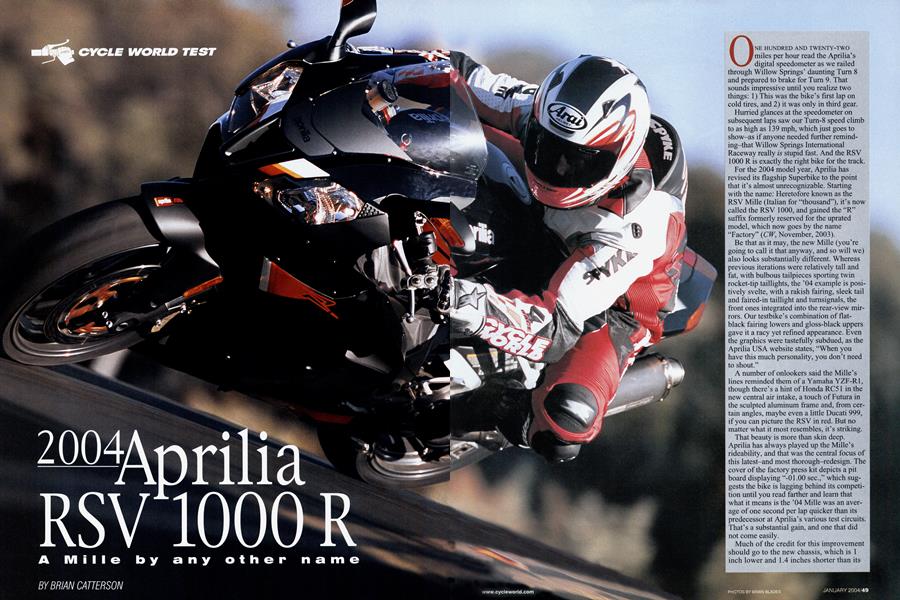
2004 Aprilia RSV 1000 R
CYCLE WORLD TEST
A Mille by any other name
BRIAN CATTERSON
ONE HUNDRED AND TWENTY-TWO miles per hour read the Aprilia’s digital speedometer as we railed through Willow Springs’ daunting Turn 8 and prepared to brake for Turn 9. That sounds impressive until you realize two things: 1) This was the bike’s first lap on cold tires, and 2) it was only in third gear.
Hurried glances at the speedometer on subsequent laps saw our Turn-8 speed climb to as high as 139 mph, which just goes to show-as if anyone needed further reminding-that Willow Springs International Raceway really is stupid fast. And the RSV 1000 R is exactly the right bike for the track.
For the 2004 model year, Aprilia has revised its flagship Superbike to the point that it’s almost unrecognizable. Starting with the name: Heretofore known as the RSV Mille (Italian for “thousand”), it’s now called the RSV 1000, and gained the “R” suffix formerly reserved for the uprated model, which now goes by the name “Factory” (CW, November, 2003).
Be that as it may, the new Mille (you’re going to call it that anyway, and so will we) also looks substantially different. Whereas previous iterations were relatively tall and fat, with bulbous tailpieces sporting twin rocket-tip taillights, the ’04 example is positively svelte, with a rakish fairing, sleek tail and faired-in taillight and tumsignals, the front ones integrated into the rear-view mirrors. Our testbike’s combination of flatblack fairing lowers and gloss-black uppers gave it a racy yet refined appearance. Even the graphics were tastefully subdued, as the Aprilia USA website states, “When you have this much personality, you don’t need to shout.”
A number of onlookers said the Mille’s lines reminded them of a Yamaha YZF-R1, though there’s a hint of Honda RC51 in the new central air intake, a touch of Futura in the sculpted aluminum frame and, from certain angles, maybe even a little Ducati 999, if you can picture the RSV in red. But no matter what it most resembles, it’s striking.
That beauty is more than skin deep. Aprilia has always played up the Mille’s rideability, and that was the central focus of this latest-and most thorough-redesign. The cover of the factory press kit depicts a pit board displaying “-01.00 sec.,” which suggests the bike is lagging behind its competition until you read farther and learn that what it means is the ’04 Mille was an average of one second per lap quicker than its predecessor at Aprilia’s various test circuits. That’s a substantial gain, and one that did not come easily.
Much of the credit for this improvement should go to the new chassis, which is 1 inch lower and 1.4 inches shorter than its predecessor. Mass centralization is key, and to that end the engine was moved slightly to the right to better balance the bike (in light of the new twin silencers), the pivot for the new banana-shaped swingarm was moved forward, and the headstock and subframe were dropped to lower the center of gravity. The cast aluminum-silicon/die-cast Peraluman 450 frame is said to be 5 percent more rigid torsionally and 21 ounces lighter than its predecessor, and is half polished, half rough-cast to complement the fairing visually.
While the engineers were improving the Mille’s frame, they also improved its seating position, the slimmer tank and lower, flatter seat giving the rider greater freedom of movement. Long-distance comfortable it’s not, but then how many sportbikes are?
The restyle was more than just a cosmetic exercise, however, as the new wind tunnel-developed fairing and tailsection are said to have significant aerodynamic benefits, lowering the drag coefficient from 0.306 to 0.3. This contributed to the Mille flashing past the CW radar gun at a top speed of 167 mph, a 1-mph increase over the last Mille R we tested in our June, 2002, issue and 5 mph faster than the first Mille we tested in April, 2000. That doesn’t sound like much, but as any Bonneville competitor will tell you, the faster you go, the more difficult it is to get to the next level.
Helping in the “faster” department is the newly upgraded engine, dubbed the “V60 Magnesium” in deference to its mag clutch and valve covers. But the most significant changes to the Rotax-built, 60-degree V-Twin lie just beneath its gold-colored valve covers. The cylinder heads have been redesigned with a larger squish area for increased turbulence, and now get by with a single central sparkplug instead of the twin-plug setup used previously. This change in layout let the engineers re-route coolant flow through the heads to help keep the combustion chambers at optimum operating temperature, and also fine-tune oil flow to better lubricate the valve train while minimizing viscous drag. Altered ignition mapping helped improve bottom-end throttle response while new porting, cams, valve springs and rods helped on top, raising redline to 11,000 rpm.
Feeding the engine are larger 57mm throttle bodies with single showerhead injectors and a new “Air Runner” intake system that inhales through a triangular duct in the fairing nose, between the split quad headlights, where pressure is highest at speed. Air is then routed through a duct in the headstock to the under-tank airbox, which is equipped with an electronically activated choke that tailors airflow to the engine’s needs. Overseeing the fuel-injection system is a new Siemens VDO engine control unit, which connects to the new instrument panel via a two-wire CAN line, as pioneered on the Ducati 999. Spent gases are evacuated through a new stainless-steel 2-1-2 exhaust with twin, black-anodized stainless mufflers that are much smaller and sexier than the single right-side silencer used before.
Taken together, these engine changes add up to a 4-bhp increase over the aforementioned ’02 Mille R we last tested, the ’04 model churning out 117 horsepower on CWs rear-wheel dyno.
You sense that power increase as soon as you ease out the clutch. Of course, you first have to ease out the clutch, which owing to a narrow range of engagement and a tall first gear in the close-ratio, six-speed transmission, is easier said than done. Dragstrip-style starts require abusive clutch slippage, which makes subsequent launches even more difficult. This was borne out in our quarter-mile testing, where the ’04 Mille actually turned a slightly slower (+. 13 of a second) ET than the ’02 model, though it was slightly quicker (-.09 of a second) than the ’01 example we tested the year before.
That clutch scenario, coupled with a hard-to-find neutral, made around-town, stop-and-go riding un-fun on our testbike. But in Aprilia’s defense, most Mille buyers won’t take their bikes to the dragstrip, and neutral was proving easier to find as our testbike’s transmission broke-in. And the tranny worked well otherwise, allowing crisp, clutchless upshifts and wheel-hop-less downshifts courtesy of Aprilia’s patented Pneumatic Power Clutch, which uses a vacuum-assisted diaphragm to emulate the mechanical oneway clutches used on some other sportbikes.
Once underway, the Mille is a pure joy to ride, its healthy intake honk and growling exhaust note the ideal soundtrack for a Sunday-morning ride. It seems impossible, but the newly revised engine actually feels smoother and produces even more linear power than before. Healthy bottom-end grunt makes for clutchless wheelies in the first two gears, while seamless midrange power gradually increases as the tach needle sweeps past 7000 rpm and explodes in a topend rush that culminates at the 10,400-rpm peak. And it’s fast, the Mille reaching an indicated 152 mph on Willow’s relatively short front straight! Thank goodness for the superb Brembo four-pad brakes.
We’ve said before that the Mille’s motor combines the best traits of twoand four-valve Ducatis, but this year, that doesn’t do it justice. It’s now more a case of combining the best of a V-Twin with the best of an inline-Four. And maybe even the best of Italy with the best of Japan. Truly a new benchmark.
The revised chassis is no less laudable. Once you’re free of around-town drudgery, the new seating position is a definite improvement. Where in the past the Mille forced its rider to adapt to it, now it’s more the opposite. You no longer need to “assume the position”-head down, one cheek hanging off, butt against seat pad-to make the bike work. You just sit on it normally, and ride in whatever style you find most effective. Including, as Aprilia’s promotional materials stress, the latest Supermoto-influenced comer entries, the bike said to have been designed “to allow riders to manage skids perfectly.” We’ll get on that right away!
As delivered, our testbike was set up with way too much sag in the rear end, which made the steering artificially heavy and let hard parts drag at even moderate lean angles. At Willow Springs, in fact, the kickstand touched down before the rider’s left knee.
Fortunately, the Mille’s Showa fork and Sachs shock have a full range of adjustments, the latter this year gaining a threaded ride-height adjuster (and a yellow spring!) that only came on the Öhlins-equipped R-model before. We made full use of those adjustments, cranking up shockspring preload and adding ride-height to achieve the proper chassis balance and increase cornering clearance, while dialing in rebound damping to match.
So dialed-in, the Mille handled fabulously, striking that rare balance between steering ease and unflappable stability. Mid-comer line changes were as simple as pushing on the bars, and applying the powerful Brembo four-pad brakes while leaned over didn’t upset the chassis in the least.
The only fault we uncovered was a tendency for the rear tire to chatter over bumps at maximum lean angle, particularly while accelerating on exit from Willow Springs’ Turn 2. But that’s a minor concern, and something with which we suspect the Öhlins shock from the Factory model would have no problem coping.
But of course, the RSV 1000 R costs about $4000 less than the Factory, not to mention the Ducati 999 with which it is destined to be compared. Whether the Aprilia is one second per lap quicker than the Ducati will have to await a formal comparison test, but there’s no doubting which comes out on top in terms of performance-per-dollar. Call it an RSV 1000 R or call it a Mille, but call the ’04 Aprilia a winner. □
EDITORS' NOTES
“RED LIGHT, GREEN LIGHT” ISN’T THE game for the Mille. She prefers “Follow the Leader”-but only if she’s the latter. Wide-open S-bends are her best friends; like a piece of music written for a specific instrument, they just flow and go together. Especially when played loud and fast.
The Mille’s frame is a work of art for which the conductor is sometimes
made to suffer. Its racy riding position, tall first gear and weak rear brake-good points for racetrack applications-are pains around town. But if it’s an uncompromising sport ride you’re after, there are few bikes that feel so well attuned.
Symphonic mechanical sounds emanate from the Twintastic motor, eight valves working in perfect harmony to deliver solid power down low that increases on top, like an inline-Multi. The Mille’s shift light may be red, but some one please show me the green, ’cause on this bike I’ve just got to go, go, go.
-Mark Cernicky, Assistant Editor
NEWPORT BEACH ISN’T MUGELLO, STREET riding isn’t the track, and the RSV 1000 R isn’t the Mille Factory. Does it matter? Well, it’s nice to have the wider adjustability and more controlled action of Öhlins suspension, plus the lighter O.Z. forged wheels of the Factory. The black frame of the top-line model is cool, too, and those rigid, super-powerful radialmount Brembo front-brake calipers set it even farther apart-all things I definitely appreciated at the bike’s track-only press introduction in Mugello, Italy.
But zapping through traffic to work riding this R-model, I wasn’t thinking about the track, Mugello or the Factory, just that I was on one of the finest sportbikes made. It crossed my mind that the R costs thousands less than the Factory, and that the money would buy a lot of gas and plenty of pasta. Really, all 1 missed about the Factory were the pretty girls Aprilia had handing us water after our track sessions. Being a Factory rider for a day was cool, but all those extras just aren’t my reality.
-Mark Hoyer, Feature Editor
IT'S BEEN 10 YEARS SINCE I ROADRACED at Willow Springs once a month, and every time I go back there, I'm blown away by the speed. There are tracks with faster averages-Daytona, for instance-but only at Willow do you spend so much time leaned over with your knee on the ground and your hair on fire. With the possible exception of Turn 1 at Brainerd, Minnesota, Willow’s 140-mph Turn 8 has the highest pucker factor of any comer in America, if not the world.
So it’s worth mentioning that, while testing the RSV 1000 R at a Pacific Track Time day recently, chasing various racers on their Supersport bikes and turning lap times in the 1:26s-lap-record territory when I raced there-I didn’t frighten myself once. Oh, my heart rate was elevated, for sure, but the Aprilia was so uncannily composed, the only thing unnerving was how easy it was to go so fast.
Bikes have come a long way in the last decade. Here’s to the next!
-Brian Catterson, Executive Editor
APRILIA
RSV 1000 R
$13,999
SPECIFICATIONS