Confederate America Gt
Confederate America GT
WHEN DOES A MACHINE POWERED BY AN S&S BIG TWIN-REPLICA V-TWIN not deserve the title, “Harley clone?” That’s easy: When Confederate Motorcycles manufactures it. The small, Louisiana-based outfit makes machines so different from the Milwaukee product that about all the two share is a basic engine configuration.
Founded in 1991 by former trial lawyer Matthew Chambers, Confederate may represent the most romantic and idealistic ideas in the motorcycle-manufacturing universe. When we first chatted with Chambers in 1996, he described what he was trying to achieve with his bikes: “It’s the machine that would be built if the Confederacy existed today-a motorcycle that exemplifies the Co^gderate culture. There’s more structure, and less emphasis on fins and wings.’!® ;;
The South has risen again
CYCLE WORLD TEST
Since then, he’s found that Yankees misunderstand his references to Confederate values, and now confines his discussion to the more abstract idea of purity. “There is no ornamentation on any of our bikes,” he says. “Every part is there specifically to do something involved with the performance of the bike; otherwise it would not be on the motorcycle.”
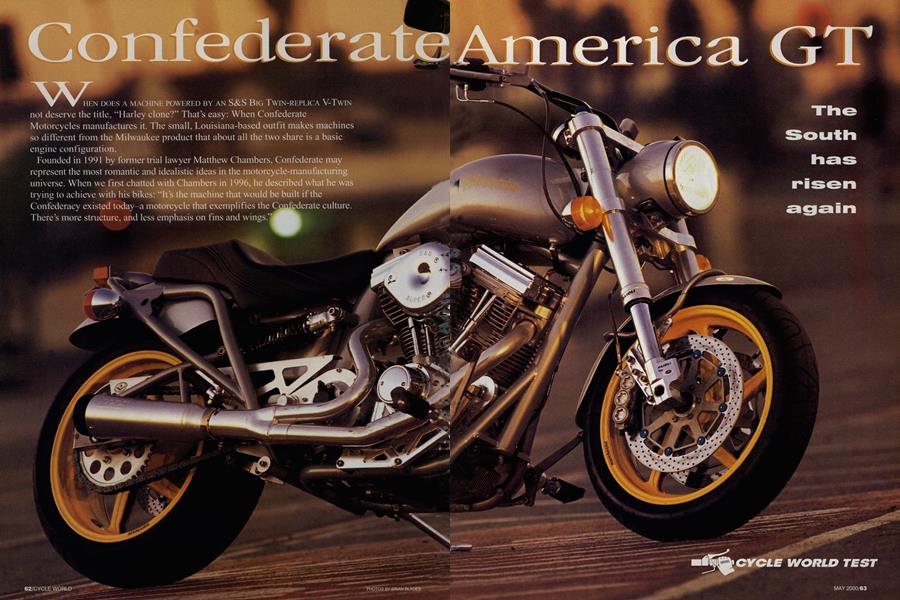
So it’s no surprise that the Confederate REL America GT is a lean-and-mean-looking motorcycle, a unique amalgamation of styles. The stretched, teardrop gas tank is allAmerican custom, while the streamlined headlight shell with integrated speedometer is Fifties British. The 45-degree S&S V-Twin broadcasts American hot-rod, while almost all the chassis components shout, “Superbike.” The 17-inch Marchesini wheels, the 46mm Paioli inverted fork, the machinedfrom-billet, six-piston ISR brake calipers, the 200mm-wide rear tire-all look as if they belong on a race-prepped GSX-R.
It’s not surprising, then, that the America GT gets thumbs-up from sportbike guys who wouldn’t take a second look at most Harleys.
Similarly, the foundation of the Confederate is far more performance-oriented than almost any other cruiser. Start with the engine/transmission; Confederate did. While most clonemakers have been comfortable taking an S&S or other Harley-inspired engine and mating it with a Harley gearbox, Confederate took a different route. Even before Yamaha did something similar with the YZF-R1, Chambers and crew created a gearbox with vertically stacked shafts that cut some 3 V2 inches off the overall length of the engine/gearbox combo.
In addition, they dumped Harley’s use of a right-side clutch outboard of the countershaft sprocket-a design that dates back to the days when gearboxes were sophisticated new additions to motorcycles. Instead, they went with the more modem and robust arrangement of clutch and output sprocket on opposite sides of the engine. In the process, they created a chainline that made room for a 230-section rear tire. (Custom builders often have to offset the rear wheel or engine in the frame to make room for a big tire.)
All this was a substantial engineering challenge for a small start-up, and the creation and de-bugging of the new gearbox delayed the introduction of the first Confederate for years. Fortunately, the resources of the Harley aftermarket were available so all components weren’t created entirely from scratch. Andrews supplies the close-ratio gearset; Rivera/Primo Engineering makes the clutch and primary drive; S&S builds the gearbox housing. The resulting billet-machined clutch cover and gearbox case give a purposeful and meaty look to the machine.
But the real meat is brought to your attention the first time you fire up the Confederate. It was delivered to us with a SuperTrapp muffler with about a billion discs installed, a setup that would fail even the Polish noise tests that allowed Harley to certify the first 50 VR1000 Superbikes as “production” motorcycles. The explosions that bring the America to life only hint at the full-throttle song of this beast. The high-flow muffler is one explanation; the other is the sheer size of the S&S powerplant itself. With a full 4-inch bore and a 4.5-inch stroke,
the GT’s engine packs 113 cubic inches-or 1852cc for those who think metrically.
Here, the old rule applies: There’s no denying cubic inches. The GT has a torque curve that starts low, low, low, pulling hard by 1200 rpm. It strengthens even more in the midrange, and keeps pulling hard until nearly 5000 rpm; by then, it’s time to shift. That big engine in this spartan motorcycle produces exceptional twin-cylinder perform-
anee, carrying the GT through the quarter in 11.42 seconds at 115 mph. More impressive, though, are the top-gear rollon times; the 3.2-second 60-80-mph time is among the best Cycle World has ever measured.
On the road, the Confederate feels lazily, effortlessly fast. It’s a machine that almost doesn’t care in what gear or from what engine speed you ask it to accelerate: Twist the throttle at any time and the GT simply surges forward. And that’s despite gearing that’s sky scraper-tall. In top gear, the GT turns about 2000 rpm at 60 mph, with its acceleration undulled.
What the tall gearing does dull is engine vibration. The big motor bolts directly into the Confederate frame, acting as a structural member and dispensing with the benefits of rubber engine mounts. Despite that, shaking is minimal at legal road speeds. At 65 mph on the freeway, the experience is similar to a pre-Twin Cam Softail at 50-the shaking is lulling and part of the machine’s character, not irritating. At 85, some buzzing shows up, but the astounding thing is that even then, the GT is still smoother than any ’99 or earlier Softail. Or any Sportster. If you have any tolerance for rigid-mounted Harleys, vibration on the Confederate is not going to be a big issue. Then again, if you expect and demand Japanese levels of smoothness, this is not the motorcycle for you.
Thankfully, there’s a benefit to the solid-mounting: handling. Combine the stiffening provided by the directly mounted engine with the inherent stiffness of a chassis with a 3-inch backbone made of 0.120-inch steel, and you have a very flexresistant chassis. Similarly, the long swingarm is well-braced, and the forks are fat and strong. All of that contributes solidity and directness to the handling of the GT. The steering is sharp, even with a moderate, 30-degree head angle, and the suspension acceptably compliant, especially for a cruiser. (The bike targeted during suspension development was the BMW R1100, which is one reason why the GT has 5 inches of rear wheel travel, rather than the 3.5 inches or so of most cruisers.)
On a curvy road, the Confederate encourages you to stick to one gear, maybe two, and just ride in the fat midrange of power. Down in the middle of the band, there’s not much engine braking, so the nose doesn’t dive if you back off in a comer; consequently, the GT makes you a smoother and better rider than you may actually be. The wide handlebar allows you to roll the bike quickly into a comer, while reasonable ground clearance and sticky tires (Pirelli radiais) allow you to lean far in by custom standards, and the smooth power blasts you out.
In practice, though, your heels set the GT’s cornering limit. The forward-mounted pegs make the bottom of your shoes the point of least ground clearance, and it’s all too easy to pitch it into a tight comer and catch your heel down hard, jerking your leg back. After that’s happened once or twice, you learn to plant your feet higher before cornering. Confederate has in the works an optional set of rearset pegs, which will also require a different bend of headpipe. We’d definitely go that route.
Heel-dragging aside, the Confederate is a machine of exceptionally strong character, the type of bike that can only come from someone like Matt Chambers who has an exceptionally strong sense of what he wants in a motorcycle. A fan of both Italian and American V-Twins, he wanted to create a motorcycle that was “a blend of cafe-racer and chopper, a very balanced motorcycle that will last a long time.” He wanted a machine that was as straightforward and honest as a Southern gentleman. With the America GT, Chambers has succeeded in his goals. With that exhaust system, though, there’s nothing soft-spoken about it. □
EDITORS' NOTES
I’VE LONG HAD A THEORY THAT ANY motor vehicle made in quantities of less than a thousand a year, particularly ones made by small manufacturers, suffers as a result. There simply aren’t the man-centuries of engineering and testing put into these limited-production vehicles that go into mass-market vehicles. But that simply explains why a Camry is more reliable than a Lamborghini. Both Lamborghini and Confederate pose the other side of the argument: Only a small manufacturer can build something special and unique, something that thumbs its nose at product planners and rational marketing types, and represents simply the dreams of its maker. The REL America GT exemplifies both aspects of this. Yes, the head-light did fall off while we had it, the turnsignals quit blinking and in no way did it meet any sound standards, but it was a blast to ride, and other motorcyclists-frequently ones who turned their noses up at the typical over-chromed Harley customs-looked at the GT with lust in their hearts. I’m just glad I live in a country where Matt Chambers can build a machine like this. -Steve Anderson, Contributing Editor
SOME THINGS YOU JUST CAN’T HIDE. Particularly while wearing an openface helmet. In the past, I’ve caught a healthy dose of good-natured flak for appearing in CW with a somewhat lessthan-enthusiastic look on my face while plodding down the road aboard cruiser-style motorcycles. Well, here I am again, photo modeling a long-n-low machine. Only this time an entirely different expression resides beneath the fullcoverage lid I’ve been mandated to wear. Behind the dark shield lurks my ubiquitous “speed grimace.” It’s the infamous toothed sneer of mine that seems to manifest itself when I’m really into the moment. What can I say, monster torque has that effect on me, and riding the big-inch Confederate is like (barely) dingin’ to a motor with wheels attached! I’d even like to borrow the GT for Daytona Bike Week. You’ll find the cannibalized chassis curbside out front of the Boothill Saloon. As for the Marchesini wheels, ISR brakes and Paioli fork? They’ll be under my watchful sneer, circulating the high-banks-attached to a contemporary Superbike. -Don Canet, Road Test Editor
SOMEBODY PLEASE TELL MATT CHAMBERS the Civil War (sorry, the Great War of Northern Aggression) is over. It’s one thing to pre-name the America GT “REL” (Robert E. Lee, get it?), quite another to pay homage to Nathan Bedford Forrest with the NBF Hellcat. Forrest, while a genius guerilla general, also happened to be the first leader of the Ku Klux Klan (though, to his credit, the good general resigned when the KKK started stringing ropes). Any guesses what the C.S.A. on the Wildcat’s gas tank stands for? Hey, I’m all for flippin’ off the legions of PC gits, but this is static Chambers’ bikes don’t need. Rough-hewn and a little crude, they also happen to be pee-yer-pants good fun, about as manly as a nasty ol’ stogie and a double-shot of Wild Turkey. Not too enamored of the Superbike-meetsbob-job styling, but there’s no denying the Confederate is an American original-and that’s not just whistlin’ Dixie. -David Edwards, Editor-in-Chief
AMERICA GT
$26,220