Cagiva Gran Canyon
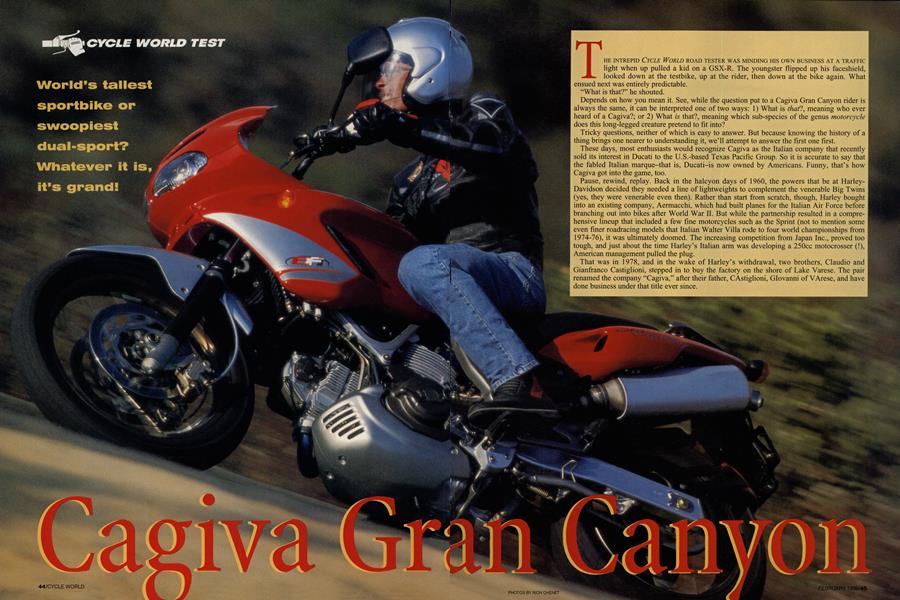
Cagiva Gran Canyon
CYCLE WORLD TEST
World's tallest sportbike or swoopiest dual-sport? Whatever it is, it's grand!
THE INTREPID CYCLE WORLD ROAD TESTER WAS MINDING HIS OWN BUSINESS AT A TRAFFIC light when up pulled a kid on a GSX-R. The youngster flipped up his faceshield, looked down at the testbike, up at the rider, then down at the bike again. What ensued next was entirely predictable.
“What is that?” he shouted.
Depends on how you mean it. See, while the question put to a Cagiva Gran Canyon rider is always the same, it can be interpreted one of two ways: 1) What is that?, meaning who ever heard of a Cagiva?; or 2) What is that?, meaning which sub-species of the genus motorcycle does this long-legged creature pretend to fit into?
Tricky questions, neither of which is easy to answer. But because knowing the history of a thing brings one nearer to understanding it, we’ll attempt to answer the first one first.
These days, most enthusiasts would recognize Cagiva as the Italian company that recently sold its interest in Ducati to the U.S.-based Texas Pacific Group. So it is accurate to say that the fabled Italian marque-that is, Ducati-is now owned by Americans. Funny, that’s how Cagiva got into the game, too.
Pause, rewind, replay. Back in the halcyon days of 1960, the powers that be at HarleyDavidson decided they needed a line of lightweights to complement the venerable Big Twins (yes, they were venerable even then). Rather than start from scratch, though, Harley bought into an existing company, Aermacchi, which had built planes for the Italian Air Force before branching out into bikes after World War II. But while the partnership resulted in a comprehensive lineup that included a few fine motorcycles such as the Sprint (not to mention some even finer roadracing models that Italian Walter Villa rode to four world championships from 1974-76), it was ultimately doomed. The increasing competition from Japan Inc., proved too tough, and just about the time Harley’s Italian arm was developing a 250cc motocrosser (!), American management pulled the plug.
That was in 1978, and in the wake of Harley’s withdrawal, two brothers, Claudio and Gianfranco Castiglioni, stepped in to buy the factory on the shore of Lake Varese. The pair renamed the company “Cagiva,” after their father, CAstiglioni, Giovanni of VArese, and have done business under that title ever since.
Along the way, the dynamic duo added the Ducati, Husqvama and Moto Morini marques to their fold, and netted considerable racing success on the World Superbike and 500cc Grand Prix fronts. Income from the bike-building business couldn’t keep pace with their racing expenditures, however, and ultimately the brothers were forced to sell Ducati to pay off their debts.
But that influx of capital also enabled the Castiglionis to purchase the rights to the most hallowed of all Italian marques, MV Agusta, which they promptly applied to their breathtaking new 750cc fourcylinder superbike, the F4. So it appears that Cagiva is poised to continue in the sportbike business even without Ducati-never mind that there’s a Ducati V-Twin in the Gran Canyon’s engine bay.
Say, what was the question again?
Oh, yeah. What the Cagiva Gran Canyon is, is a bike that refuses to be pigeonholed. Ostensibly, it is the latest development of the Cagiv ’ Elefant introduced in 1984. But where that dual-purpose bike emulatp ed the Paris-Dakar rally racers of the day, later versions grew more street-biased. And larger: Originally offered as a 600, the Elefant’s engine was enlarged first to 650cc, then 750cc and finally to 900cc, in which guise it was marketed as the Ducati E900. And now, ht comes the Cagiva Gran Canyon, resplendent in its new. Pierre» Terblanche-designed bodywork and 916-style underseat muffle and boasting a Weber-Marelli fuel-injection system.
At any rate, just to give this protracted tale a sense of closure, the Elefant-cum-Canyon is now being imported by a new company, Cagiva USA. Many Italian-bike enthusiasts will recognize this enterprise as Fast By Ferracci, a high-performance shop best known, paradoxically, for roadracing Ducatis.
Told you these were tricky questions.
Anyway, back to the purported subject of this test, the Cagiva Gran Canyon. We picked up our testbike at Malcolm Smith Motorsports in Riverside, California, and from the moment we rode it up the ramp into the OF box van, we were hooked. The thing’s an absolute laughriot, in spite of the fact that it’s almost too refined.
First thing you notice after thumbing the starter button is how quiet the engine is. Hard to believe there’s a Ducati V-Twin between your legs, there’s so much less intake honk and exhaust noise. The twovalve-per-cylinder 904cc desmo, polished over a period of two decades, has been developed to the point that it is virtually above reproach. The 90-degree veeangle provides perfect primary balance, thus vibration is not an issue, and torque flows seamlessly from 2500 right up to 6250 rpm, with usable power all the way to the 9500-rpm redline. In terms of real-world usability, this engine has few peers.
Our only real complaint continues to be the dry clutch, whose rattling plates some testers deemed too noisy, and whose pull, while markedly lighter than in years past, most felt was too stiff. Gearbox action, though, was universally proclaimed to be excellent, positive yet slick-shifting. And throttle response was equally praiseworthy, even when the engine was cold, even after the rider had failed to find the choke lever hidden behind his left calf.
A word about that: Like most fuel-injected bikes, the Canyon’s “choke” is technically a cold-start enrichener. This works simply by opening the throttle a tad, which means you can achieve the same effect by twisting the grip. That being the case, you’ll find that should you activate the enrichener once underway, it does a decent impression of cruise-control-though we would never advocate using it in a manner for which it clearly was not intended.
Which raises another tricky question: What is the Gran Canyon intended for, anyway? In Europe, where “enduro” bikes of this type are hot sellers, they are used primarily as around-town transport; knobs rarely contact terra firma. Yet even so, we couldn’t resist getting the Cagiva’s Pirellis smelly, and took it exploring in horse country on the fringes of the city. Wending our way down gravel-strewn, graded-dirt roads, it quickly became apparent that the Canyon is quite capable of off-road duty.
To a point, anyway. First thing you need to know is that the Gran Canyon is heavy, and top-heavy. Fill up its commodious, 5.3-gallon fuel tank-or, to be accurate, tanks, because there are two, each with its own filler cap-and the bike weighs a not-insignificant 511 pounds. (Last time we checked, a good Open-class dual-purpose bike weighed around 350.) That said, venturing into more radical off-road terrain can only lead to trouble, for a couple of reasons. First, standing up on the pegs is awkward, because the fuel tank flares out right where your thighs need to be. And second, this is one bike on which you absolutely do not want to run into a dead end, or lose traction while climbing a hill, because it would take the strength of Hercules to get it turned around.
Ridden conservatively, however, the Gran Canyon takes whatever a dirt road might throw at it in stride, its 6.7 inches of suspension travel and plastic “skidplate” coping with bumps and rocks almost as well as a bonafide dirtbike. And while increasing compression damping might allow it to better cope with squareedged holes and g-outs, there unfortunately are no such provisions; the Marzocchi 50mm fork is non-adjustable and the Sachs-Boge shock only has provisions for varying spring preload and rebound damping.
But that’s okay, because frankly, this isn’t a dual-purpose bike. It’s really more of a sport-utility vehicle, a two-wheeled approximation of the overgrown station wagons you see parked at the mall. And used as such, it’s an exceptional performer.
First off, the plush, long-travel suspension makes great sense in an urban environment, because face it, roads aren’t getting any smoother. Second, the barstoolheight seat lets you see over the tops of cars, and at least puts you on equal footing with towering pickups, vans and the increasingly prolific sport-utes. And third, the comfortable, upright seating position doesn’t force you into a position that feels unnatural at high or low speeds. You can’t say that about cruisers and sportbikes.
Passengers, too, find the ride comfortable, particularly if you take the time to strap a tail pack onto the rear rack and adjust shock-spring preload and rebound damping to compensate. And unfortunately, both of these procedures do take some time, because the rack’s bungee hooks are difficult to use and the shock employs twin lockrings rather than a more convenient ramp-type arrangement. Oh well, maybe your passenger will be impressed by your wielding a hammer and punch. What was that we said about Hercules?
Dare to venture out past the city limits and you’ll find the Cagiva works well on the open road, too. The vestigial windscreen doesn’t offer much protection, but the Superbike-bend handlebar lets you lean forward into the windblast, so that you don’t feel as though you’re about to be blown off the back like on some unfaired bikes. Find a long, straight stretch of road, hold the twistgrip wide-open in sixth gear and you’ll eventually reach a top speed of 119 mph-slower than a similarly powered sportbike, yes, but then, the Gran Canyon is geared lower. And that, coupled with the aforementioned abundant torque, held the Cagiva in good stead during our performance testing. It covered the quarter-mile in 12.45-seconds at 104.85 mph and posted respectable top-gear roll-on figures of 3.2 seconds from 40-60 mph and 3.5 from 60-80.
While we were at the dragstrip, we discovered another benefit of the torque/ gearing combination: wheelies! (Though you probably could have guessed that by looking at the photos...) We also discovered what we thought was an oil leak, before realizing that lubricant had simply made its way out of the crankcase breather and into the airbox during one of Don “Monowheel” Canet’s near-vertical return passes. “Problem” solved.
Taking the Canyon into the canyons is where you’ll find the real fun, though, because few bikes are as enjoyable-or as fast-down a tight, twisty, bump-riddled backroad. In a word, the Cagiva is surefooted, as it lets the rider know exactly what’s transpiring at the twin contact patches way down there. Cornering clearance is virtually limitless; we tried to drag the footpegs and failed.
It pays to be smooth, though, because as the pace quickens, the chassis becomes increasingly sensitive. The wide handlebar affords into corners, but get ham-fisted and you’ll invoke a weave and a wallow. Similarly, grabbing a fistful of brakes causes the bike to pitch forward unnervingly as the fork bottoms and the shock tops out. Better to squeeze on the brakes and let the front suspension settle before applying maximum stopping power.
These limitations should come as no surprise, really. Much has been made of Ducati’s efforts to get enough weight onto the front tire of their racing Superbikes, and given the Gran Canyon’s conservative 27.5 degrees of rake, long-travel suspension and 19-inch front wheel, it doesn’t take a mathematician to figure that these are all steps in the wrong direction. But that’s the price you pay to achieve the sort of versatility that this bike possesses.
And what price must you pay, you ask? Another tricky question. Pressed for a figure, Cagiva USA honcho Larry Ferracci hemmed and hawed, and said he’d get back to us with an answer. Expecting the worst, we were pleasantly surprised when he called back to say $8995. That’s cheap compared to the only other bikes in this class currently being sold in the U.S, the $13,900 BMW R1100GS, $9990 Moto Guzzi Quota and $10,795 Triumph Tiger. Cagiva clearly wants to move some bikes.
How will the Gran Canyon fare in the sales wars? Will Cagiva ever fully recover as a company? Two more tricky questions that we don’t dare answer. All we can say is, if the Gran Canyon is any indication of Cagiva’s capabilites, the company’s future is secure.
GRAN CANYON
$8995
EDITORS' NOTES
“NAME’S BOND...JAMES BOND.” I felt like 007 every time I pulled a sustained wheelie on the Cagiva Gran Canyon because of the thick smokescreen it laid down. Seems tipping the Canyon high onto its rear wheel dumps engine oil through its crankcase breather right into the airbox-and not just a drop or two. The ensuing white cloud is quite spectacular, although certainly not EPA-approved.
While I doubt such pursuit countermeasures were a planned design feature, Cagiva’s engineers did get a lot right. Great brakes, a stable chassis and never-ending cornering clearance mean the GC is capable of smoking off many sportbikes on tight mountain roads-without need for Hollywood special effects. If a playful two-wheeler offering a wide range of uses interests you, this is it. From inner-city commuter to sport-tourer to Sunday-morning giant-slayer, the Canyon easily fills the void. Think of it as a dual-sport on steroids. -Don Canet, Road Test Editor
As THE SOLE CAGIVA OWNER ON STAFF, I often have my sanity called into question. So that’s what I was expecting when I announced that yes, I did in fact like this new Gran Canyon.
wouldn’t be surprised to see something similar from his new post at Ducati. Fact is, Terblanche rides a Gran Canyon himself, and says it’s his favorite type of motorcycle. But until Ducati gets around to building a Euro-enduro of its own, consider the Gran Canyon its entry in the marketplace. Never mind that the money goes to Varese instead of Bologna; think of it as helping to fund production of the MV Agusta F4. Sell enough of those, and maybe Cagiva
will even make a new batch of kickstarters to replace the one that snapped off my WMX500. -Brian Cat ter son, Executive Editor Thing is, no one disagreed. Everyone who rode the bike-and even a few who didn’t-thought it was pretty dang cool. This is the final machine that Pierre
Terblanche designed for Cagiva, so we
OKEY-DOKEY, YOU’RE IN THE MARKET FOR a new scoot, but what to buy? Sportbikes have never been better, but your days of playing King of the Mountain are over and, besides, weekend treks with your snookums on the back will be on the itinerary-two-up on a 996 is grounds for divorce. Cruisers are cooler than ever, true, but still a little bloodless for your tastes. The Floorboard Brigade will have to do without you for a few more years.
What’s left? Standards? Snoozeville. Dual-purpose? Too dirty. Luxo-tourers? Your belly’s not big enough.
May we suggest something in a Cagiva? The Gran Canyon is like a classic, wire-wheeled sports car-not as fast as a Lamborghini, say, but way more fun than an Impala sedan. It’s a cross between supermotard and superbike. It’s at home strafing apexes or splitting lanes. It’s funky and functional. It’s exotic and affordable.
It might just be the perfect motorcycle.
-David Edwards, Editor-in-Chief