Yamaha Virago 1100
YAMAHA VIRAGO 1100
FIRST of the '94s
THE WELL-DEVELOPED CRUISE-MOBILE
WHEN YAMAHA'S DESIGN TEAM undertook creation of the first Viragos, there was plenty of styling to be done, but the bike’s basic format already was set. This bike was going to be a Japanese version of the timeless American classic, the cruiser.
And it’s clear Yamaha has been doing something right: The Virago is still around, nearly unchanged,
13 years and 22,000 units later.
Like all good cruisers, this one is based around a V-Twin engine-in this case, 1063 cubic centimeters of VTwin-up from the 920cc capacity of the original. Surrounding components have gone the distance since a minor 1986 revision, with the transmission, flywheel and cooling fins built up to accommodate the larger motor. A new carburetor setup was also added in ’86 to make service a little easier.
What’s new for this year? Adhering to the If-lt-Ain’t-Broke-Don’t-Fix-It School of Design, only the two-tone paint scheme.
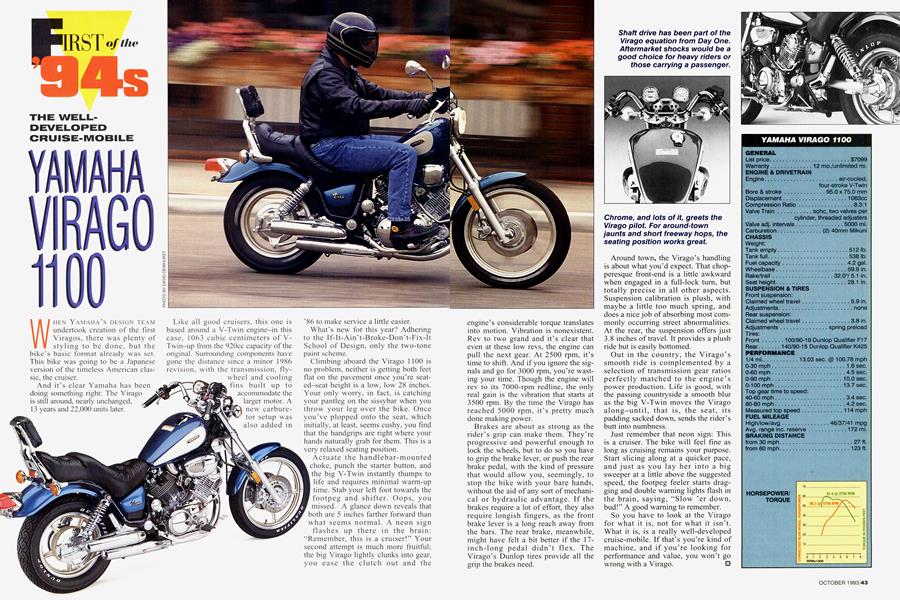
Climbing aboard the Virago 1100 is no problem, neither is getting both feet flat on the pavement once you’re seated-seat height is a low, low 28 inches. Your only worry, in fact, is catching your pantleg on the sissybar when you throw your leg over the bike. Once you’ve plopped onto the seat, which initially, at least, seems cushy, you find that the handgrips are right where your hands naturally grab for them. This is a very relaxed seating position.
Actuate the handlebar-mounted choke, punch the starter button, and the big V-Twin instantly thumps to life and requires minimal warm-up time. Stab your left foot towards the footpeg and shifter. Oops, you missed. A glance down reveals that both are 5 inches farther forward than what seems normal. A neon sign flashes up there in the brain: “Remember, this is a cruiser!” Your second attempt is much more fruitful; the big Virago lightly clunks into gear, you ease the clutch out and the engine’s considerable torque translates into motion. Vibration is nonexistent. Rev to two grand and it’s clear that even at these low revs, the engine can pull the next gear. At 2500 rpm, it’s time to shift. And if you ignore the signals and go for 3000 rpm, you’re wasting your time. Though the engine will rev to its 7000-rpm redline, the only real gain is the vibration that starts at 3500 rpm. By the time the Virago has reached 5000 rpm, it’s pretty much done making power.
Brakes are about as strong as the rider’s grip can make them. They’re progressive and powerful enough to lock the wheels, but to do so you have to grip the brake lever, or push the rear brake pedal, with the kind of pressure that would allow you, seemingly, to stop the bike with your bare hands, without the aid of any sort of mechanical or hydraulic advantage. If the brakes require a lot of effort, they also require longish fingers, as the front brake lever is a long reach away from the bars. The rear brake, meanwhile, might have felt a bit better if the 17inch-long pedal didn’t flex. The Virago’s Dunlop tires provide all the grip the brakes need.
Around town, the Virago’s handling is about what you’d expect. That chopperesque front-end is a little awkward when engaged in a full-lock turn, but totally precise in all other aspects. Suspension calibration is plush, with maybe a little too much spring, and does a nice job of absorbing most commonly occurring street abnormalities. At the rear, the suspension offers just 3.8 inches of travel. It provides a plush ride but is easily bottomed.
Out in the country, the Virago’s smooth ride is complemented by a selection of transmission gear ratios perfectly matched to the engine’s power production. Life is good, with the passing countryside a smooth blur as the big V-Twin moves the Virago along-until, that is, the seat, its padding sacked down, sends the rider’s butt into numbness.
Just remember that neon sign: This is a cruiser. The bike will feel fine as long as cruising remains your purpose. Start slicing along at a quicker pace, and just as you lay her into a big sweeper at a little above the suggested speed, the footpeg feeler starts dragging and double warning lights flash in the brain, saying, “Slow ’er down, bud!” A good warning to remember.
So you have to look at the Virago for what it is, not for what it isn’t. What it is, is a really well-developed cruise-mobile. If that’s you’re kind of machine, and if you’re looking for performance and value, you won’t go wrong with a Virago. □
YAMAHA VIRAGO 1100
$7099
HORSEPOWER/ TORQUE