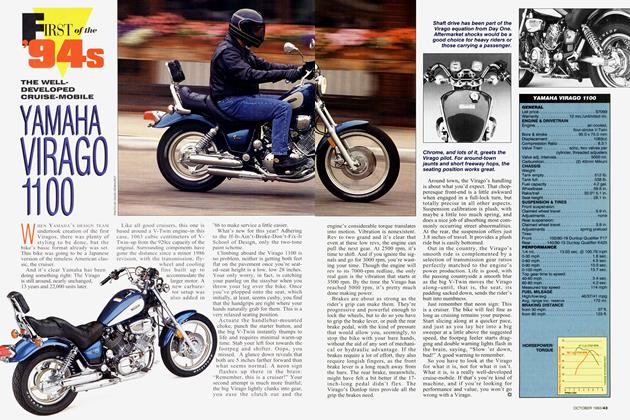
Honda Pacific Coast
HONDA PACIFIC COAST
FIRST of the '94s
IS THE TIME RIGHT FOR THE PC800’S RETURN?
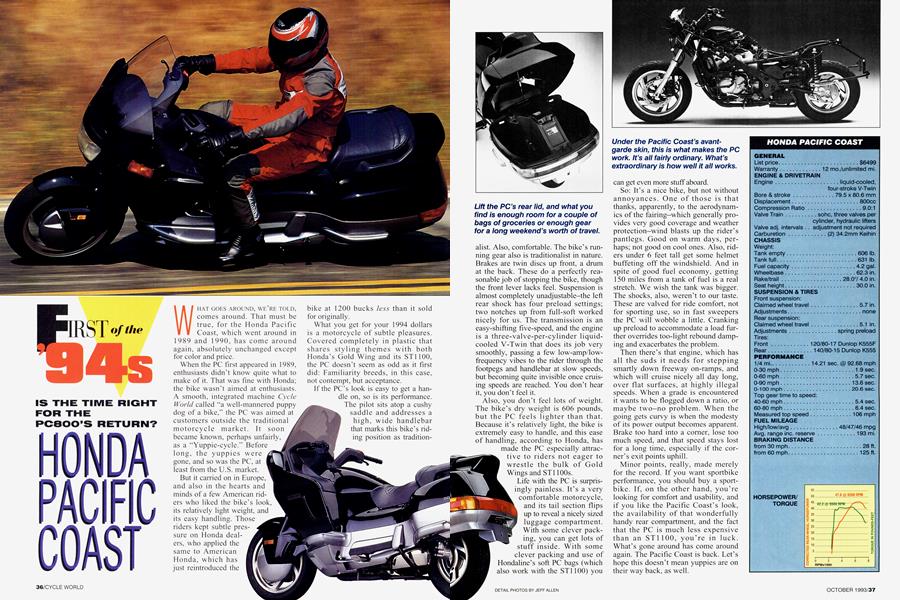
WHAT GOES AROUND, WE'RE TOLD, comes around. That must be true, for the Honda Pacific Coast, which went around in 1989 and 1990, has come around again, absolutely unchanged except for color and price.
When the PC first appeared in 1989, enthusiasts didn’t know quite what to make of it. That was fine with Honda; the bike wasn’t aimed at enthusiasts. A smooth, integrated machine Cycle World called “a well-mannered puppy dog of a bike,” the PC was aimed at customers outside the traditional motorcycle market. It soon became known, perhaps unfairly, as a “Yuppie-cycle.” Before long, the yuppies were gone, and so was the PC, at least from the U.S. market.
But it carried on in Europe, and also in the hearts and minds of a few American riders who liked the bike’s look, its relatively light weight, and its easy handling. Those riders kept subtle pressure on Honda dealers, who applied the same to American Honda, which has just reintroduced the bike at 1200 bucks less than it sold for originally.
What you get for your 1994 dollars is a motorcycle of subtle pleasures. Covered completely in plastic that shares styling themes with both Honda’s Gold Wing and its ST1100, the PC doesn’t seem as odd as it first did: Familiarity breeds, in this case, not contempt, but acceptance.
If the PC’s look is easy to get a handle on, so is its performance. The pilot sits atop a cushy saddle and addresses a high, wide handlebar that marks this bike’s riding position as traditionalist. Also, comfortable. The bike’s running gear also is traditionalist in nature. Brakes are twin discs up front, a drum at the back. These do a perfectly reasonable job of stopping the bike, though the front lever lacks feel. Suspension is almost completely unadjustable-the left rear shock has four preload settings; two notches up from full-soft worked nicely for us. The transmission is an easy-shifting five-speed, and the engine is a three-valve-per-cylinder liquidcooled V-Twin that does its job very smoothly, passing a few low-amp/lowfrequency vibes to the rider through the footpegs and handlebar at slow speeds, but becoming quite invisible once cruising speeds are reached. You don’t hear it, you don’t feel it.
Also, you don’t feel lots of weight. The bike’s dry weight is 606 pounds, but the PC feels lighter than that. Because it’s relatively light, the bike is extremely easy to handle, and this ease of handling, according to Honda, has made the PC especially attractive to riders not eager to wrestle the bulk of Gold Wings and ST 1100s.
Life with the PC is surprisingly painless. It’s a very comfortable motorcycle, and its tail section flips up to reveal a nicely sized luggage compartment. With some clever packing, you can get lots of stuff inside. With some clever packing and use of Hondaline’s soft PC bags (which also work with the ST 1100) you can get even more stuff aboard.
So: It’s a nice bike, but not without annoyances. One of those is that thanks, apparently, to the aerodynamics of the fairing-which generally provides very good coverage and weather protection-wind blasts up the rider’s pantlegs. Good on warm days, perhaps; not good on cool ones. Also, riders under 6 feet tall get some helmet buffeting off the windshield. And in spite of good fuel economy, getting 150 miles from a tank of fuel is a real stretch. We wish the tank was bigger. The shocks, also, weren’t to our taste. These are valved for ride comfort, not for sporting use, so in fast sweepers the PC will wobble a little. Cranking up preload to accommodate a load further overrides too-light rebound damping and exacerbates the problem.
Then there’s that engine, which has all the suds it needs for stepping smartly down freeway on-ramps, and which will cruise nicely all day long, over flat surfaces, at highly illegal speeds. When a grade is encountered it wants to be flogged down a ratio, or maybe two-no problem. When the going gets curvy is when the modesty of its power output becomes apparent. Brake too hard into a comer, lose too much speed, and that speed stays lost for a long time, especially if the corner’s exit points uphill.
Minor points, really, made merely for the record. If you want sportbike performance, you should buy a sportbike. If, on the other hand, you’re looking for comfort and usability, and if you like the Pacific Coast’s look, the availability of that wonderfully handy rear compartment, and the fact that the PC is much less expensive than an ST1100, you’re in luck. What’s gone around has come around again. The Pacific Coast is back. Let’s hope this doesn’t mean yuppies are on their way back, as well.
HONDA PACIFIC COAST
$6499
HORSEPOWER/ TORQUE