Honda Cbr600f2
HONDA CBR600F 2
FIRST of the '94s
Road tests of four early-release 1994 models from Honda and Yamaha
STILL COOKIN’ IN ITS FOURTH MODEL YEAR
WHEN YOU HAVE SOMETHING THAT sells like hot cakes, why raise the cost by adding more syrup? Consider the case of Honda’s CBR600, which according to an American Honda spokesman is currently the company’s best selling bike and has sold in excess of 50,000 units since its 1987 inception as the 600 Hurricane. Perhaps it was the sight of its once-all-dominant CBR being bested by Kawasaki and Suzuki in national supersport racing that prompted Honda to return to the pantry for a few more ingredients.
Changes within the ’94 engine are minor, directed at improving feel and function when shifting the CBR’s sixspeed gearbox. A revised shift drum and a lighter spring on the shift mechanism work together to provide lighter, more positive gear changes.
The chassis has received the most notable updates for ’94, with a new 41mm Showa fork-the same tube diameter as before-featuring a cartridge damper unit with externally adjustable rebound damping and spring preload. A screw adjuster on the fork cap has 14 indexclicks for setting the rebounddamping rate. Complementing the updated fork is a new fully adjustable Showa shock fitted at the rear. The new damper has adjusters for both compression and rebound damping, along with spring preload. Infinitely variable screw adjusters are located on the shock’s remote reservoir and on the shock body for setting compression and rebound damping, respectively. A special tool is provided for setting shock-spring preload.
The new suspension components weigh a bit more than the items they’ve replaced, so Honda engineers made an effort to offset some of the additional weight by replacing the caststeel sidestand with a lighter one made of hollow steel tubing. A pair of castaluminum passenger footrest brackets have also replaced the heavier steeltube structure of old.
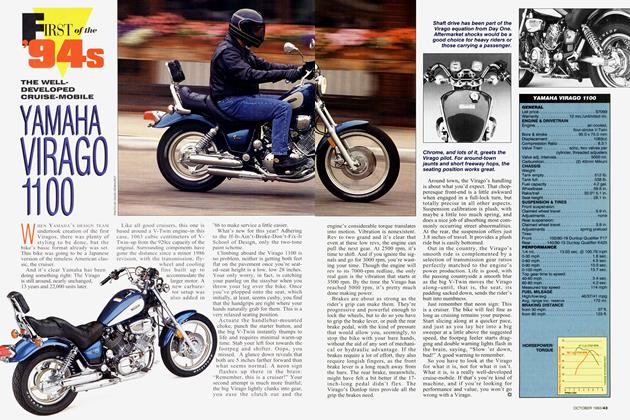
Other changes to the bike are purely cosmetic in nature. The ’94 CBR600F2 is available in three color schemes: black/purple/red, black/blue/yellow and white/red/black. The swingarmmounted rear subfender is now black instead of the silver color of past models, and the engine exterior has also received a minor makeover, with charcoal-black-coated clutch and generator covers.
New looks aside, the big question is how well the latest CBR works on the road. The engine is the same strongrunning-albeit slightly buzzy-unit as before, but within a few miles, it’s evident that the CBR’s new legs are a leap ahead of the components they’ve replaced. Both ends offer a wide range of rebound-damping adjustability, though we found that remaining close to the factory settings provided an excellent ride over a variety of road-surface conditions. Hard riders and roadracers will appreciate the improvement in front-end feedback and road-holding stability the new fork gives.
A stock shock is one of the first items that racers replace with an aftermarket unit. Unfortunately, we didn’t have the opportunity to flog the ’94 F2 around a race course to establish the new shock’s all-out capabilities, but we have no complaints with its performance during even the most spirited street usage.
All in all, the latest CBR600F2 blends some significant improvements with a proven recipe for success. At $6199, it’s up $300 dollars from last year, but you can consider that money well spent.
HONDA CBR600F2
$6199
HORSEPOWER/ TORQUE