Legacy of the Hustler
Legacy of the Hustler
AT LARGE
Steven L. Thompson
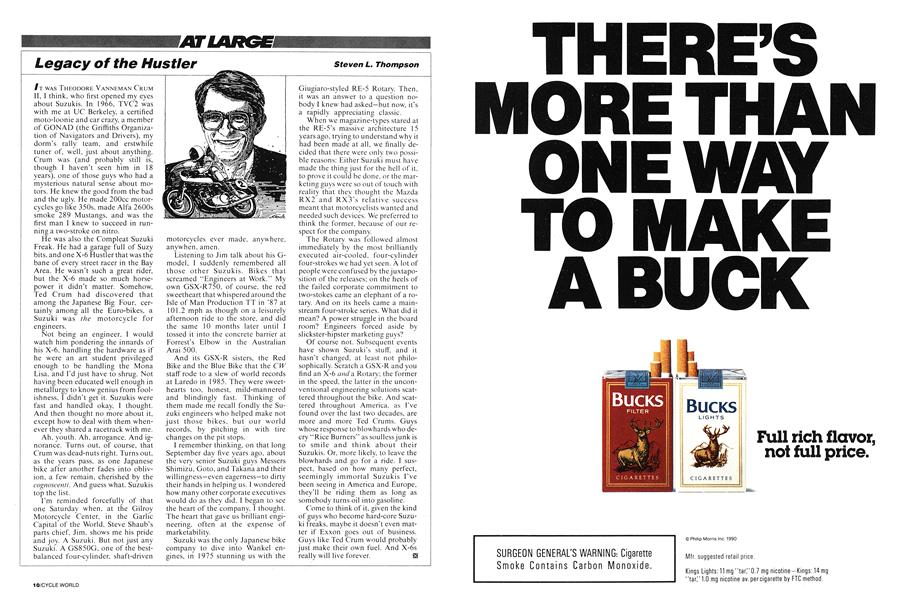
IT WAS THEODORE VANNEMAN CRUM II, I think, who first opened my eyes about Suzukis. In 1966, TVC2 was with me at UC Berkeley, a certified moto-loonie and car crazy, a member of GONAD (the Griffiths Organization of Navigators and Drivers), my dorm’s rally team, and erstwhile tuner of, well, just about anything. Crum was (and probably still is, though I haven't seen him in 18 years), one of those guys who had a mysterious natural sense about motors. He knew the good from the bad and the ugly. He made 200cc motorcycles go like 350s, made Alfa 2600s smoke 289 Mustangs, and was the first man I knew to succeed in running a two-stroke on nitro.
He was also the Compleat Suzuki Freak. He had a garage full of Suzy bits, and one X-6 Hustler that was the bane of every street racer in the Bay Area. He wasn’t such a great rider, but the X-6 made so much horsepower it didn't matter. Somehow, Ted Crum had discovered that among the Japanese Big Four, certainly among all the Euro-bikes, a Suzuki was the motorcycle for engineers.
Not being an engineer, I would watch him pondering the innards of his X-6, handling the hardware as if he were an art student privileged enough to be handling the Mona Lisa, and I'd just have to shrug. Not having been educated well enough in metallurgy to know genius from foolishness, I didn’t get it. Suzukis were fast and handled okay, I thought. And then thought no more about it, except how to deal with them whenever they shared a racetrack with me.
Ah, youth. Ah, arrogance. And ignorance. Turns out. of course, that Crum was dead-nuts right. Turns out, as the years pass, as one Japanese bike after another fades into oblivion, a few remain, cherished by the cognoscenti. And guess what. Suzukis top the list.
I'm reminded forcefully of that one Saturday when, at the Gilroy Motorcycle Center, in the Garlic Capital of the World. Steve Shaub’s parts chief, Jim. shows me his pride and joy. A Suzuki. But not just any Suzuki. A GS850G, one of the bestbalanced four-cylinder, shaft-driven motorcycles ever made, anywhere, anywhen, amen.
Listening to Jim talk about his Gmodel. I suddenly remembered all those other Suzukis. Bikes that screamed “Engineers at Work.” My own GSX-R750, of course, the red sweetheart that whispered around the Isle of Man Production TT in ’87 at 101.2 mph as though on a leisurely afternoon ride to the store, and did the same 10 months later until I tossed it into the concrete barrier at Forrest’s Elbow in the Australian Arai 500.
And its GSX-R sisters, the Red Bike and the Blue Bike that the CW staff rode to a slew of world records at Laredo in 1985. They were sweethearts too, honest, mild-mannered and blindingly fast. Thinking of them made me recall fondly the Suzuki engineers who helped make not just those bikes, but our world records, by pitching in with tire changes on the pit stops.
I remember thinking, on that long September day five years ago, about the very senior Suzuki guys Messers Shimizu, Goto, and Takana and their willingness—even eagerness—to dirty their hands in helping us. I wondered how many other corporate executives would do as they did. I began to see the heart of the company. I thought. The heart that gave us brilliant engineering, often at the expense of marketability.
Suzuki was the only Japanese bike company to dive into Wankel engines, in 1975 stunning us with the Giugiaro-styled RE-5 Rotary. Then, it was an answer to a question nobody I knew had asked—but now, it’s a rapidly appreciating classic.
When we magazine-types stared at the RE-5’s massive architecture 15 years ago, trying to understand why it had been made at all, we finally decided that there were only two possible reasons; Either Suzuki must have made the thing just for the hell of it, to prove it could be done, or the marketing guys were so out of touch with reality that they thought the Mazda RX2 and RX3’s relative success meant that motorcyclists wanted and needed such devices. We preferred to think the former, because of our respect for the company.
The Rotary was followed almost immediately by the most brilliantly executed air-cooled, four-cylinder four-strokes we had yet seen. A lot of people were confused by the juxtaposition of the releases; on the heels of the failed corporate commitment to two-stokes came an elephant of a rotary. And on its heels came a mainstream four-stroke series. What did it mean? A power struggle in the board room? Engineers forced aside by slickster-hipster marketing guys?
Of course not. Subsequent events have shown Suzuki’s stuff, and it hasn’t changed, at least not philosophically. Scratch a GSX-R and you find an X-6 and a Rotary; the former in the speed, the latter in the unconventional engineering solutions scattered throughout the bike. And scattered throughout America, as I’ve found over the last two decades, are more and more Ted Crums. Guys whose response to blowhards who decry “Rice Burners” as soulless junk is to smile and think about their Suzukis. Or. more likely, to leave the blowhards and go for a ride. I suspect, based on how many perfect, seemingly immortal Suzukis I’ve been seeing in America and Europe, they’ll be riding them as long as somebody turns oil into gasoline.
Come to think of it, given the kind of guys who become hard-core Suzuki freaks, maybe it doesn’t even matter if Exxon goes out of business. Guys like Ted Crum would probably just make their own fuel. And X-6s really will live forever. ED
More From This Issue
-
 Up Front
You Meet the Nicest People...
January 1991 -
 Leanings
The Gold Wing From Red Wing
January 1991 -
Letters
Letters
January 1991 -
 Roundup
Euro-Enduros: the Rally Rage Rolls On
January 1991 -
Roundup
Yamaha's New Approach: Buy A Bike, Get Insurance As Part of the Package
January 1991 -
Roundup
Great Beemer Hunt
January 1991