Hodakability
HODAKABILITY
The Marvelous Marsupials, and How They Made Off-Road Riding So Much Fun
Steve Booth
They Successed Themselves Out Of Business
June, 1964. The first shipment of a new motorcycle arrived in the United States. It was the Hodaka Ace 90. This virtually unnoticed event set the stage for an epidemic that would sweep the country before the end of the decade. The era of the lightweight, street-legal trailbike had begun! With it came a growing cult of enthusiastic riders and innovators and racers who helped spread dirt riding to every state and who influenced the development of the Hodaka through 16 years of production.
In little more than two years' 10.000 of the bright red Ace 90s had been built—one color, one model—constantly improved, but basically the same well-thought-out design concocted by the trail-riding gnomes of Athena. Oregon, and bottled in Nagoya, Japan. The team of PABATCO, the U.S. designer and importer, and Hodaka Industrial Co., Ltd., the manufacturer, had a winner. By July 1966, production had reached 800 a month.
To sell this many motorcycles, especially a new brand, you have to prove it’s good. Hodaka did this by firing up the enthusiasm of riders everywhere with spectacular distance runs in challenging and desolate
parts of the world and with some impressive race wins. In 1965. long before Baja running became popular. Frank Wheeler and Marvin Foster rode Ace 90s from Lancaster. Calif., to the tip of Baja and back, over 2000 miles. Then later that year Big Frank took oft'for Alaska alone, covering 7000 miles from Oregon and back in just 14 days. In a 24-hour desert hare scrambles in Colorado the follow ing year. Hodaka really scored. Jim Cosco and Art Bocek. teamed on an Ace 90, dusted the entire field, every class from lOOcc through Open, to take the overall win against 24 other teams. Hodaka also won the California trailbike championship for the first time in 1966. (It repeated in ’67 and ’68.) And at Daytona that year, Harry Taylor of PABATCO’s engineering department rode a modified Ace 90 road racer to first place among lOOcc bikes to start a three-year string of high placings there.
The heart of the Ace 90. its dependable and easily modified engine, and its strong double-downtube frame, gave racer-mechanics and aftermarket suppliers a dream come true: no model changes each year to make accessories and race mods obsolete, and most parts were interchangeable for years. All improvements made by the factory could be retrofitted to earlier bikes easily.
The street-legal Ace 90 was being turned into a motorcycle that was competitive in scrambles, desert racing, trials and road racing. Later models, still built as trailbikes—the Ace 100 with more displacement and a five-speed gearbox appeared in 1967—ended up in flat track, TT, enduro and motocross, and there were occasional choppers and hill-climbers and even> speedway bikes. On the most successful applications, PABATCO passed on the details to dealers and riders with a series of beautifully illustrated modification leaflets to supplement the illustrated parts list and owners manual for every bike. Some of these changes found their way into models still under development, or inspired the introduction of a new motorcycle. Hodaka mania was taking over the small-bore world.
Brad Lackey, likely to be America’s first world motocross champion, started out on a Hodaka. Desert aces Tom and Cordis Brooks once blinded the opposition with the glare from the chrome-plated gas tanks of their Hodakas. Scores of future stars spent some time and learned a lot aboard the agile little red terrors.
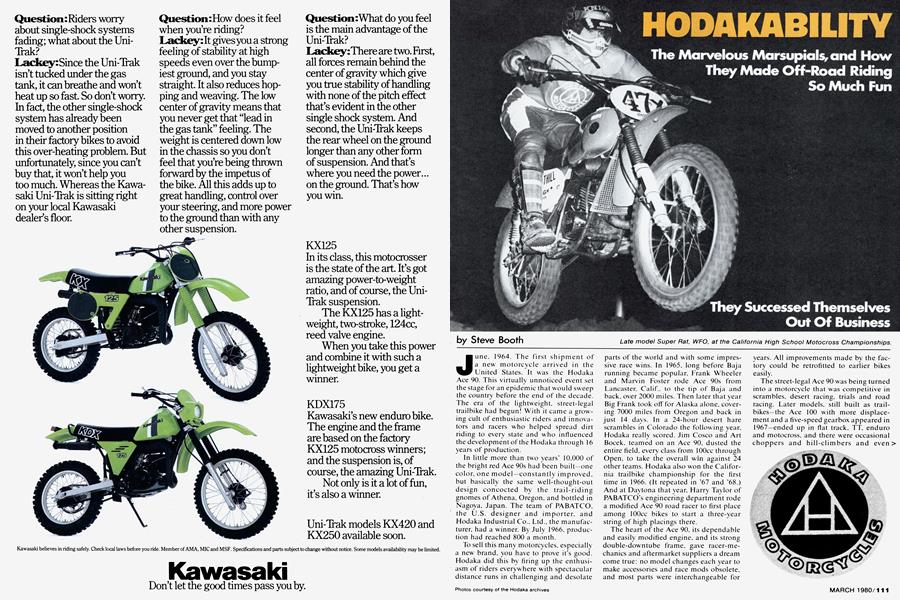
Then came Hodaka’s first out-of-thecrate racer, the Ace 100/MX, quickly dubbed “Super Rat” by a test rider, and the beginning of the crazy names, a menagerie of wombats, toads, clams and rodents (even one dog), monikers which belied the seriousness of the designs and the integrity of the machines they identified. One model, and soon one color, was a thing of the past, and eventually even the familiar chrome “toaster” disappeared. With the names came new fun as the line of Hodakas expanded and new' models with funny sounding names were tested by the motorcycle press and found to be good, in spite of what they were called.
The distance runs and race wins continued to sell Hodakas as a whole new' wave of riders took to the dirt. With the new 125cc Wombat that came out in 1972, Frank Wheeler eclipsed his previous longhaul runs by riding 10,000 miles around the perimeter of Australia in just 21 days, without a support crew. That’s about 475 miles a day. Frank weighed 225 pounds at the time, and he rode a stock bike equipped with a fairing and loaded down with 200 additional pounds of gas, water, tools and gear. Temperatures on the run ranged from below freezing up to a scorching 131°. That sold a lot of Hodaka motorcycles and hooked a lot of new' riders, our family included. By the end of the next year we had ow ned four of the critters, and Wombats and Combat Wombats (designed for enduro and MX) filled the woods and competed in enduros and other events across the U.S.
Those were the happy, carefree days before land-use hassles, noise regulations and inflation started squeezing the sport, days when amateur competition was more relaxed, and hardly anyone needed a new bike each year. Hop-up kits from the likes of E. C. Birt could give you more beans if you wanted them, and long-travel suspension was still in your knees. And if you wanted to be different you rode a Carabella or a Monark or maybe an MZ. and nobody laughed because you weren't mounted on a world-class European marque or one of the Nipponese Big Four. Or you rode a Hodaka and tricked it out for your kind of riding with factory racing parts, accessories and advice right from your friendly dealer.
The people at Hodaka never said it in so many words, but they obviously wanted to be your bike company. What other firm ever featured a 500cc alloy beer stein in its accessory catalogue, right next to a complete line of alloy rear sprockets and Girling shock components? Or showed the craziest collection of stickies, patches and iron-ons ever assembled, alongside reed valves, chrome-plated rings and shifter spring kits? “Hodaka Uber Alles.” one cries. “Get It On With Wombat.” says
another, and “It's a Boogie Machine.” all illustrated with caricatures of that hitherto little-known marsupial from the land down-under. And there are Super Rats. Dirt Squirting clams. Road Toads, a Combat military arm patch and the super canine, Thunderdog, which touts the 250 enduro bike so long in eoming. Here’s a real treasure of motorcycle pop art.
It was fun w hile it lasted. As the Hodaka line expanded beyond the smallbores into the 250 class, and later a 175, the company was unable to keep abreast of the Big Four in quickly providing what riders really wanted. Quality and reliability were not enough to satisfy demands for speed, super-suspension and race-proven refinements passed on almost immediately to you and me. In this, Hodaka was not alone. The troubled dollar and the big-bucks investments of Honda, Kawasaki, Suzuki and Yamaha in race-ready machinery for the masses spelled The End to several fine off-road motorcycles produced on a more limited scale.
But in 1977. Hodaka made a final at tempt to rekindle the mania of years past with race wins and distance runs over terrain that would prove just how good these motorcycles were. The completely new' version of the 125 Wombat was out. sporting many of the components from the 250/ED. and the street-legal edition of that motorcycle, the 250/SL. had just appeared.
(continued on page 118)
First. John Tow nsend and Bob Brownell tackled the Baja 1000 on a Wombat and came in second in the 125 class. The only changes in their bike were alloy rims. Works Performance shocks. Tiger snake pipe, a plastic gas tank and an overstufted seat. Then Doug Richmond rode a boxstock 250/SL from Ensenada. Mexico, to San Jose. Costa Rica, covering 4637 miles of back roads in one month, using cheap gasoline and cheap oil, the only kind he could buy along the route. He made only one spark plug change and rode a steady 50 mph most of the way.
Finally. Max Bubeck. who had won the District 37 enduro trailbike class four years straight ( 1969-72) on Hodakas, took to the highways on a stock Wombat 125/SL-03 after only 100 miles of break-in and bopped along from LA to Denver and back—2370 miles—taking only three days each way. Not bad for a 125 that’s more at home in the dirt.
But it didn't help. Hodaka production stopped in late 1978. PABATCO is out of it. The trading company sold all the parts and accessories to Wheels of Time, Inc. (P.O. Box 7A. Island Route. Lock Haven, Pa. 17745). so Hodaka owners can keep their bikes going.
Now the last two of our five Hodakas are in other hands, and only a few' remnants of Hodakamania are around to remind us of those good and crazy days. A Hodaka emblem on the pocket of my Levi riding jacket and two well-worn T-shirts I decorated myself with Hodaka iron-ons. A Wombat sticker on my toolbox next to the ones for Curnutt shocks and Uni levers.
There are a bunch of color slides, too. and a framed Cibachrome that hangs above my typewriter. The photo is of Woody riding the 39th minute in a soggy Michigan enduro on his Combat the day he DNFed after a rock flew up and caught between the chain and the countershaft sprocket and took out everything, including third gear. It spoiled a near-perfect ride., SI