Honda's 500t Vs. Yamaha's Xs500
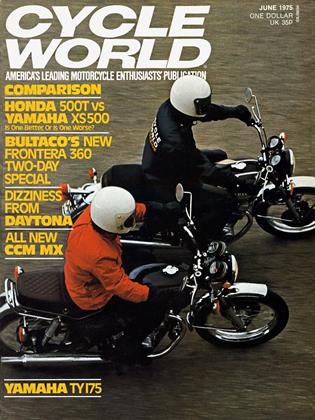
HONDA'S 500T Vs. YAMAHA'S XS500
In Answer To The Question: Is One Better Or Is One Worse?
CYCLE WORLD COMPARISON TEST
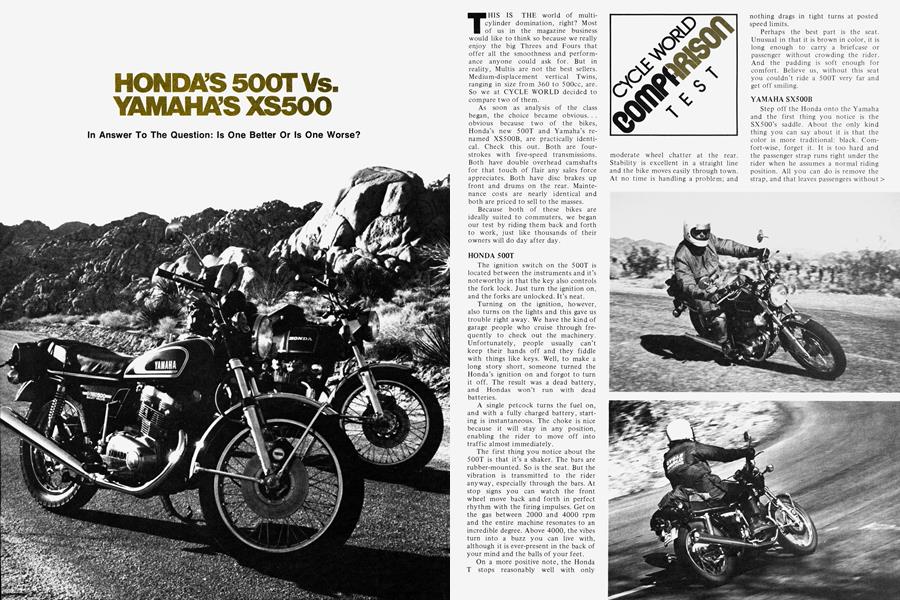
THIS IS THE world of multi-cylinder domination, right? Most of us in the magazine business would like to think so because we really enjoy the big Threes and Fours that offer all the smoothness and performance anyone could ask for. But in reality, Multis are not the best sellers. Medium-displacement vertical Twins, ranging in size from 360 to 500cc, are. So we at CYCLE WORLD decided to compare two of them.
As soon as analysis of the class began, the choice became obvious. . . obvious because two of the bikes, Honda’s new 500T and Yamaha’s renamed XS500B, are practically identical. Check this out. Both are fourstrokes with five-speed transmissions. Both have double overhead camshafts for that touch of flair any sales force appreciates. Both have disc brakes up front and drums on the rear. Maintenance costs are nearly identical and both are priced to sell to the masses.
Because both of these bikes are ideally suited to commuters, we began our test by riding them back and forth to work, just like thousands of their owners will do day after day.
HONDA 500T
The ignition switch on the 500T is located between the instruments and it’s noteworthy in that the key also controls the fork lock. Just turn the ignition on, and the forks are unlocked. It’s neat.
Turning on the ignition, however, also turns on the lights and this gave us trouble right away. We have the kind of garage people who cruise through frequently to check out the machinery. Unfortunately, people usually can’t keep their hands off and they fiddle with things like keys. Well, to make a long story short, someone turned the Honda’s ignition on and forgot to turn it off. The result was a dead battery, and Hondas won’t run with dead batteries.
A single petcock turns the fuel on, and with a fully charged battery, starting is instantaneous. The choke is nice because it will stay in any position, enabling the rider to move off into traffic almost immediately.
The first thing you notice about the 500T is that it’s a shaker. The bars are rubber-mounted. So is the seat. But the vibration is transmitted to the rider anyway, especially through the bars. At stop signs you can watch the front wheel move back and forth in perfect rhythm with the firing impulses. Get on the gas between 2000 and 4000 rpm and the entire machine resonates to an incredible degree. Above 4000, the vibes turn into a buzz you can live with, although it is ever-present in the back of your mind and the balls of your feet.
On a more positive note, the Honda T stops reasonably well with only
moderate wheel chatter at the rear. Stability is excellent in a straight line and the bike moves easily through town. At no time is handling a problem; and nothing drags in tight turns at posted speed limits.
Perhaps the best part is the seat. Unusual in that it is brown in color, it is long enough to carry a briefcase or passenger without crowding the rider. And the padding is soft enough for comfort. Believe us, without this seat you couldn’t ride a 500T very far and get off smiling.
YAMAHA SX500B
Step off the Honda onto the Yamaha and the first thing you notice is the SX500’s saddle. About the only kind thing you can say about it is that the color is more traditional: black. Comfort-wise, forget it. It is too hard and the passenger strap runs right under the rider when he assumes a normal riding position. All you can do is remove the strap, and that leaves passengers without a legal handhold.
Ignition switch location is identical to that on the Honda, but the fork lock is separate and difficult to get to. After dark you can fumble with it for several minutes. There are two petcocks on the Yamaha (awkward when you need reserve in a hurry), and the choke is an on/off device that forces a lengthy warmup before joining traffic.
As soon as the clutch is let out, it becomes obvious that Yamaha has done some anti-vibration research and development. The SX500 is not vibrationfree, but from 2000 to just under 6000 rpm, it is no worse than the Multis. It’s not necessary to exceed six grand very often, so in this respect the Yamaha is infinitely superior to its counterpart.
As is the case with the 500T, the Yamaha is a good handler. Straight-line stability is again good, but the Yamaha is front-heavy and exhibits a slight reluctance to turn easily in tight quarters. The bike isn’t a handful mind you, but you notice it wanting to fall from side to side, just like you notice a tendency for the rear wheel to shudder slightly when braking on a street that needs resurfacing.
Get on the brakes hard, though, and the SX will outbrake the 500T by a considerable margin. Whether this is due to a greater mechanical advantage offered by the Yamaha’s brake linkage (brake swept area on both bikes is too close to provide either bike with an advantage), or whether tires make the difference is impossible to determine; but we suspect that the Yamaha’s Dunlop tires have straight-up traction that is superior to that of the Bridgestones fitted to the Honda.
TOURING CAPABILITY AND HANDLING ON THE OPEN ROAD
At this point in our test, we were calling it a draw. For short hops across town the Honda is better balanced and more comfortable, but the Yamaha stops better and is smoother. Neither machine showed a clear advantage until we packed our bags for a typical weekend ride.
After a brief encounter with traffic that convinced us that leaving the city was indeed the right thing to do, we found ourselves on a freeway heading for the warmth of the desert. Several gas stops later, one of the Honda’s advantages showed up on paper. The 500T gets better gas mileage, particularly when you’re running along at a good clip. The exact figures are 43.6 miles per gallon for the Honda and 39.6 mpg for the Yamaha. Multiply this by fuel tank capacity and another Honda advantage shows up: cruising range. The Honda is capable of going 183 miles to the Yamaha’s 134. This might not mean much on a weekend trip, but next time there’s an energy crisis with the accompanying long gas station lines, the extra range could prove convenient.
After circumnavigating the desert around Palm Springs, we doubled back toward that city and spent the night. Because the 500s are rather utilitarian in both design and outward appearance, the thought of theft never entered our minds.
An inspection the following morning showed the Yamaha to be a half-quart down on oil. Neither final drive chain needed adjustment, but we did notice that the Honda comes equipped with an endless-type chain. This isn’t necessarily better or worse on a machine of this size, but it does require removal of the swinging arm when replacement becomes necessary.
We wanted to try some winding roads and avoid as much traffic as possible (an easy task midweek), so we rode down to Joshua Tree National Monument and the Cholla Cactus Gardens. The Monument was both beautiful and deserted; and south of the Cactus Gardens we found a two-lane road that wound endlessly through the foothills. The surface had been patched countless times, so the road provided a good test of both suspension and higher speed handling.
The two bikes are, for all practical purposes, equal in the suspension department; both are lacking here. The ride is very harsh over rough pavement and if you push at all, both bikes will wiggle. Suspension with better damping and more travel would cure this on either machine.
On smoother roads stability in a straight line is good on the Honda and the Yamaha, right up to top speed, which is also equal at just over 100 mph. Sure stops from top speed are also well within the capability of either machine, although some brake fade (especially in the rear) will be noticed if you repeat the test.
If you like to play racer, any corner free of debris can be taken 20 mph faster than the posted limit on either motorcycle. Grounding is not a problem and neither machine will wiggle at this velocity. Go faster and the Yamaha exhibits a top-heavy feel that won’t really be noticeable to the average person. The Honda, when cornering to the left near it’s limit, will drag the centerstand and peg, but again this occurs beyond the average rider’s capability. Ride double and grounding will occur frequently.
From the desert we went over the mountains, through the town of Julian, to the coast. Altitude has little effect on the bikes, but as the day wore on we discovered that the Honda’s vibration is less fatiguing than the soreness caused by the Yamaha’s seat.
As darkness approached, we switched on the Yamaha’s lights and compared them with those on the Honda. Again, identical. If you are cruising fast down any road that is itself lighted, no problem. Out in the boonies, however, anything over 50-60 mph is over driving the illumination available. Incidentally, the dimmer switch on the Honda is difficult to reach.
TECHNICAL EVALUATION
Basically, what we have are two Twins with double overhead camshafts. The actual execution is carried out differently, however, and with two separate trends of thought.
Both engines measure out to 498cc, or 30.38 cu. in. Honda’s 500T is an offshoot of their well-established 450. However, rather than following the common practice of increasing the bore size to arrive at a larger displacement, they chose to increase the stroke while maintaining the 70mm bore. This, of course, necessitated an all new crankshaft, but permitted retention of the same cylinder head and cams, as well as valves and valve angle. A simple increase in bore diameter would have made modification of these items necessary.
Another improvement over the popular 450 is the change from needle to roller bearings on the crankshaft. This mod adds to the lateral support of the crank and increases the durability of the unit.
Lubrication requirements remain the same, so the plunger-type pump is retained. The pump, whose pickup is on the primary side of the engine, is actuated off a cam on the back side of the clutch hub. From the pump, oil is forced through a filter and on to the top end of the engine. Oil is also pressure fed to the big end of the crank, the transmission shafts, and the kickstarter shaft.
The pair of overhead cams work just one set of valves per cylinder—that is, one intake and one exhaust valve. A single-row chain driven off the center of the crank operates the two camshafts. Guides and rollers are incorporated to assure true operation of the chain. A tensioner is also employed to take out any slack that occurs with mileage.
There are no coil springs to return the valves as they are opened by the cam follower. Instead, Honda uses a torsion bar setup that requires less space than the usual coil spring. Also, spring resonance is eliminated.
Valve clearance is adjusted by turning the cam follower shaft, which is eccentric, to the right or left. This adjustment does require removal of the fuel tank.
As with the GL1000, the Kawasaki Z1, etc., the 500T recirculates unburned gases. Any blow-by is directed to a breather box where oil is separated out by a foam rubber element. Blow-by is then directed through the paper element air filter and back into the carburetors for a second trip through the engine.
First, second and third gears are slightly lower than on 450 Hondas. Fourth and fifth remain the same. The rear sprocket on the 500T, however, is two teeth smaller, yielding a higher overall ratio. This in an effort to slow the engine down and reduce vibration at cruising speed.
In spite of taller gearing, the Honda is a shaker. The XS500 Yamaha, on the other hand, is free of this affliction because of its Omni-phase contrarotating weights. This 3-lb. 6-oz. mass is rotated by a chain off the crankshaft on the left side of the engine. The mass spins in the opposite direction of the crank and has a tendency to cancel the inherent vibration of a large-displacement Twin.
The Yamaha is also a double overhead camshaft design with variations. For example, the chain used to drive the camshafts is a duplex type that’s guided by idler gears and driven off the right (primary) side of the crank. Chain tension is adjustable.
Instead of two valves per cylinder, the XS features four: two intake and two exhaust. This setup is similar to that of the Honda XL350 Single. The main advantage of the design is improved breathing efficiency without a weight penalty in any single component.> Add to this the central location of the spark plugs (even though they are difficult to get to), and we also have better flame propagation at the time of ignition.
HONDA
500T
$1545
Unlike Honda, Yamaha claims that its 500 runs well on low-lead and no-lead fuels. This is accomplished by the use of stellite in both the valves and valve seats. Each valve is returned to the closed position by two sets of springs (an inner and an outer).
Both the Honda and Yamaha use straight-cut gears for the primary drive. Honda’s drive produces less noise than the one found on the XS. This is probably due to closer tolerances. On the Yamaha one trochoidal oil pump is used to force lubricating oil to the necessary spots and another pump returns it.
Carburetion in both cases is handled by 32mm constant velocity units. They are not identical. The throttle valve on the XS carb is operated by two cables: one to open and the other to close the valve. On either bike, carburetor vacuum adjustments are critical. If the settings are not correct, surging to the extreme and constant stalling can occur.
Yamaha has made very few changes from the ‘74 model. Output of the ignition coils has been increased to give a hotter spark to better burn the combustion mixture. A copper gasket is now used between the camshaft housing and cylinder head to prevent oil leakage at this point, something earlier bikes were faced with. A balance tube is fitted to the exhaust pipes just in front of the rear wheel to improve engine torque. And finally, there’s a new balance tube between the carburetor.
SUMMARY
Change the seat on the XS500 Yamaha and it would be our choice for straight-line cruising. Lack of vibration is just what you need for extended periods in the saddle. Leave the stock seat in place, and we would choose the Honda every time.
For commuters, flip a coin. Lights are equal. The Honda accelerates better and is marginally quieter, but the Yamaha stops shorter.
For those who value handling, choose the Honda even though it can be made to drag the centerstand in a fast lefthander. Its steering is better and it doesn’t have the top-heavy feel of the Yamaha.
Add in the categories of price, gas mileage and cruising range, and the Honda comes out slightly ahead. Taken in total, the 500T is the better machine. . .better that is until you compare it to a Multi of similar displacement. Then it is worse unless your only interests are price and simplicity.
CATEGORY ELEVEN PENALTY POINTS
HONDA—5 Excessive mirror vibration—rider can’t see to the rear clearly Difficult to get bike on centerstand Dimmer switch for headlight too far from handgrip Clutch fades under hard use Excessive speedometer error
Yamaha—3 Plug change difficult when cold-impossible when hot without burning hands. Engine oil leak (front, left) between cylinder base and engine cases Excessive speedometer error
YAMAHA
XS500
$1749