Riding Up the Capitol Steps
RIDING UP THE CAPITOL STEPS
You Can Make Sure America’s Legislators Get The Right Facts About Motorcycling
ROBERT S. WALKER
THERE was a time when a motorcyclist bought a bike, rode it and enjoyed it. These days, the situation is not quite so simple. Purchasing a cycle now means concerning yourself with special driver’s licenses, helmet regulations, periodic inspections for the bike and required safety equipment on the bike.
The change has been fundamentally legislative in nature. As motorcycles have become more popular, state legislatures and even the U.S. Congress have turned more attention toward them.
In some cases, the legislative decisions have been worthwhile attempts to make the sport safer. But quite often good legislation from the viewpoint of cyclists has been by accident rather than by plan. That is true because bike riders have had little or no influence on the legislative process. And, the sad commentary to this lack of influence is that cyclists have gotten saddled with a good bit of bad law, too.
Now, the American Motorcycle Association has become more active on a nationwide scale in the business of seeking favorable legislation for bikes and bikers. Just as important, it is trying to combat bills offered in the States and in Washington that appear offensive.
But cyclists cannot afford to sit back in the belief that the AMA can wage their fight for them. The legislators making the decisions under Capitol domes all across the country see the AMA as just another pressure group like dozens of others they deal with daily. The only thing that will make a difference to these legislators is when their constituents, the people they serve, show an interest in motorcycling.
The cyclist interested in making that difference should first realize that he is a constituent himself. There is no need for him to go out and round up public supporters for cycling. As a constituent, the cyclists can go to his legislators and present a strong case for the sport on his own. Even better, if he is visiting his assemblyman rather than writing, is to take along a couple of other riders who also can speak out on behalf of motorcycling.
Of course, the temptation is to make this contact only when there is an issue before the legislature about which bikers are concerned. While this is a time when you must make your views known, it is probably not the best time to get acquainted initially with your legislators. The initial contact is best made when you have no particular issue in mind, but simply want to make your general interest in motorcycling known to the man who represents you in the State Capitol or in Washington.
If you wait until there is an important bill regarding cycles facing the legislator before getting to know him, the chances are that your meeting may turn into more of a confrontation than a get-acquainted session. But if you have made some preliminary contacts, the meeting is more likely to be a mutual exchange of ideas that benefits everyone.
The question naturally arises of how you go about seeing your representatives. Can you just go talk to him anytime? Yes. You may be surprised to find just how much time the legislators who serve you spend in a home or office just a short ride from where you live. And, if you arrange to meet with them while they are “back in the district,” you can be guaranteed that you will be listened to and your views will make an impact.
But the serious business of getting to know your elected officials does not have to be all business. It can be a part of your scheduled fun. Instead of going to see a representative, don’t overlook the possibility that he can be invited to come to an event that your motorcycle club has planned. If that event is going to be well attended, a legislator will have an opportunity not only to meet cyclists, but will see how much interest there is in the sport in his area. That’s good for him and even better for you.
After these initial contacts are made, don’t fail to follow them up. For instance, your motorcycle group may put out a newsletter describing your activities. Put your legislators on the mailing list for such publications. There is a pretty good chance that what you are printing will get read in legislative circles, because politicians are always interested in what the voters are doing.
The benefits you derive from having legislators who are bike conscious are not apparent until there is a bill you want to see passed or one that you want to see defeated. The issue may be insurance, helmets, safety checks, off-theroad land use or something else where motorcyclists have a special interest. Regardless of the particular issue, it is easier to present your case to a representative who has been previously cultivated and knows something about your interests and activities. If you have done a good job of selling him on cycles, the legislator even may have bought himself a bike and really be one of you.
But, the key to winning legislative battles is to make sure your point of view gets considered. To have it considered means more than having it mentioned. It means having a large block of legislators talking and voting your way.
In the county from which this author hails, there are about 5000 cyclists. What an impact those 5000 could have on the county’s five state legislators if they all became involved.
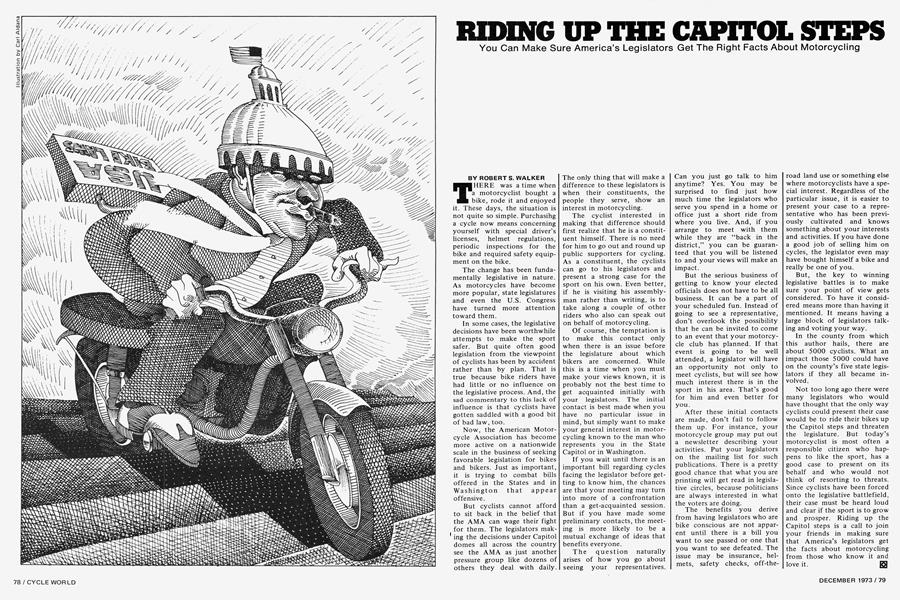
Not too long ago there were many legislators who would have thought that the only way cyclists could present their case would be to ride their bikes up the Capitol steps and threaten the legislature. But today’s motorcyclist is most often a responsible citizen who happens to like the sport, has a good case to present on its behalf and who would not think of resorting to threats. Since cyclists have been forced onto the legislative battlefield, their case must be heard loud and clear if the sport is to grow and prosper. Riding up the Capitol steps is a call to join your friends in making sure that America’s legislators get the facts about motorcycling from those who know it and love it.