Tokyo Motor Show
TOKYO MOTOR SHOW
Beauty by the Big Four
IVAN J. WAGAR
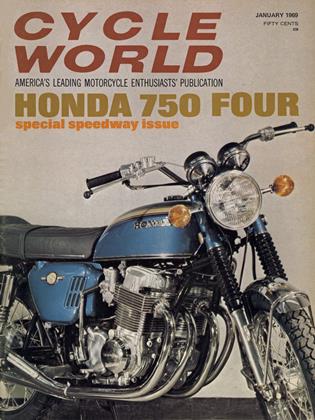
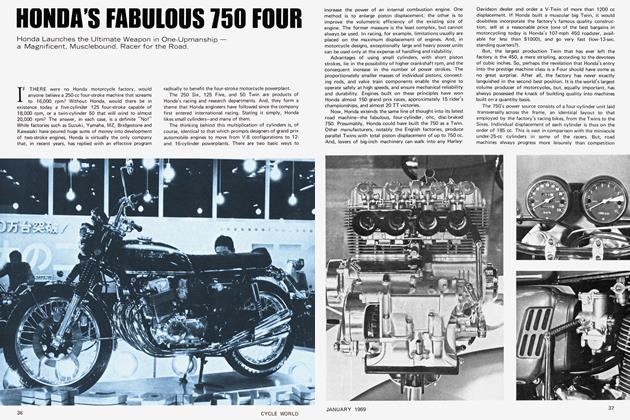
JAPANESE manufacturers traditionally use the Tokyo Motor Show to boast their wares, and display engineering talents developed during the previous year. This year, one display stood head and shoulders above all else in the show. This was Honda's exhibit, featuring the revolutionary 750 Four. Not only did Honda steal the thunder from all other motorcycle exhibits, but the firm's new air-cooled 1300-cc sedan proved the center of attraction in the adjoining auto show. The car will be exported to the U.S., like its twowheeled brother. While little technical information now is available, it's a safe bet that the 1300 will be a much sought after prize among those Americans who want something quite different.
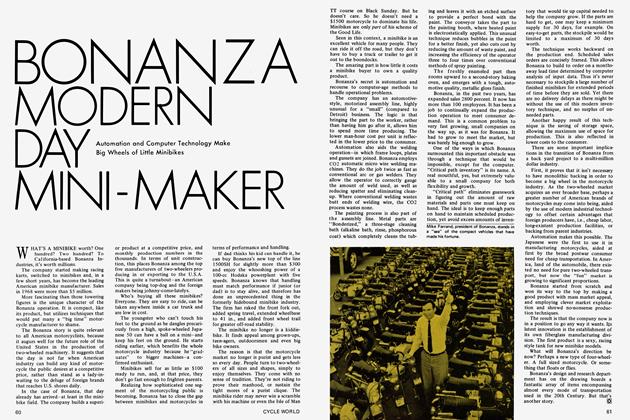
Throughout the show area were dozens of beautiful mini-skirted eijo-sans, waving wireless public address microphones and presenting very non-carnival-like spiels in soft, delicate Japanese. Even the kimono has given way to progress, and the biggest indication of progress is the fact that only four factories were represented at the 1968 Tokyo Show. Like Detroit, the Japanese motorcycle industry has shrunk in numbers from an all time high of some 50 manufacturers.
Three manufacturers tied for 2nd place in the show, and it is difficult to say which would take the honors for top of the three. The expected and long-awaited Yamaha 650 ohc Twin did not materialize. There were all sorts of rumors floating around the place, and the most likely is the possibility that the Yamaha will now become a full 750, because of the sudden muscle-flexing of “Mr. Number One.” Yamaha did, however, display some rather sensational, small displacement motorcycles. Probably the most noteworthy was a new AT-1, a scaled down version of the highly successful 250-cc DT-1. The powerplant essentially is the old YA-6, a 125 Single of almost unlimited heritage in this age of overnight, new designs, but with almost all new castings and trappings to fool the unwary. This is not a bad plan because Yamaha has managed to integrate into a single package two of the most successful machines the firm ever has produced. And, the AT-1 comes out of the marriage as a most pleasant little motorcycle, one with an almost certain road to success in the fruitful U.S. market.
The human mind boggles under the number of designations given to the various other Yamaha mini-models. The most newsworthy fact throughout the beautiful Yamaha exhibits is that a great many machines, large and small, show upswept exhaust pipes for the American market, a fad that now is quickly changing to the more pleasant downward exhaust pipe sweep.
Suzuki featured a new T 350, which actually is a 315-cc engined motorcycle. Its basic engine components are derived from the 305-cc powerplant. Styling, on the other hand, is completely different than anything produced by Suzuki in the past. There is no doubt that the parent company now is mainly concerned with the American market. The tanks are longer and flatter. The seat is tuck and roll upholstered. And, even standing still, the new styling gives the impression of brisk movement. The Suzuki display also featured an almost limitless number of new 90and 125-cc Twins. All of the little Twins, for some curious reason, had jet black extensions on the exhaust pipes which, according to all the Suzuki people queried, could be removed without affecting performance or noise level. There still is no earthly reason why these extensions were fitted in the first place. However, if Tokyo showgoers had been silly enough to try to find an answer, it usually boiled down to “rooks.”
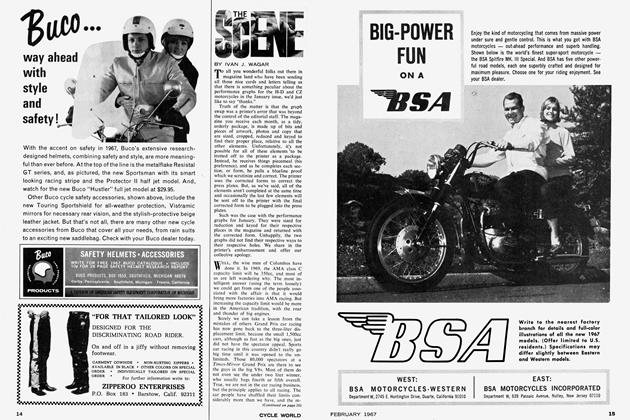
Kawasaki had nothing new to display, but outfoxed the opposition with some very beautiful background waterfalls, rock gardens and tremendous backlighted murals, all of which contributed to an outstanding exhibit. Most noteworthy among the motorcycles, which also were on display, was the new trail version of the 238-cc motocross machine. It has been a long time coming, considering the racer has provision for adapting lights, but there it was in all its glory. Unfortunately, the 250 F4 is no match for the ordinary sized motorcyclist. It virtually is impossible for a normal human to sit on the seat and touch the ground with either, let alone both feet. Unless some very drastic changes are made in the F4, before introduction to the U.S., it will die a most horrible death. At the present time ground clearance is far too great, the front fender is too close to the tire and follows the same radius, thus encouraging mud packing, the last hazard required by any enduro rider. The front fork has neither sufficient travel nor adequate damping. And, although the machine was not ridden by CW’s reporter, it is doubtful that the F4 has wheelbase dimensions suitable for a good woods bike.
The fifth Japanese manufacturer of interest to the American consumer was not represented at the Tokyo Motor Show—Bridgestone. Although Bridgestone has developed four new models for the U.S. market, the company is insistent in its policy of no home sales. The Bridgestone Tire and Rubber Co. is a very large firm in Japan. The motorcycle division represents only a small portion of total effort. Nevertheless Bridgestone has been very busy developing new models for the U.S. market. For 1969 there will be no fewer than four new models for American buyers, a fact that should dispel any rumor in regard to Bridgestone’s lack of interest in the motorcycle field.
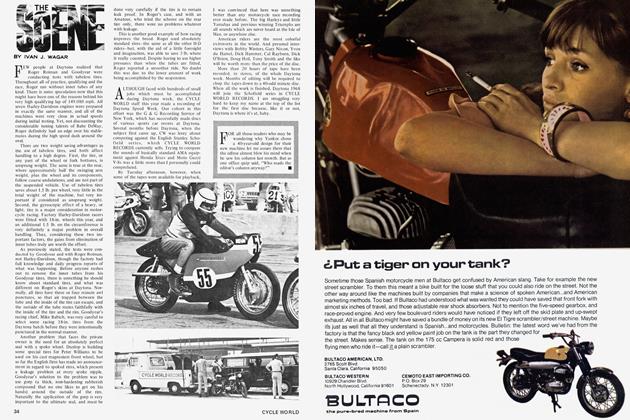
This year, there was very little emphasis on racing equipment, as compared with previous shows. Yamaha brought out a pair of rather tattered Fours, presumably just back from the 1 96 8 European series. The factory Kawasaki motocross machinery formed an impressive exhibit, while Suzuki featured a lone RH 68 motocross model, and no sign whatever of road racers. In years past, Honda especially has exhibited examples of all conquering multis with endless championship laurels hung about the place. And, while it is logical not to expect the Japanese to bask in past glory, it is sad to see the demise of these great machines.
Honda did show a road racing machine, a race-kitted CB 350, which is not built by the Honda factory, but rather by the Honda Racing Service Club, an organization based at Suzuki Circuit which race prepares cars and motorcycles. Designated the RSC, the machine is very beautiful and, except for different footpeg mountings, the frame appears to be standard. The engine, on the other hand, has an extensive list of modified parts, including a polished crankshaft and connecting rod assembly; a replacement cylinder head, which is an entirely different casting, as compared with the original component; a substitute ignition system, pistons, valves and valve springs; and very long, tapering megaphones, with the taper beginning all the way forward at the crankcase. Already the club plans to produce these high performance extras for sale through Honda dealers in Japan.
Was the Tokyo Motor Show worth the trip? You bet it was. Both Yamaha and Kawasaki have flexed muscles during the past six months. CYCLE WORLD has been up to date on previews of large displacement machines from both companies. In the long haul, however, it was still the perennial Mr. Big who produced the thrills of the 15th Tokyo Motor Show.