Cheney-Triumph
CHENEY-TRIUMPH
BRYAN KENNEY
A 242-Lb. Happening For a Familiar Engine
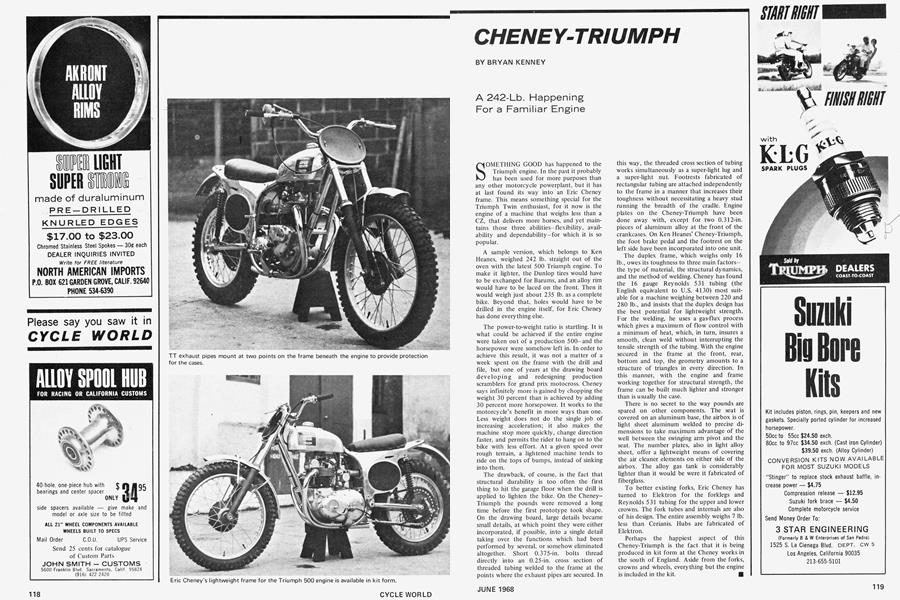
SOMETHING GOOD has happened to the Triumph engine. In the past it probably has been used for more purposes than any other motorcycle powerplant, but it has at last found its way into an Eric Cheney frame. This means something special for the Triumph Twin enthusiast, for it now is the engine of a machine that weighs less than a CZ, that delivers more horses, and yet maintains those three abilities—flexibility, availability and dependability-for which it is so popular.
A sample version, which belongs to Ken Heanes, weighed 242 lb. straight out of the oven with the latest 500 Triumph engine. To make it lighter, the Dunlop tires would have to be exchanged for Barums, and an alloy rim would have to be laced on the front. Then it would weigh just about 235 lb. as a complete bike. Beyond that, holes would have to be drilled in the engine itself, for Eric Cheney has done everything else.
The power-to-weight ratio is startling. It is what could be achieved if the entire engine were taken out of a production 500-and the horsepower were somehow left in. In order to achieve this result, it was not a matter of a week spent on the frame with the drill and file, but one of years at the drawing board developing and redesigning production scramblers for grand prix motocross. Cheney says infinitely more is gained by chopping the weight 30 percent than is achieved by adding 30 percent more horsepower. It works to the motorcycle’s benefit in more ways than one. Less weight does not do the single job of increasing acceleration; it also makes the machine stop more quickly, change direction faster, and permits the rider to hang on to the bike with less effort. At a given speed over rough terrain, a lightened machine tends to ride on the tops of bumps, instead of sinking into them.
The drawback, of course, is the fact that structural durability is too often the first thing to hit the garage floor when the drill is applied to lighten the bike. On the CheneyTriumph the pounds were removed a long time before the first prototype took shape. On the drawing board, large details became small details, at which point they were either incorporated, if possible, into a single detail taking over the functions which had been performed by several, or somehow eliminated altogether. Short 0.375-in. bolts thread directly into an 0.25-in. cross section of threaded tubing welded to the frame at the points where the exhaust pipes are secured. In this way, the threaded cross section of tubing works simultaneously as a super-light lug and a super-light nut. Footrests fabricated of rectangular tubing are attached independently to the frame in a manner that increases their toughness without necessitating a heavy stud running the breadth of the cradle. Engine plates on the Cheney-Triumph have been done away with, except for two 0.312-in. pieces of aluminum alloy at the front of the crankcases. On Ken Heanes’ Cheney-Triumph, the foot brake pedal and the footrest on the left side have been incorporated into one unit.
The duplex frame, which weighs only 16 lb., owes its toughness to three main factorsthe type of material, the Structural dynamics, and the method of welding. Cheney has found the 16 gauge Reynolds 531 tubing (the English equivalent to U.S. 4130) most suitable for a machine weighing between 220 and 280 lb., and insists that the duplex design has the best potential for lightweight strength. For the welding, he uses a gas-flux process which gives a maximum of flow control with a minimum of heat, which, in turn, insures a smooth, clean weld without interrupting the tensile strength of the tubing. With the engine secured in the frame at the front, rear, bottom and top, the geometry amounts to a structure of triangles in every direction. In this manner, with the engine and frame working together for structural strength, the frame can be built much lighter and stronger than is usually the case.
There is no secret to the way pounds are spared on other components. The seat is covered on an aluminum base, the airbox is of light sheet aluminum welded to precise dimensions to take maximum advantage of the well between the swinging arm pivot and the seat. The number plates, also in light alloy sheet, offer a lightweight means of covering the air cleaner elements on either side of the airbox. The alloy gas tank is considerably lighter than it would be were it fabricated of fiberglass.
To better existing forks, Eric Cheney has turned to Elektron for the forklegs and Reynolds 531 tubing for the upper and lower crowns. The fork tubes and internals are also of his design. The entire assembly weighs 7 lb. less than Cerianis. Hubs are fabricated of Elektron.
Perhaps the happiest aspect of this Cheney-Triumph is the fact that it is being produced in kit form at the Cheney works in the south of England. Aside from the forks, crowns and wheels, everything but the engine is included in the kit. ■