Dick Mann's Tt Prototype
DICK MANN'S TT PROTOTYPE
BRYAN KENNEY
IF YOU WANT your unit-construction twin to really handle, all you have to do is bolt it into a special frame. If you want your unit-construction twin to really perform, all you have to do is install a power kit and bolt on a splayed head. But if you are looking for both handling and performance, you are bound to discover that the special frame and the splayed head have a mighty poor. marriage rate.
Until Dick Mann found the golden means of combining these two factors, the market in special frames was offering breeds with double maintubes that ran right through the path of the splayed head manifold. Serious TT riders were faced with a choice between the splayed head and a hefty conventional frame, or a single port head and a special frame. And since
the special frames have a predisposition to be unacceptable to professional Class "C" regulations, the prevailing choice has been the combination involving the impressive head and the ponderous standard frame.
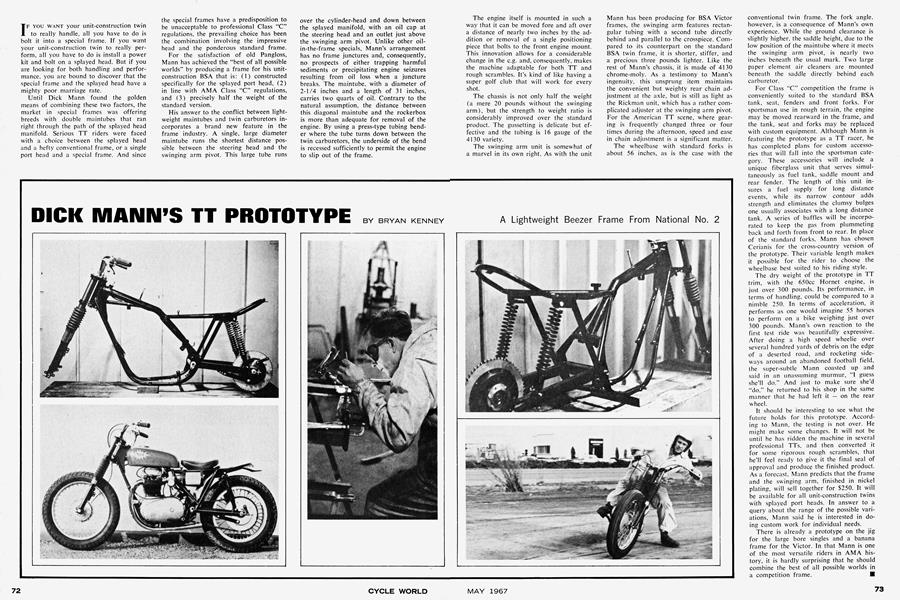
For the satisfaction of old Pangloss, Mann has achieved the "best of all possible worlds" by producing a frame for his unitconstruction BSA that is: (1) constructed specifically for the splayed port head, (2) in line with AMA Class "C" regulations, and (3) precisely half the weight of the standard version.
His answer to the conflict between lightweight maintubes and twin carburetors incorporates a brand new feature in the frame industry. A single, large diameter maintube runs the shortest distance possible between the steering head and the swinging arm pivot. This large tube runs
over the cylinder-head and down between the splayed manifold, with an oil cap at the steering head and an outlet just above the swinging arm pivot. Unlike other oilin-the-frame specials, Mann's arrangement has no frame junctures and, consequently, no prospects of either trapping harmful sediments or precipitating engine seizures resulting from oil loss when a juncture breaks. The maintube, with a diameter of 2-1/4 inches and a length of 31 inches, carries two quarts of oil. Contrary to the natural assumption, the distance between this diagonal maintube and the rockerbox is more than adequate for removal of the engine. By using a press-type tubing bender where the tube turns down between the twin carburetors, the underside of the bend is recessed sufficiently to permit the engine to slip out of the frame.
The engine itself is mounted in such a way that it can be moved fore and aft over a distance of nearly two inches by the addition or removal of a single positioning piece that bolts to the front engine mount. This innovation allows for a considerable change in the e.g. and, consequently, makes the machine adaptable for both TT and rough scrambles. It's kind of like having a super golf club that will work for every shot.
The chassis is not only half the weight (a mere 20 pounds without the swinging arm), but the strength to weight ratio is considerably improved over the standard product. The gussetting is delicate but effective and the tubing is 16 gauge of the 4130 variety.
The swinging arm unit is somewhat of a marvel in its own right. As with the unit
Mann has been producing for BSA Victor frames, the swinging arm features rectangular tubing with a second tube directly behind and parallel to the crosspiece. Compared to its counterpart on the standard BSA twin frame, it is shorter, stiffer, and a precious three pounds lighter. Like the rest of Mann's chassis, it is made of 4130 chrome-moly. As a testimony to Mann's ingenuity, this unsprung item maintains the convenient but weighty rear chain adjustment at the axle, but is still as light as the Rickman unit, which has a rather complicated adjuster at the swinging arm pivot. For the American TT scene, where gearing is frequently changed three or four times during the afternoon, speed and ease in chain adjustment is a significant matter.
The wheelbase with standard forks is about 56 inches, as is the case with the
conventional twin frame. The fork angle, however, is a consequence of Mann's own experience. While the ground clearance is slightly higher, the saddle height, due to the low position of the maintube where it meets the swinging arm pivot, is nearly two inches beneath the usual mark. Two large paper element air cleaners are mounted beneath the saddle directly behind each carburetor.
For Class "C" competition the frame is conveniently suited to the standard BSA tank, seat, fenders and front forks. For sportsman use in rough terrain, the engine may be moved rearward in the frame, and the tank, seat and forks may be replaced with custom equipment. Although Mann is featuring the prototype as a TT racer, he has completed plans for custom accessories that will fall into the sportsman category. These accessories will include a unique fiberglass unit that serves simultaneously as fuel tank, saddle mount and rear fender. The length of this unit insures a fuel supply for long distance events, while its narrow contour adds strength and eliminates the clumsy bulges one usually associates with a long distance tank. A series of baffles will be incorporated to keep the gas from plummeting back and forth from front to rear. In place of the standard forks, Mann has chosen Cerianis for the cross-country version of the prototype. Their variable length makes it possible for the rider to choose the wheelbase best suited to his riding style.
The dry weight of the prototype in TT trim, with the 650cc Hornet engine, is just over 300 pounds. Its performance, in terms of handling, could be compared to a nimble 250. In terms of acceleration, it performs as one would imagine 55 horses to perform on a bike weighing just over 300 pounds. Mann's own reaction to the first test ride was beautifully expressive. After doing a high speed wheelie over several hundred yards of debris on the edge of a deserted road, and rocketing sideways around an abandoned football field, the super-subtle Mann coasted up and said in an unassuming murmur, "I guess she'll do." And just to make sure she'd "do," he returned to his shop in the same manner that he had left it — on the rear wheel.
It should be interesting to see what the future holds for this prototype. According to Mann, the testing is not over. He might make some changes. It will not be until he has ridden the machine in several professional TTs, and then converted it for some rigorous rough scrambles, that he'll feel ready to give it the final seal of approval and produce the finished product. As a forecast, Mann predicts that the frame and the swinging arm, finished in nickel plating, will sell together for $250. It will be available for all unit-construction twins with splayed port heads. In answer to a query about the range of the possible variations, Mann said he is interested in doing custom work for individual needs.
There is already a prototype on the jig for the large bore singles and a banana frame for the Victor. In that Mann is one of the most versatile riders in AMA history, it is hardly surprising that he should combine the best of all possible worlds in a competition frame. B
A Lightweight Beezer Frame From National No. 2