Continental Report
CONTINENTAL REPORT
B. R. NICHOLLS
AFTER EIGHT WEEKS of virtual stagnation, an apparent check in the hoof and mouth epidemic has enabled the sport to pull itself up by the bootlaces and slowly get to its feet again. Initial meetings were attended only by riders who lived outside infected areas, and the ace among these was Vic Eastwood, BSA. But last weekend all riders who had scored in the first 750 Grandstand trophy meeting almost three months ago, plus Dave Bickers who was across the pond at the time, turned out to battle on a tricky little circuit in Suffolk. Some riders obviously were suffering from lack of riding, but not Bickers, who in the all important trophy race built up a big lead, only to retire when he injured his ankle. This allowed the local hero, John Banks, BSA, to repeat his win of the first meeting. He now holds the lead in the competition with a maximum of 16 points. He was followed home in the race by Bryan Wade, Greeves, with Jeff Smith, BSA, third.
Bickers went on to win the scratch race, with Smith second, while Wade won the handicap event. Eastwood's form of the earlier meetings deserted him. He went out of the trophy race with a faulty filler cap, though he finished second to Wade in the handicap race.
However, the big news of the motocross front is that the brilliantly consistent young Swedish rider Olle Pettersson, who finished third in last year's 250-cc world motocross championship, has signed to ride Suzuki in this year's championship series. The inference here is obvious; the 1968 Suzuki scrambler is a much better machine than those which previously attempted to make the grade in European motocross. It has an oversquare engine with the single port exhaust running underneath the engine, and is reputed to turn out 35 bhp. It will be interesting to see how it fares in the first round of the championships in Barcelona where Norton Villiers ex-team man Freddie Mayes will try to keep the Spanish flag flying for Montesa, the firm he signed with for 1968. Though he mainly will contest British events, he will enter one or two world championship rounds. Eastwood had been approached to ride the Montesa, but decided to stay with BSA. With a little more luck, he could be a strong candidate for world honors. Andy Robertson may switch from CZ to Husqvarna, and another youngster to watch for in '68 will be Malcolm Ballard on a Montesa.
The other rough riders who go about their business in a more sedate way, the trials men, may be without a big event for another month or more unless they cross the channel to ride in France or Belgium. Some will do this in a few weeks for the Clamart trial near Paris. Sammy Miller made the trip awhile back to win his third European Trials Championship round in a row, and to make sure of the title — provided no more events are added to the calendar. Miller won on his Bultaco with a loss of 14 marks, while behind him came the incredible 128-cc Suzuki in the hands of Peter Gaunt who lost 22 marks. Third was ex-Triumph teamster Gordon Farley, riding his works Greeves.
Best of the Europeans was Gustav Franke, 250 Zundapp, in fourth place, three marks behind Farley. Holder of the title last year in its "unofficial" capacity, Don Smith did not ride as he has semi-retired, but hopes to ride a Montesa in the Scottish six days event. Don presently is engaged in running a trials and scrambles rider school where his youngest pupil to date is an 11-year-old with his own machine.
(Continued on page 98)
The New Year started well for Mike Hailwood. Not only was he winning races in South Africa, but in the Honors List received the M.B.E. (Order of the British Empire) for his services to motorcycle racing. Jim Redman, Gary Hocking and John Surtees all are previous recipients of the award, while Freddie Frith and Geoff Duke have gained the O.B.E. This higher distinction presumably is due to the fact that they achieved world titles on British machinery.
For the Jawa concern in particular, and racing in general, tragedy struck on New Year's Eve when popular works rider Gustav Havel was involved in a fatal road accident, while riding a four-cylinder twostroke road bike. Only Franta Stastny remains for Jawa in 1968, unless they enlist the services of someone like Franta Srna, who already has some experience in grand prix racing.
The virtual withdrawal of Castrol from racing, except for its support of Honda and Hailwood, two names synonymous with success in motorcycle racing, has meant that the East German MZ concern will have to withdraw from the world championships, unless their lone rider Heinz Rosner achieves miraculous results in the early meetings to make him a title contender. Good as he is, he stands no chance against the Hondas and Yamahas, unless they break down. So it looks like curtains for the road racing section led by the brilliant Walter Kaaden. At this late stage, Derek Woodman is hunting for machinery for the 1968 season. As a parting gift, MZ gave him a complete six-speed 125-cc racer with spare engine, which he will keep for home meetings. He will contest the 350 and 500 world title classes with an AJS and a Matchless.
So there will be two 125 MZ machines on the home circuits this year, for Derek Chatterton, the British 250 champion, has ordered one from the factory. Perhaps the hardest hit by withdrawal of oil company support is Helmut Fath, the West German who builds his own four-cylinder engines for his own sidecar outfit and for John Blanchard who rode solo last year. Fortunately for them, another oil company, Duckhams, will support them in 1968.
The engines basically will be the same as in 1967, but Helmut has redesigned the cylinder heads, and spends something like 16 hours a day, 7 days a week getting ready for the coming season. As there will be no start money for British national meetings, Blanchard will ride only in international events, which include the full world championship series. If Fath has found reliability during the winter months, he has every chance of becoming world champion, a title he previously held in 1960.
Many competitors have high hopes for the new Read-Weslake engine, delivery of which is scheduled for early in the season. Weslake's design powers the Eagle car that Dan jurney drives. Gurney is no slouch on a bike either, for as long ago as 1958 he finished 21st in the Big Bear run on a 650-cc Triumph TR6, when only 204 of 863 starters finished. Harry Weslake is the sort of man so steeped in engines that one can only believe him when he says that 75 bhp from a Twin should be no great problem. The ironic thing is that when the Manx lottery was run, with the partial intention of covering the cost of a British world beater, Weslake's offer was turned down.
There has been delay in production of the engine, because originally only the engine was to be built, while now the entire unit including clutch and gearbox will be constructed. It will be a unit construction Twin with four valves per cylinder, the cylinders being inclined slightly forward. Following modern practice, it will be oversquare with a capacity of 497 cc. With the use of elektron and titanium, it is hoped to keep the weight below 100 lb.
What about a frame? Three well known riders already have ordered the engine units, and all have different ideas of what to put it in. John Hartle plans to use a Metisse frame, Peter Williams will have a Reynolds frame built by Ken Sprayson, and Australian Kel Carruthers, a Drixl pattern. Colin Seeley also intends to build a frame and this probably will be tested by Derek Minier, though Derek still maintains he will not return to racing. Many engine building schemes in the past have seemed promising and failed, but this venture has the hallmark of class stamped upon it. As soon as it has been tested, full details and photographs will be given in this column.
While the AJS scrambles machines produced by Norton Villiers now are handling much better and becoming fully competitive in the hands of Malcolm Davis, the 250-cc production road racer announced at the Earls Court Show last year now has been scrapped from the production schedule, at least for 1968. Also, the London factory at Plumstead is to close down to make way for a housing scheme. Motorcycle manufacture started in that part of London before the turn of the century. The firm now will concentrate its production in the Midlands.
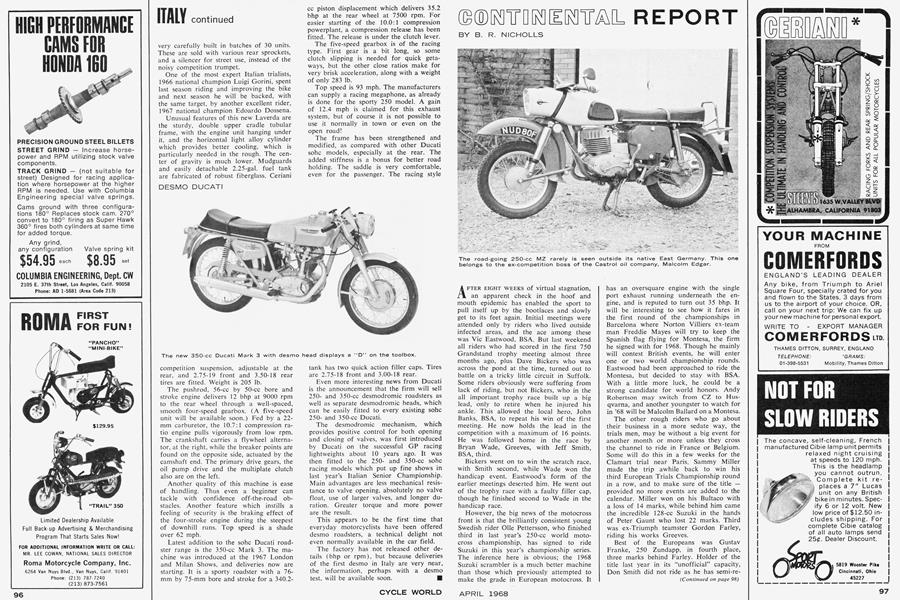
Malcolm Edgar, ex-competition manager of Castrol Ltd., has one of the most unusual machines this side of the Iron Curtain — an almost-new 250-cc MZ. Malcolm obtained the bike during one of his several trips into East Germany last year. The engine is virtually the same as the single-cylinder two-stroke unit used to power the almost invincible ISDT models. It is oversquare, with a bore and stroke of 69 mm x 65 mm. The compression ratio is only 8.5:1.
Six volt, coil ignition is fitted, and has an automatic advance/retard system. The engine runs on a 33:1 petrol mix, metered by a 1.187-in. BVF carburetor. The gear-box is a four-speeder with a fiveplate clutch.
An all-welded, single tube frame has the engine mounted in rubber, with swinging arm suspension at the rear and Earles-type leading link fork for the front.