Continental Report
CONTINENTAL REPORT
B. R. NICHOLLS
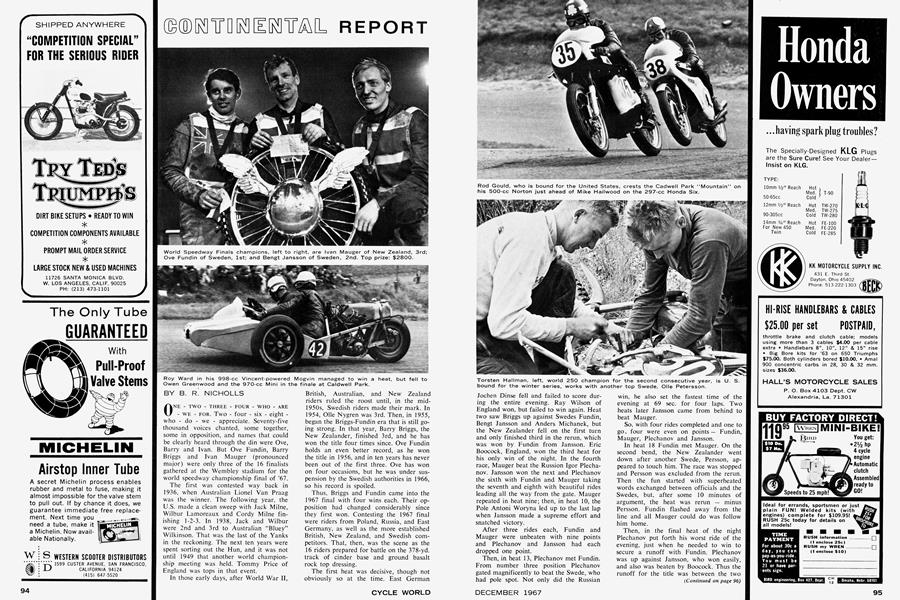
ONE - TWO - THREE - FOUR - WHO - ARE - WE - FOR. Two - four - six - eight -| who - do - we - appreciate. Seventy-five thousand voices chanted, some together, some in opposition, and names that could be clearly heard through the din were Ove, Barry and Ivan. But Ove Fundin, Barry Briggs and Ivan Mauger (pronounced major) were only three of the 16 finalists gathered at the Wembley stadium for the world speedway championship final of '67.
The first was contested way back in 1936, when Australian Lionel Van Praag was the winner. The following year, the U.S. made a clean sweep with Jack Milne, Wilbur Lamoreaux and Cordy Milne finishing 1-2-3. In 1938, Jack and Wilbur were 2nd and 3rd to Australian "Bluey" Wilkinson. That was the last of the Yanks in the reckoning. The next ten years were spent sorting out the Hun, and it was not until 1949 that another world championship meeting was held. Tommy Price of England was tops in that event.
In those early days, after World War II, British, Australian, and New Zealand riders ruled the roost until, in the mid1950s, Swedish riders made their mark. In 1954, Olle Nygren was 3rd. Then, in 1955, began the Briggs-Fundin era that is still going strong. In that year, Barry Briggs, the New Zealander, finished 3rd, and he has won the title four times since. Ove Fundin holds an even better record, as he won the title in 1956, and in ten years has never been out of the first three. Ove has won on four occasions, but he was under suspension by the Swedish authorities in 1966, so his record is spoiled.
Thus, Briggs and Fundin came into the 1967 final with four wins each. Their opposition had changed considerably since they first won. Contesting the 1967 final were riders from Poland, Russia, and East Germany, as well as the more established British, New Zealand, and Swedish competitors. That, then, was the scene as the 16 riders prepared for battle on the 378-yd. track of cinder base and ground basalt rock top dressing.
The first heat was decisive, though not obviously so at the time. East German Jochen Dinse fell and failed to score during the entire evening. Ray Wilson of England won, but failed to win again. Heat two saw Briggs up against Swedes Fundin, Bengt Jansson and Anders Michanek, but the New Zealander fell on the first turn and only finished third in the rerun, which was won by Fundin from Jansson. Eric Boocock, England, won the third heat for his only win of the night. In the fourth race, Mauger beat the Russion Igor Plechanov. Jansson won the next and Plechanov the sixth with Fundin and Mauger taking the seventh and eighth with beautiful rides leading all the way from the gate. Mauger repeated in heat nine; then, in heat 10, the Pole Antoni Woryna led up to the last lap when Jansson made a supreme effort and snatched victory.
After three rides each, Fundin and Mauger were unbeaten with nine points and Plechanov and Jansson had each dropped one point.
Then, in heat 13, Plechanov met Fundin. From number three position Plechanov gated magnificently to beat the Swede, who had pole spot. Not only did the Russian win, he also set the fastest time of the evening at 69 sec. for four laps. Two heats later Jansson came from behind to beat Mauger.
So, with four rides completed and one to go, four were even on points — Fundin, Mauger, Plechanov and Jansson.
In heat 18 Fundin met Mauger. On the second bend, the New Zealander went down after another Swede, Persson, appeared to touch him. The race was stopped and Persson was excluded from the rerun. Then the fun started with superheated words exchanged between officials and the Swedes, but, after some 10 minutes of argument, the heat was rerun — minus Persson. Fundin flashed away from the line and all Mauger could do was follow him home.
Then, in the final heat of the night Plechanov put forth his worst ride of the evening, just when he needed to win to secure a runoff with Fundin. Plechanov was up against Jansson, who won easily, and also was beaten by Boocock. Thus the runoff for the title was between the two Swedes Fundin and Jansson, and Fundin's experience gained him the title from Jansson, with Mauger 3rd and Plechanov 4th.
(Continued on page 96)
The presentation and atmosphere must be experienced to be believed with the smell of dope-burning engines, the noise and the racing under floodlights.
For the technically minded, only three JAP engines were being used. Both Fundin and Mauger used JAPs, while all the others had Czech Eso units, to which Jansson had fitted a Wal Phillips device.
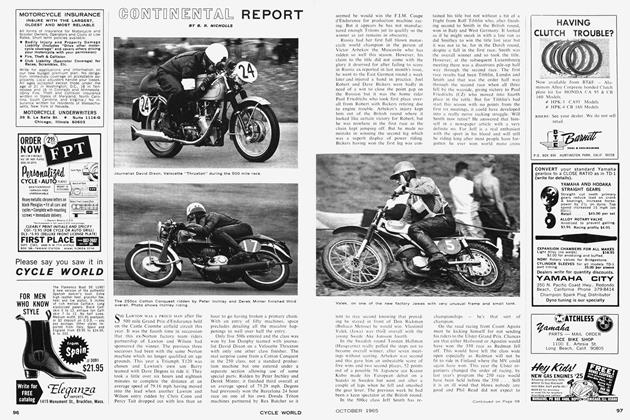
With speedway fans' appetites satisfied by the final, road racing fans were given ample rations the following day at Mallory Park. The well established annual Race of the Year brought together Hailwood, Read, Agostini, Ivy, Weil and a host of short circuit aces to battle for a first prize of £1050, almost $3000. Something over 40,000 fans crowded to the 1.35-mile circuit to see the battle of the giants and were rewarded with terrific racing and new records.
The meeting is run with heats and finals in all classes except the 125, which is run as a straight final.
Initial event was the 350-1000-cc first heat, in which Agostini astounded the crowd as he struggled to get the MV Three to fire after the remainder of the field had streaked away toward Gerard's bend. Fire it did — eventually — and Ago hurtled like a devil possessed to pull up to 5th place in five laps and so earn a place in the final.
In the large-bore final, Cooper got off to a good start on the 500 Seeley and led for three of the 20 laps before Ago swooped past him in front of the grandstand to gain an easy victory, with Cooper an equally easy second. Ray Pickrell on a 750 Dunstall Dominator engaged in a prolonged dice with Dave Croxford on a Matchless, but pulled away in the closing stages. However, Croxford never was a threat to Cooper.
Lance Weil dropped his Harley at the hairpin. He wasn't hurt but his machine was out for the rest of the day.
Far more serious was John Hartle's crash at notorious Gerard's bend. Hartle suffered a broken arm, sprains of both ankles, some broken toes and facial injuries. The crash put paid to his anticipated rides in the Canadian and Japanese GPs, and did him little good for winning a factory ride for 1968. Gerard's bend is bumpy and has a nasty groove.
The junior final saw the first major clash of the day, with Hailwood, Agostini and Read finishing in that order. However, the excitement lay in a fierce scrap for 4th. Involved, in finishing order, were Paul Smart (Aermacchi), Griff Jenkins (Norton), Ron Chandler (AJS), Rex Butcher (Norton), Dave Croxford (AJS), Dave Degens (Aermacchi), and Dan Shorey (Norton). Seven men finished within 2 sec! Hailwood set a record lap at 92.40 mph and did likewise in the 250 race at 92.05 mph. He was followed home at a respectable distance by Phil Read, who took things quietly on a four-cylinder Yamaha that he was to race in Canada. Third was Derek Woodman on an MZ.
Riders then had a short breather before the Race of the Year, sponsored by the Daily Mail. A first prize of almost $3000 and a capacity range from 175 to 1000-cc ensured a full field for racing over 30 laps. Of course Weil and Hartle were missing from the lineup because of earlier crashes.
From the fall of the flag it was the old story of Hurricane Hailwood hurtling away as if first prize was Sophia Loren instead of just money. He was never headed and rushed on to win by over 15 sec. from Agostini who took 2nd from Read on the fourth lap. They finished thus, with Cooper 4th.
Ivy borrowed Read's 251 Yamaha and, after a bad start, fought through to 5th place. He was able to emerge from a big scrap that left Dave Croxford 6th, Barry Randle 7th, and Percy Tait 8th.
Hailwood set an absolute lap record at 93.46 mph during the race.
The 125 event which followed was rather anti-climactic because Bill Ivy oiled up his Yamaha's plugs on the first lap and retired. Nevertheless it was a popular victory for Stuart Graham on the Suzuki.
To round off the meeting, the sidecar final, with entries up to 1000 cc, was dominated by 654-cc BSA outfits. World champion Klaus Enders' BMW was eliminated in his heat. Owen Greenwood's Mini and Norman Hanks' BSA retired after clashing at the hairpin. Peter Brown (BSA) raced to victory, but not without difficulty as Mick Boddice, also BSAmounted, had passed him to take the lead on the third lap. Four laps later, however, a connecting rod greeted daylight and that was that for Boddice. A week earlier, at the Cadwell Park International, the sidecar boys had taken a real shaking when the three-wheelers had got among them and produced some surprising results. The greatest of these was the first 1000-cc class race, won by Jon Worthington in his Triumph-engined device, called Scitsu. The second was won by Roy Ward in his Vincent-powered Mogvin. The fastest 15 from these two races then did battle together. The finale was won by the three-wheeler arch devil himself, Owen Greenwood, in his 970-cc Mini Special. In the 500s-only sidecar event, Tony Wakefield (BMW) won easily from his entrant, Pip Harris, also BMW mounted.
Bill Ivy walked away with the 125-event on his Yamaha and followed Hailwood home in the 250 race. Mike won again in the 350 class from Dan Shorey and Billie Nelson, both on Nortons, and then went on to prove his superiority in the 750-cc invitational event by winning with the 297cc Honda Six with Ivy's 249 Yamaha 2nd. Then came the 500 Nortons of Shorey, Rod Gould, and Nelson.
There is no doubt that Hailwood and Honda now are household names and any organizer with Mike racing is almost certain to draw a large crowd. Mike gets paid accordingly, as does Agostini when racing in England. The handsome Italian is a popular pin-up with girls aged 6 to 60. Money for supporting riders, however, is becoming scarce indeed. As previously mentioned (CW, Nov. '67), the withdrawal of start money at national meetings next season and B.P. quitting racing means there must be some serious thinking if racing is to flourish. This is where motorcycling can learn a lot from the six-day cycle race held at Earls Court. In that event, teams of riders compete against each other for the whole of the seven days, with the public watching right up to midnight. All through the week, concerns offered money prizes in addition to those listed before the event. Anyone could suddenly offer $15 for the first team to gain a lap, which meant that even the lowest placed team stood a chance of earning these extras. A similar form of bonus could become the thing in motorcycle racing, with prizes for lap leaders, especially in something like the 500-mile production race. Advertising on machines was mentioned months ago in this column. It now seems that the A-CU will start the ball rolling in a limited fashion when the matter is discussed at the next competitions committee meeting. One can only hope they will amend the rules to allow advertising and start a move to get the FIM to allow advertising in international racing.
Pat Mahoney, who was gaining quite a reputation as horizontal champion this year, for falling off nine times, has parted company with Tom Kirby, who intends to finish the season with just one solo runner, Alan Barnett, who is fast approaching top form again after sustaining a broken leg earlier in the season. Tom went over to Belgium and saw the British team win the Motocross des Nations 500-cc team event in which Vic Eastwood (BSA) played such an important part by finishing 3rd in the first race and winning the second. It was the British team's fifth win on the trot and consolation for the earlier crushing defeat in the 250 Trophy contest. The visit finally made up Tom's mind for him and he will enter a motocross team of three riders in important scrambles through the winter. The first two riders chosen are Jim Aim and Len Neve. Those two and one yet unnamed will ride Victor-powered Metisse machines.
Keeping to the rough stuff, the less said about the British effort in the ISDT the better, but all congratulations must go to the East German MZ team which won so convincingly for the fifth successive year. As a full report of the event appears elsewhere in this issue, it only remains to put the British Trophy team in perspective for, like the Americans, the cost of competition for the most part came out of riders' pockets. It was a swan song event for Johnny Giles, who has an enviable reputation in this event. Giles has ridden 14 times, always on Triumphs, and has gained 13 gold medals. Now, at age 38, he has retired. He has been all that a team man should be, dedicated, methodical, and unflurried when the pressure is on, and those qualities, combined with his mechanical knowledge and brilliant riding, mean there will be a hard to fill gap in any future ISDT.
The last of the big motocross internationals before the winter television series starts have been held. At the first, Vic Eastwood was unbeaten in the three races on his works BSA, and won from Sweden's Olle Petersson (Husqvarna), who a week later was in equally invincible form at the Daily Express-sponsored meeting. Petersson won over Belgian Sylvain Geboers (CZ), with Jeff Smith, the best home rider, in third place.
Now on absolute press deadline comes news that Shell will support motorcycle racing next year, but on a reduced scale. There will be no retainers paid to riders, but bonuses will be paid down to 6th place, instead of 3rd as previously. Shell will attend the TT, Ulster GP, Hutchinson Hundred, and 500-mile Production Race, and will extend the support given to motocross, especially the television series during the winter months. It remains to be seen what Castrol will do, but with Honda and Hailwood 'the firm has had all the publicity, and almost all the success it could want.
In the last of the big internationals held at Brands Hatch the crowd of 20,000 had the chance to see Hailwood, Agostini, Ivy, and Read in action the day after they had all raced in the Canadian GP. From Mosport Park they were whisked by helicopter to the airport, then flew by jet to London, arriving at Brands in time for the morning practice session. In Canada, Ago made sure of the 500 cc world title for the second year in succession by finishing in 2nd place to Mike Hailwood, who also won the 250 race. This was vitally important, because in beating Read, who was second, it means the championship crown will be decided in the final round to be contested in. Japan. The seven best performances by Hailwood and Read count for the title. Each has 50 points, Hailwood by virtue of five wins and a 2nd and 3rd, and Read with four wins and three 2nds. Imagine the activity in the Honda and Yamaha shops between now and race day.
At the Brands meeting, the first race was the 350. Hailwood rushed off into the distance to set a new lap and race record, with Agostini in 2nd place. Then, with no opposition in the 500 race, the crowd at Paddock Hill bend saw the new world champion drop the MV Three, and somersault across the track, out of action for the remainder of the day. Hailwood went on to win the big race, again setting lap and race records. In the absence of Ago for the 500 battle, Dan Shorey and Derek Minier, showing his form of yesteryear, battled it out on their Nortons, with Dan getting the verdict by a couple of lengths. Helmut Fath was supreme in the 500-cc sidecar class, while Chris Vincent on a 654 BSA was equally good in the larger capacity sidecar race.
Absent from the meeting was John Cooper, who had been summoned to Japan for tests on works machinery. This entire operation has been shrouded in mystery, but most people's money is on Kawasaki as the interested party. Dave Simmonds, who was thought to be No. 1 contender there, still is out of action following his Ulster GP crash. Both John Hartle and Peter Williams, who had been thought of as potential works runners, also are out with injuries.