Dirty Riot
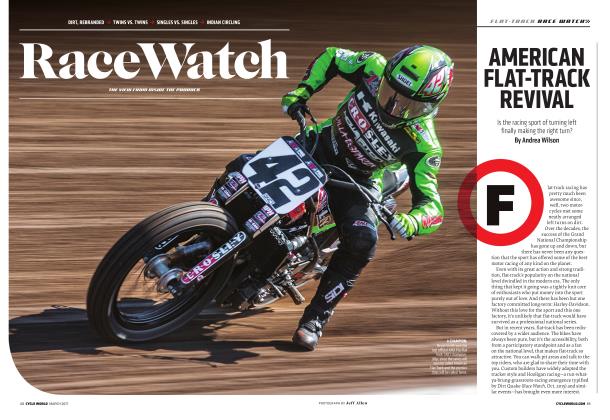
It started as flat-track racing by the people for the people, and then some above-average Joes started showing up
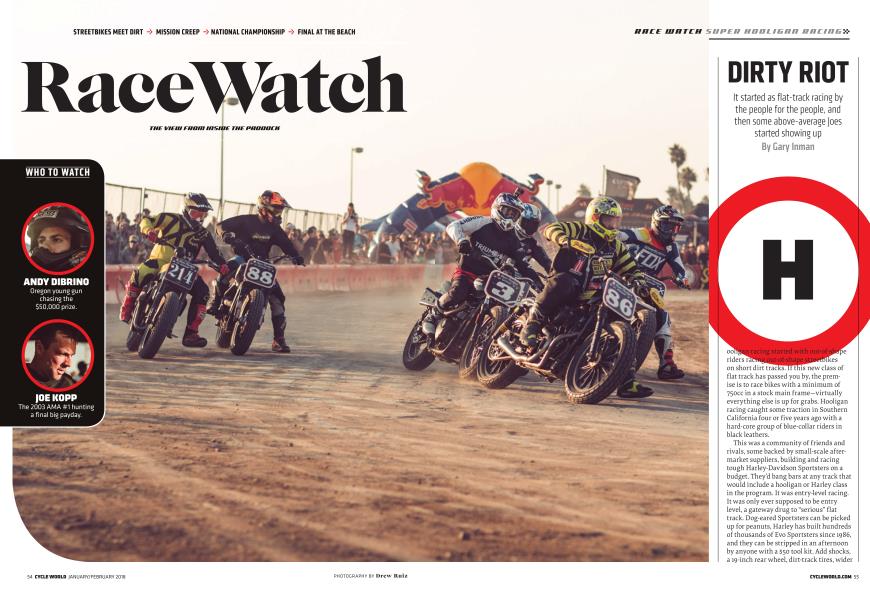
It started as flat-track racing by the people for the people, and then some above-average Joes started showing up
Race Watch
STREETBIKES MEET DIRT MISSION CREEP NATIONAL CHAMPIONSHIP FINAL AT THE BEACH
THE VIEW FROM INSIDE THE PADDOCK
WHO TO WATCH
DIRTY RIOT
SUPER HOOLIGAN RACING
It started as flat-track racing by the people for the people, and then some above-average Joes started showing up
Gary Inman
Hooligan racing started with out-of-shape riders racing out-of-shape streetbikes on short dirt tracks. If this new class of flat track has passed you by, the premise is to race bikes with a minimum of 750CC in a stock main frame—virtually everything else is up for grabs. Hooligan racing caught some traction in Southern California four or five years ago with a hard-core group of blue-collar riders in black leathers.
This was a community of friends and rivals, some backed by small-scale aftermarket suppliers, building and racing tough Harley-Davidson Sportsters on a budget. They’d bang bars at any track that would include a hooligan or Harley class in the program. It was entry-level racing. It was only ever supposed to be entry level, a gateway drug to “serious” flat track. Dog-eared Sportsters can be picked up for peanuts, Harley has built hundreds of thousands of Evo Sportsters since 1986, and they can be stripped in an afternoon by anyone with a $50 tool kit. Add shocks, a 19-inch rear wheel, dirt-track tires, wider bars, and you’re ready to race. Really.
Then something changed.
The marketability of the series was not lost on manufacturers and parts suppliers. There was no disguising that these were streetbikes out there battling. And people, young people—those gold-horned unicorns of the motorcycle market—were taking notice of the hooligans. Roland Sands converted a fleet of Indian Scout 60s into trackers and came up with the idea of the Superhooligan, a bare-knuckle bout on the undercard of the frankly terrible Superprestigio of the Americas, back in late 2015.
American Flat Track embraced the hooligans, to the disgust of some of their pro teams and riders. They didn’t want to share the limelight with no streetbike-riding clowns. The bigger picture was not being seen. AFT still kept an arm around the hooligans. After all, this emerging class was important to two of their biggest supporters: Harley and Indian. In 2016 the hooligans appeared at selected AFT rounds, at innovative inner-city races, upstart events like Flat Track Friday in Milwaukee and even the X Games.
By now Harley-Davidson was paying decent expenses to some of the original California crew and helping them travel across country and maintain their bikes, in return for guaranteed appearances at big races and, implicitly, their loyalty. Roland Sands Design and Indian were inviting big-name and less-bigname riders (including me) to jump on its bikes and raise the profile of the class. The original blue-collar feel was being diluted, but exciting things were happening. Then a seismic shift occurred. A 10-round national championship of hooligan racing was announced, organized by RSD and backed by Indian, Bell, and Dunlop. There’d be prize money at every round, plus those expenses for many of the riders, and a prize that would change everything.
“I was on the phone to Roland,” remembers Reid Wilson, Indian’s head of marketing. “I said, ‘Why don’t we give an FTR out?’ and I immediately regretted it. It was probably a little more than we expected to do, but that’s our relationship with RSD—we commit to something and we do it.”
The FTR Indian would give to the series winner is the $50,000 Indian Scout FTR750, identical to the one Jared Mees has just used to win the American Flat Track number-one plate. And out came the wolves...
“Last year, early in the summer, Roland called and asked if I wanted to race a hooligan,” says Joe Kopp, 2000 AMA Pro Flat Track champion. “He asked if I’d race an Indian at an event in Austin, Texas. That was the first I’d heard about hooligans. My first impression was that everyone was there to totally have fun. Up until then, my racing was all serious, about points and AMA nationals. [The hooligans are] racing something that isn’t made to go around a circle, fast. We’re pushing the limits of something that could slap us any second. Everybody had a great attitude in this class. Honest to God, these guys are having fun. Sure, there’s some seriousness, but they’re having a lot of fun.”
Kopp got a last-minute call to race the Indian Scout at the opening round of the inaugural Superhooligan National Championship, back in February 2017 at the indoor track in Salem, Oregon, a race that coincided with Portland’s One Motorcycle Show weekend. He was beaten by Sammy Halbert, another guest rider on an Indian. By now the regulars were upset with the pros encroaching on their territory, as they saw it, chasing the prize money and that FTR750. Meanwhile those who were being paid expenses were keeping quiet about their payments, so there was some level of hypocrisy. Some hooligan riders were earning more from flat-track than lower-ranking national numbers and all but the cream of the AFT Singles class. It has to be said that only a few of the riders were complaining; many were just enjoying the limelight and new opportunities.
The series pinballed from Oregon to Milwaukee; Georgia; California; Castle Rock, Washington; and Sturgis before four rounds in the spiritual home of the hooligans: California.
A leading pack had been established: a diverse bunch, from one end of the scale, 24-year-old Jordan Baber, an Iowan who would clock 25,000 miles just attending the season’s races, to 55-year-old semi-retired carpenter Brad Spencer. Both regular podium men, Baber with two race wins in the season. Both riders had tastes of pro flat track in their careers.
After racing the Indian at round one, Kopp was contacted by another manufacturer wanting in on the hooligan scene.
“Triumph approached me about getting a bike out there, but I told them I didn’t want to be the guy who raced every race in the series, as a pro,” Kopp said between the qualifying and heat race of the final round of the series on the beach in Southern California at Bolsa Chica State Beach.
“I talked to Roland about it, and he said, ‘Yeah, if you came out and won everything it wouldn’t be what we were looking for,’ so we purposely skipped three rounds. I was 40-something points back, I think, and a couple of guys in front of me skipped some races and then I’m only two points behind. Do I go or do I not? Then I thought I would. It’s a $50,000 motorbike. If I get that bike I’m going to put it to use or put a rider on it and put my kid on it down the road, but I’m trying not to think too far ahead.”
While Kopp had been enamored with the attitude and bonhomie of the hooligan pits, by the last round the mood had changed. The final race would take place on a pop-up track formed in the Bolsa Chica beach parking lot, sandwiched between the ocean and the Pacific Coast Highway.
RSD had tweaked the rules to make the final round a double points affair to ensure the season went down to the final lap and perhaps to stop the Kopp. Smokin’ Joe should’ve had one hand on the prize bike’s bars already, but he had a mechanical at the previous round, just the week before, on the Perris Auto Speedway half-mile, where the hooligans were, once again, a support race for the AFT Pros. I was at the race and the attitude toward the hooligans had changed markedly. Much of that is likely to be down to Kopp’s patronage of the series.
Even without Kopp on the track for the Perris main the racing was hot, with Baber taking the win on an S&S-supported Sportster.
Yes, Kopp had won some races on his Triumph Street Twin, but he wasn’t walking away with it. Anyone who made the main in the latter half of the season could hustle one of these hippos. The hooligans had, it seemed to me at least, earned the grudging respect of the pro paddock, but there was a growing animosity between the hooligans themselves.
WHILE SPORTSTERS ARE THE MOST POPULAR MACHINE, THERE ARE THE SCOUTS, HARLEY-DAVIDSON STREET XG750S, DUCATI SCRAMBLERS, KOPP’S TRIUMPH, AND EVEN A YAMAHA SCR950.
RSD’s vision for the Bolsa Chica is one that brings motorcycling into the focus of the wider public and the vision was supported by the industry at large. Three riders enter the day with a chance of winning the FTR750, Joe Kopp, 23-year-old road racer Andy DiBrino, and the granddaddy of the pack, Brad Spencer. Others, from an entry list of more than 30 have differing goals, ranging from pocketing some dough in the dash for cash to simply leaving with their ribs intact.
The first of the six heat races starts ominously, with two redflag stoppages, before things settle down. The series regulars are joined by other guest riders, including former national number Johnny Murphree, racing an RSD Sportster and looking like a class act.
While Sportsters are the most popular machine, there are the Scouts, Harley-Davidson Street XG750S, Ducati Scramblers, Kopp’s Triumph, and even a Yamaha SCR950.
All the title contenders make it through their heats by finishing first or second. Mikey “Virus” Hill, racing for the Rusty Butcher team and very much the archetypal hooligan, surprises many by winning the $1,000 dash for cash on an old Sportster. Then comes the B Main, 12 riders chasing one transfer to the A Main. It’s red flagged three— or was it four times?—before one miffed hooligan does a huge, postrace, crowd-pleasing burnout and flips off the organizers. I guess if you are going to call your series Superhooligans you can’t complain when one behaves like one.
The main sees 13 riders line up on a track not much bigger than basketball court, as the sun makes a beeline for the sea. Something like 2.7 tons of hot metal aims at the corner entry point, and all but one rider makes it around. His bike is still on the deck, rider hoping for a red flag that never comes, as the slavering pack start lap two. Early-leader Hill goes high, while Ducati-mounted Frankie Garcia squeezes through a gap on the inside. Within seconds Kopp has been T-boned by Spencer, with his Triumph is on the ground, and Spencer is way down the field. The MotoAmerica Supersport rider and Oregon regional roadrace champ, DiBrino is in third on his See See Motorcycles Harley XG750, but Baber, who is already down a lap, has tucked in behind and is giving him a hard time but not enough to put him off his stride.
The main ends Garcia, Hill, DiBrino. That’s Ducati, Harley, Harley. Kopp is sixth, Spencer 10th. There are a few tense minutes until DiBrino is confirmed as champion. He’s here with his parents and girlfriend and starts to cry, like he told me he would. “I’m going to do a season of AFT Pro Twins,” he tells me once he dries his eyes. Depending who won, Indian’s FTR750 could have been the most expensive trophy in motorcycling racing history; instead, it’s just about to help launch a pro flat-track career. Where DiBrino and the Superhooligan race series go from here is unknown, but it seems everyone will be watching closely.