Racing A Legend
Race Watch
AHRMA -> NEW JERSEY MOTORSPORTS PARK -> KENNY ROBERTS -> 144 HORSEPOWER!
RACING A LEGEND
YAMAHA TZ750
Sampling a Spondon Yamaha TZ750 roadracer at speed
Nick lenatsch
"I high-sided the TZ750 more than any other bike I’ve ridden.” Dead silence from me. I was four days away from racing Russ Bigley’s Yamaha TZ750. Kenny Roberts continued: “The thing was just so much better than the tires we could get. I’d get it in there and want to pick up the throttle and get going... It would just come around on me.”
I gulped nervously.
“I know the TZ700 [predecessor of the 750] brought on the retirement of a lot of racers,” the three-time Grand Prix World Champion continued. “Back then, those guys would run a bike into the corner at 80 miles per hour and exit at 75 miles per hour. The TZ wanted to get in at 80 and exit at too. It wanted to shake its head everywhere and you had to ride through that. A lot of those older guys couldn’t adjust.”
I’m not really ready to retire, I whispered to myself. “Urn, Kenny... How does the 750 rank on your favorite-bikes chart?” I squeaked, hoping for a glimmer of positivity about my upcoming AHRMA weekend at New Jersey Motorsports Park.
“Oh, it was my favorite until I got on the OWs, the factory stuff,” he admitted. “Before that, I couldn’t wait to get my new 750 each year. The factory did a great job of bringing it along, making it better. Those things were freight trains. The only thing that ever stopped us was little parts like the chain adjuster or something else minor breaking. Hey, on modern tires you’re going to enjoy it. It’s going to be cool.”
The King was right: It was cool. And exhilarating, and a bit frightening, and totally absorbing. Nothing gets a
rider focused like a 38-year-old two-stroke 75OCC four-cylinder that high-sided KR a few times;
I brought focus and curiosity to New Jersey Motorsports Park in equal measures.
My curiosity came from two sources. The first was the legend of the TZ750. Over the years I’ve heard stories from riders of that era, tales of headshaking tank-slappers at 175 mph toward Daytona’s chicane in a mob of 35 bikes. All my heroes got legs over the biggest TZ at some point, and I was lucky enough to see them in action at Daytona in 1984, an experience that changed my life.
The change came from the wildness of this motorcycle and the insight it gave me into the mind of a pro racer. We like to think our sport is “motorized ballet” and “grace at speed” and other poetic descriptions, but that weekend at Daytona showed me that unflinching desire and enormous courage were present in the best riders. But in 1984, at 23 years old, I had never been to an AMA race, and when two mechanics bump-started a TZ750 to life behind me I would never be the same. Three years later I bought one.
And that was the second
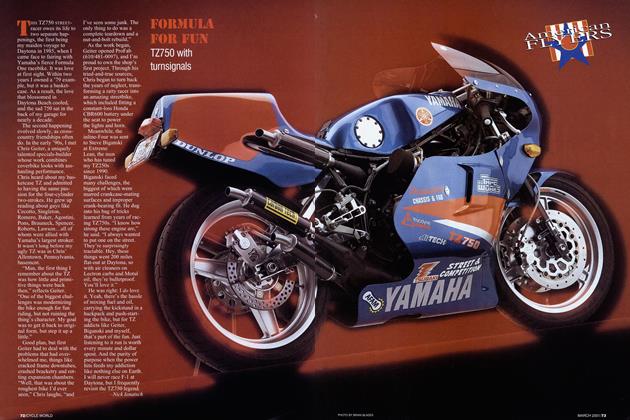
source of my curiosity. My ’79 model was built into a beautiful streetbike by Chris Geiter and Steve Biganski, and it has given me many hours of pleasure. It’s a tiny, uncomfortable, loud, stinky, smoky masterpiece of man’s desire to propel himself across the tarmac as quickly as possible with no concession to comfort or political correctness. The TZ’s raw purposefulness exposes itself in leg-burning pipes, short, low clip-ons, and minuscule seat. And every time I ride my streetbike I wonder what it would be like to race. Crazy. But how crazy? Could I master it? Was I man enough?
I was about to find out. I arrived at New Jersey like a 54-year-old kid, prepped for the opportunity of a lifetime to step into Kenny Roberts’ boots. It was not just going to meet Santa Claus but ride in his sleigh.
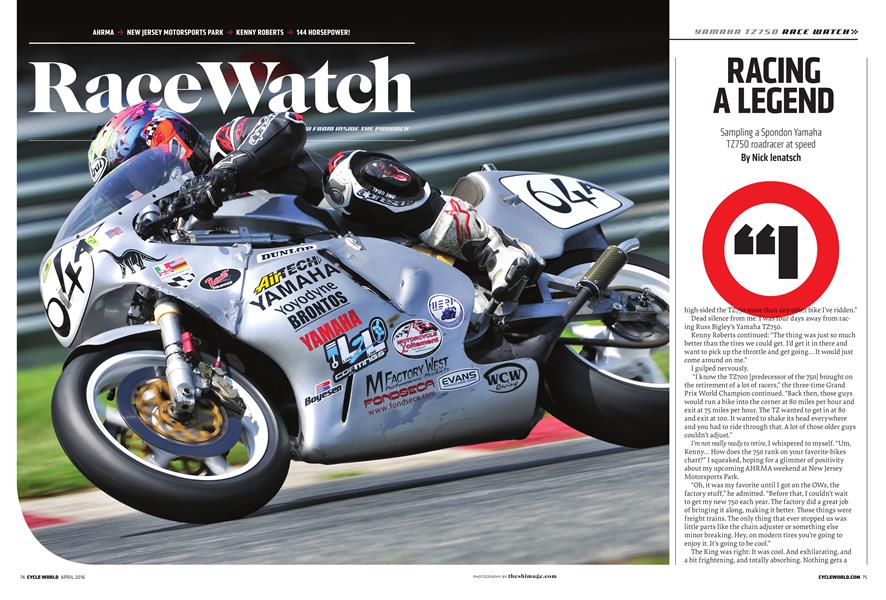
And this sleigh was special, one of only three aluminum Spondon chassis in existence. This 1983 chassis held a 1977 TZ engine with a liberal sprinkling of YZR parts put together by Russ Bigley with mentoring from Kurt Lentz. TZ followers know those names, and it’s fair to say
these two are leading the world in TZ750 development.
The bike I met at NJMP on Friday morning was not a piece of perfect jewelry primped and prettied for a show. I likened it to a veteran boxer with a bent nose and cauliflower ear. Would it still be able to take and deliver a blow? Bigley and Lentz haven’t wasted time and money with intensive paint schemes or tricky powdercoating, instead putting the effort into going, stopping, and turning.
And let me tell you, this thing goes, stops, and turns.
The going comes from 144 rear-wheel horsepower pushing 300 pounds with fuel. The power delivery is best described by imagining Jimmy Hendrix on stage with his axe plugged in and the amp at max. He strikes a single note and it’s off-key. As the discordant note blasts around the amphitheater Hendrix deftly twists the tuning peg and the tone becomes perfect, brilliant, and slices to the soul of all present. That twist of the tuning peg happens at 7,400 rpm on this TZ750, and from that moment to 10,800 rpm the music is unmatched. You want to listen to it all day.
The turning part didn’t come easily to Bigley and Lentz. “The Spondon’s front downtubes and swingarm area couldn’t handle the power we were making,” Bigley says. “We had to remake the tubes with solid stock and strengthen the swingarm pivot.”
A big step came with 17-inch wheels that could hold 120 and 180 rubber while FZR1000 chain adjusters added valuable swingarm length. An Öhlins monoshock is matched to a CBR900RR fork revalved by Evan Yarnell.
The chassis works.
The Honda runs Brembo calipers mated to a Brembo master, a vital part of the package. The bike hits so hard that lack of confidence in the brakes would be a big deterrent to life, limb, and lap times.
I entered three races at this AHRMA round: Saturday’s Open
Two-Stroke and Formula Vintage, and Sunday’s Open Two-Stroke.
Motojournalists live, or should live, in a 95 percent world. We leave something on the table because we’re rarely racing our own equipment or riding something cheap. Bigley’s TZ750 is valued north of $75,000, and I didn’t want my unpronounceable last name to be replaced with “the-guy-who-crashed-theTZ750.” Bigley told me he brought no crash spares and if I tossed it, the weekend was over.
My first two laps were cautious on this 38-year-old bike with a giant-killer legacy. By lap three the temperature was fine at 75 degrees and my brain was relaxing as my body took over. Nothing could fit in my mind except the nuances of riding a TZ750 around Thunderbolt raceway. Every moment of lapping had force in it. At no point could I simply lie on the tank and say, “Ah, this is just a relaxing motorized ballet, and I am poetry in motion.” At no point did the bike feel slow or disappointing. It was all I’d hoped for, all I’d trained for. It was the bike we all try to
own or build: too much power in a chassis that stops and turns. It wanted to wheelie or spin the tire on every exit and every corner entry was just this side of crazy:
I was enthralled.
Bigley and Lentz, guys with thousands of racing miles on TZ75OS, smiled at my immersion in this bike. They know.
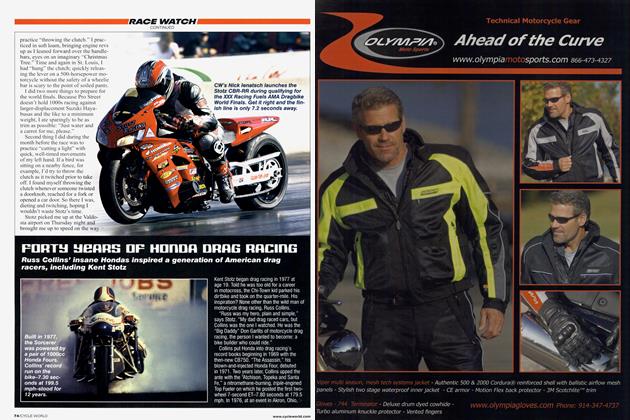
A few tweaks to the setup and we went quicker. Nothing in either of my classes could come close to Bigley’s bike, and someone said we ran the fifthor sixth-quickest laps of the weekend—not bad for a 38-year-old bike on Dunlop Q3S, considering the Panigales, EBRs, Pierobons, TZ25OS, and Bimotas also racing AHRMA. We won three of three.
The most dominant motorcycle in the two-stroke era of roadracing didn’t disappoint. It’s everything you’ve heard and read. The brutality of the power delivery in Roberts’ day has been harnessed by modern tires and the development Bigley and Lentz put into this bike. For three days in New Jersey I rode an icon and raced in Kenny Roberts’ boots on a motorcycle worthy of its legend.