A Cooler Boxer
A Cooler Boxer
BMW (carefully) liquid-cools the flat-Twin. It only took 90 years...
KEVIN CAMERON
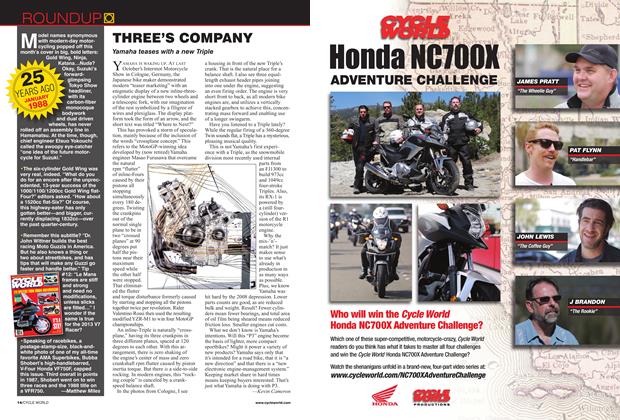
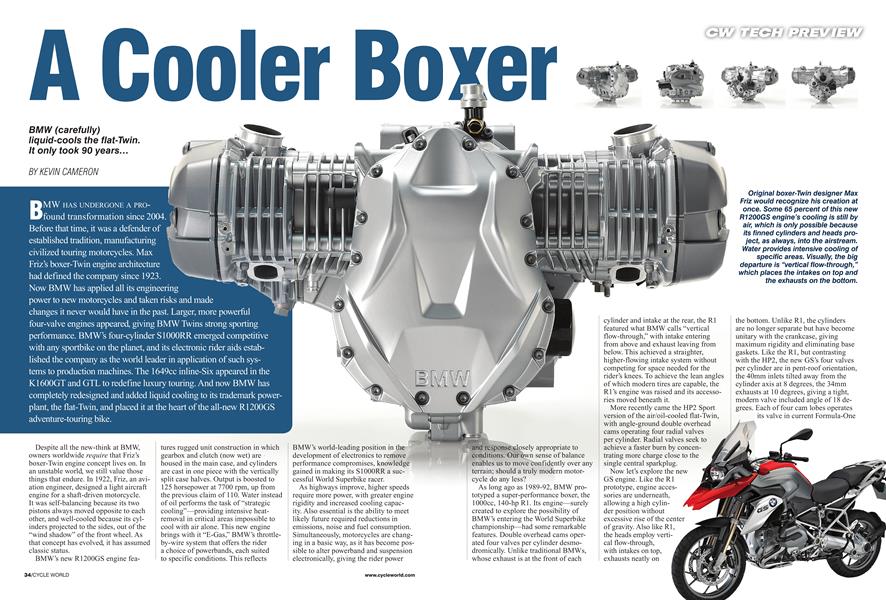
BMW HAS UNDERGONE A PROfound transformation since 2004. Before that time, it was a defender of established tradition, manufacturing civilized touring motorcycles. Max Friz's boxer-Twin engine architecture had defined the company since 1923. Now BMW has applied all its engineering power to new motorcycles and taken risks and made changes it never would have in the past. Larger, more powerful four-valve engines appeared, giving BMW Twins strong sporting performance. BMW~S four-cylinder S 1000RR emerged competitive with any sportbike on the planet, and its electronic rider aids established the company as the world leader in application of such systems to production machines. The 1649cc inline-Six appeared in the K1600GT and GTL to redefine luxury touring. And now BMW has completely redesigned and added liquid cooling to its trademark powerplant, the flat-Twin, and placed it at the heart of the all-new R1200GS adventure-touring bike.
Despite all the new-think at BMW, owners worldwide require that Friz `s boxer-Twin engine concept lives on. In an unstable world, we still value those things that endure. In 1922, Friz, an avi ation engineer, designed a light aircraft engine for a shaft-driven motorcycle. It was self-balancing because its two pistons always moved opposite to each other, and well-cooled because its cyl inders projected to the sides, out of the "wind shadow" of the front wheel. As that concept has evolved, it has assumed classic statns
BMW'S new R1200GS engine fea tures rugged unit construction in which gearbox and clutch (now wet) are housed in the main case, and cylinders are cast in one piece with the vertically split case halves. Output is boosted to 125 horsepower at 7700 rpm, up from the previous claim of 110. Water instead of oil performs the task of "strategic cooling"-providing intensive heat removal in critical areas impossible to cool with air alone. This new engine brings with it "E-Gas," BMW'S throttle by-wire system that offers the rider a choice of powerbands, each suited to specific conditions. This reflects BMW's world-leading position in the development of electronics to remove performance compromises, knowledge gained in making its Si 000RR a suc cessful World Superbike racer.
As highways improve, higher speeds require more power, with greater engine rigidity and increased cooling capac ity. Also essential is the ability to meet likely future required reductions in emissions, noise and fuel consumption. Simultaneously, motorcycles are chang ing in a basic way, as it has become pos sible to alter powerband and suspension electronically, giving the rider power and response sely appropriate to conditions. Our own sense of balance enables us to move confidently over any terrain; should a truly modern motor cycle do any less?
CW TECH PREVIEW
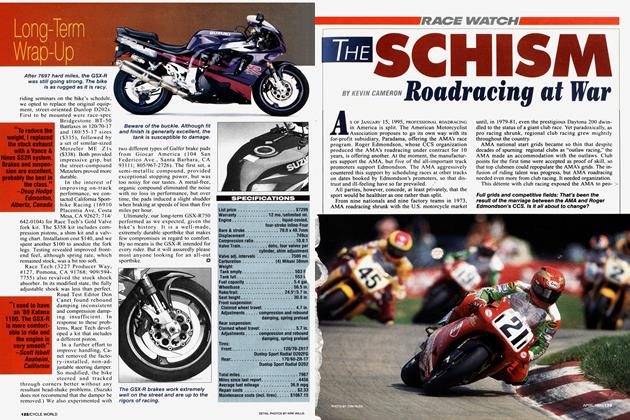
As long ago as 1989-92, BMW pro totyped a super-performance boxer, the 1000cc, 140-hp Ri. Its engine-surely created to explore the possibility of BMW's entering the World Superbike championship-had some remarkable features. Double overhead cams oper ated four valves per cylinder desmo dromically. Unlike traditional BMWs, whose exhaust is at the front of each cylinder and intake at the rear, the Ri featured what BMW calls "vertical flow-through," with intake entering from above and exhaust leaving from below. This achieved a straighter, higher-flowing intake system without competing for space needed for the rider's knees. To achieve the lean angles of which modern tires are capable, the Ri `s engine was raised and its accesso ries moved beneath it.
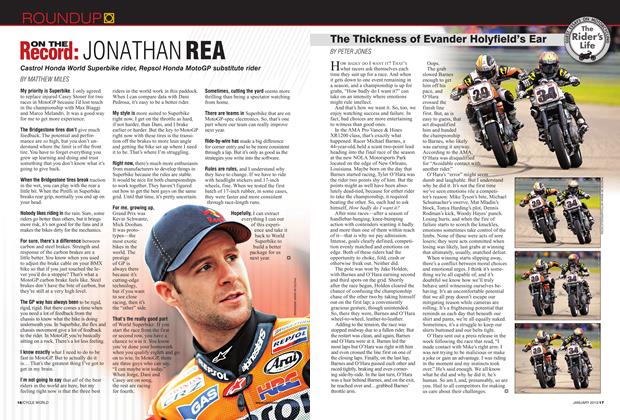
More recently came the HP2 Sport version of the air/oil-cooled flat-Twin, with angle-ground double overhead cams operating four radial valves per cylinder. Radial valves seek to achieve a faster burn by concen trating more charge close to the single central sparkplug. Now let's explore the new GS engine. Like the Ri prototype, engine acces sories are underneath, allowing a high cylin der position without excessive rise of the center of gravity. Also like Ri, the heads employ verti cal flow-through, with intakes on top, exhausts neatly on the bottom. Unlike Ri, the cylinders are no longer separate but have become unitary with the crankcase, giving maximum rigidity and eliminating base gaskets. Like the Ri, but contrasting with the HP2, the new GS `s four valves per cylinder are in pent-roof orientation, the 40mm inlets tilted away from the cylinder axis at 8 degrees, the 34mm exhausts at 10 degrees, giving a tight, modern valve included angle of 18 de grees. Each of four cam lobes operates its valve in current Formula-One style through a short, very light finger follower whose design is derived from those used on S1000RR. Valves are held to their cam profiles by helical springs. In each cylinder head are three gears. The central one is driven by a chain, and each of the two cams is geared to it. The left cylinder’s cam chain is driven from the crank, and the right cylinder’s from the engine-speed balance shaft. The fact that intake and exhaust cams are separate makes it possible that future models could incorporate variable valve timing.
In any engine, some critical cooling areas are the piston’s top ring and the narrow bridges of metal between the valve seats. With hot exhaust gas flowing very near on both sides, the bridges between exhaust seats can become so hot in purely air-cooled engines that distortion and poor sealing develop. In the nine-year-old previous R1200GS, this was prevented by circulating oil through these bridges. To extend this capability to future power levels, BMW now provides more intensive cooling by switching from oil to water as the coolant liquid. Never fear, traditionalists, 65 percent of engine cooling is still direct to air!
Reading the specifications, we see that bore and stroke remain as before at 101.0 x 73.0mm to yield 1170cc, but valve sizes have been increased by 1 millimeter on both intake and exhausts, as compared with the HP2. Doesn’t this make the critical exhaust bridges even narrower? It does, but water cooling gets the job done.
In traditional cylinder construction, the cylinder’s top deck is a solid surface, pierced by a few coolant holes. The new GS engine has open-deck construction in which a ring-shaped coolant passage surrounds the top of the bore in direct contact with the head. “We designed the open deck to enable the precision cooling of the cylinder head,” explained R1200GS Project Manager Antonius Ruhe.
Each cylinder has its own oxygen sensor, and exhaust pipes join behind the engine where a motor-controlled valve both reduces unwanted noise at certain engine speeds and also prevents out-of-phase exhaust waves from producing dips in the torque curve.
Optimum use of intake-flow velocity to generate flame-speeding turbulence has made possible knock-free operation at this model’s higher 12.5:1 compression ratio. Fast combustion outruns the processes that lead to knock. Fuel requirement is 95 RON/91 R+M/2.
The center of a boxer-Twin is its 180-degree crankshaft. Some ask why BMW does not support the center of the crank with a third main bearing. Engineer Ruhe said, “It was also a target to optimize the friction in the engine. For this reason, an additional bearing is used only if it’s necessary. In the new engine, a third main bearing is not
necessary because the boxer crankshaft is short and we reached 30 percent more crankshaft stiffness compared to the previous one.”
Ideally, the shaking forces of the two pistons would cancel each other perfectly, but because their two connecting rods must be offset from each other, piston-inertia forces twist the engine back and forth slightly around a vertical axis. “This vibration is the reason for using a balancing shaft,” said Ruhe.
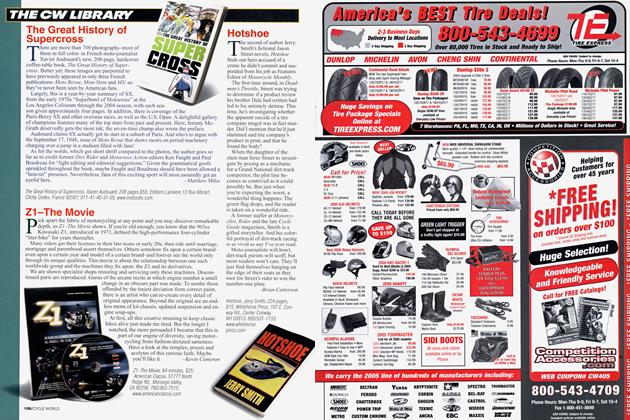
On the front of the crank is the water pump, and on the rear, a large outerrotor alternator. The crankshaft drives two concentric shafts below. The inner shaft takes engine power aft, through a cam-and-saddle torsional absorber, to the new, smaller-diameter, eight-plate ramptype slipper clutch. The outer shaft, driven at crank speed, is the balance shaft to which Ruhe refers. Earlier boxers have a single, large clutch friction disc whose considerable rotational inertia produces the traditional clack” at each upshift. A new, smaller multi-
disc clutch reduces this inertia. The single-plate clutch operated dry, but because slipper-clutch operation (BMW calls it “anti-hopping”) can generate considerable heat, the heat-dissipating ability of wet operation becomes useful. This clutch is easily serviced through the engine front cover.
The six-speed transmission is left of center, with the driveshaft. All gears are helical to reduce noise and increase
strength by placing more teeth in simultaneous mesh. A ball-bearing shift drum positions three selector forks and engaging dog rings.
All this describes how power is made, but more important today is how much it is possible to use. The latter is the purpose of racingderived electronic controls, which greatly increase the versatility and capability of this “travel enduro” motorcycle.
The key is throttle-by-wire, allowing the ECU to “understand” what the rider needs and deliver it in the rider-selected mode. As noted in the BMW text, “.. .different throttle response characteristics can be set (soft, optimum, direct), according to the intended purpose.”
A rider coping with fast-changing traction on off-road surfaces doesn’t time to visualize the engine’s torque curve at this instant’s rpm, then open the throttle to deliver the desired thrust to the rear wheel. But the ECU, performing a traction-control function, easily makes this calculation many times per second.
The higher an engine’s state of tune, the less smooth is its torque curve. Torque bumps and dips are a liability when traction is limited, but the ECU can transform the real torque curve, with its ups and downs, into something smoother by opening or closing the throttles a bit to fill in dips and trim off spikes. The result is a smooth “virtual torque curve” that the rider can use with confidence.
Once an engine has throttle-by-wire, it is just a software matter to implement cruise control (optional). With wheelspeed sensing already present for ABS, it is a small step to add traction control, which BMW calls Automatic Stability Control.
While national and international race series debate the propriety of electronic controls,
BMW has no doubt about them. Its E-Gas, Automatic Stability Control and Dynamic ESA adaptive suspension are altering the nature of the motorcycle and delivering new capability to riders.
How do you change an iconic powerplant like the BMW Boxer? Very carefully, to get what engineering needs to meet customer expectations and government regulations while not upsetting the traditional customers who will make the engine a commercial success.
The profound transformation of BMW continues, and as much as some things change, other things do not. Just as we like it. □