2013 Honda Crf 450r
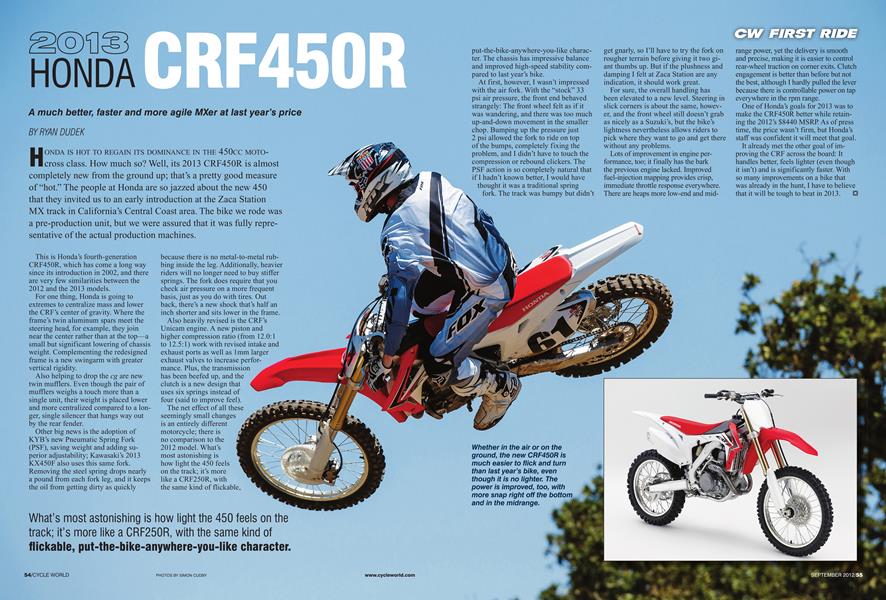
2013 HONDA CRF 450R
A much better, faster and more agile MXer at last year's price
RYAN DUDEK
HONDA IS HOT TO REGAIN ITS DOMINANCE IN THE 450CC MOTOcross class. How much so? Well, its 2013 CRF450R is almost completely new from the ground up; that's a pretty good measure of "hot." The people at Honda are so jazzed about the new 450 that they invited us to an early introduction at the Zaca Station MX track in California's Central Coast area. The bike we rode was a pre-production unit, but we were assured that it was fully representative of the actual production machines.
This is Honda’s fourth-generation CRF450R, which has come a long way since its introduction in 2002, and there are very few similarities between the 2012 and the 2013 models.
For one thing, Honda is going to extremes to centralize mass and lower the CRF’s center of gravity. Where the frame’s twin aluminum spars meet the steering head, for example, they join near the center rather than at the top—a small but significant lowering of chassis weight. Complementing the redesigned frame is a new swingarm with greater vertical rigidity.
Also helping to drop the eg are new twin mufflers. Even though the pair of mufflers weighs a touch more than a single unit, their weight is placed lower and more centralized compared to a longer, single silencer that hangs way out by the rear fender.
Other big news is the adoption of KYB’s new Pneumatic Spring Fork (PSF), saving weight and adding superior adjustability; Kawasaki’s 2013 KX450F also uses this same fork. Removing the steel spring drops nearly a pound from each fork leg, and it keeps the oil from getting dirty as quickly because there is no metal-to-metal rubbing inside the leg. Additionally, heavier riders will no longer need to buy stiffer springs. The fork does require that you check air pressure on a more frequent basis, just as you do with tires. Out back, there’s a new shock that’s half an inch shorter and sits lower in the frame.
Also heavily revised is the CRF’s Unicam engine. A new piston and higher compression ratio (from 12.0:1 to 12.5:1) work with revised intake and exhaust ports as well as 1mm larger exhaust valves to increase performance. Plus, the transmission has been beefed up, and the clutch is a new design that uses six springs instead of four (said to improve feel).
The net effect of all these seemingly small changes is an entirely different motorcycle; there is no comparison to the 2012 model. What’s most astonishing is how light the 450 feels on the track; it’s more like a CRF250R, with the same kind of flickable, put-the-bike-anywhere-you-like charac ter. The chassis has impressive balance and improved high-speed stability com pared to last year's bike.
What's most astonishing is how light the 450 feels on the track; it's more like a CRF25OR, with the same kind of flickable, put-the-bike-anywhere-you-like character.
CW FIRST RIDE
At first, however, I wasn’t impressed with the air fork. With the “stock” 33 psi air pressure, the front end behaved strangely: The front wheel felt as if it was wandering, and there was too much up-and-down movement in the smaller chop. Bumping up the pressure just 2 psi allowed the fork to ride on top of the bumps, completely fixing the problem, and I didn’t have to touch the compression or rebound clickers. The PSF action is so completely natural that if I hadn’t known better, I would have thought it was a traditional spring fork. The track was bumpy but didn’t get gnarly, so I’ll have to try the fork on rougher terrain before giving it two giant thumbs up. But if the plushness and damping I felt at Zaca Station are any indication, it should work great.
For sure, the overall handling has been elevated to a new level. Steering in slick corners is about the same, however, and the front wheel still doesn’t grab as nicely as a Suzuki’s, but the bike’s lightness nevertheless allows riders to pick where they want to go and get there without any problems.
Lots of improvement in engine performance, too; it finally has the bark the previous engine lacked. Improved fuel-injection mapping provides crisp, immediate throttle response everywhere. There are heaps more low-end and midrange power, yet the delivery is smooth and precise, making it is easier to control rear-wheel traction on corner exits. Clutch engagement is better than before but not the best, although I hardly pulled the lever because there is controllable power on tap everywhere in the rpm range.
One of Honda’s goals for 2013 was to make the CRF450R better while retaining the 2012’s $8440 MSRP. As of press time, the price wasn’t firm, but Honda’s staff was confident it will meet that goal.
It already met the other goal of improving the CRF across the board: It handles better, feels lighter (even though it isn’t) and is significantly faster. With so many improvements on a bike that was already in the hunt, I have to believe that it will be tough to beat in 2013. □