Peraves Monotracer
PERAVES MONOTRACER
One-third more aerodynamic than a Ducati World Superbike, plus a heater, seatbelts and air conditioning. A trip into the alternative universe of cabin motorcycles.
STEVE ANDERSON
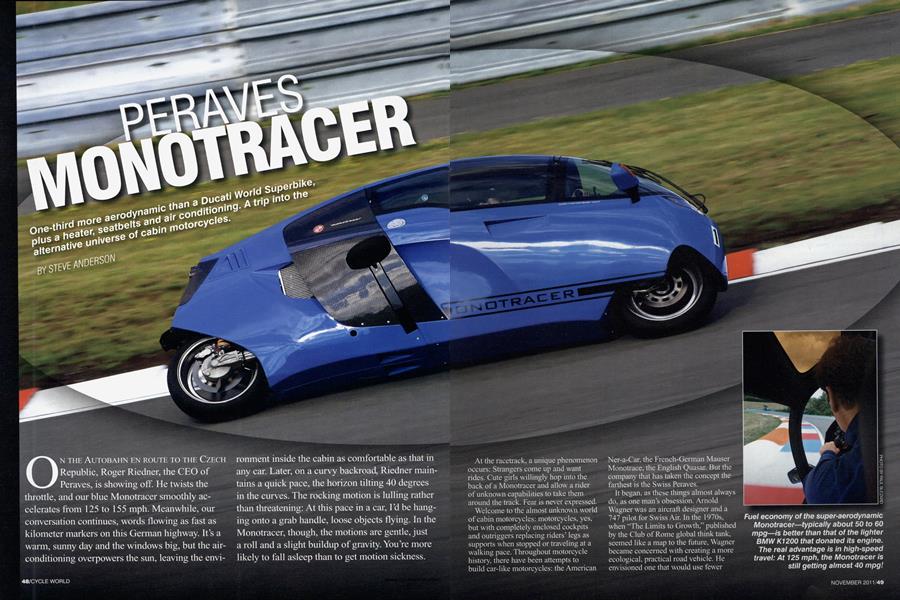
ON THE AUTOBAHN EN ROUTE TO THE CZECH Republic, Roger Riedner, the CEO of Peraves, is showing off. He twists the throttle, and our blue Monotracer smoothly accelerates from 125 to 155 mph. Meanwhile, our conversation continues, words flowing as fast as kilometer markers on this German highway. It’s a warm, sunny day and the windows big, but the airconditioning overpowers the sun, leaving the environment inside the cabin as comfortable as that in any car. Later, on a curvy backroad, Riedner maintains a quick pace, the horizon tilting 40 degrees in the curves. The rocking motion is lulling rather than threatening: At this pace in a car, I’d be hanging onto a grab handle, loose objects flying. In the Monotracer, though, the motions are gentle, just a roll and a slight buildup of gravity. Yoifre more likely to fall asleep than to get motion sickness.
At the racetrack, a unique phenomenon occurs: Strangers come up and want rides. Cute girls willingly hop into the back of a Monotracer and allow a rider of unknown capabilities to take them around the track. Fear is never expressed.
Welcome to the almost unknown world of cabin motorcycles: motorcycles, yes, but with completely enclosed cockpits and outriggers replacing riders’ legs as supports when stopped or traveling at a walking pace. Throughout motorcycle history, there have been attempts to build car-like motorcycles: the American Ner-a-Car, the French-German Mauser Monotrace, the English Quasar. But the company that has taken the concept the farthest is the Swiss Peraves.
It began, as these things almost always do, as one man’s obsession. Arnold Wagner was an aircraft designer and a 747 pilot for Swiss Air. In the 1970s, when “The Limits to Growth,” published by the Club of Rome global think tank, seemed like a map to the future, Wagner became concerned with creating a more ecological, practical road vehicle. He envisioned one that would use fewer
resources to build and operate than existing automobiles, and that would be more useful than existing motorcycles.
With international flight rules only allowing Wagner to fly 40 hours a month, he had time to experiment. The result of several years of his efforts emerged from a tiny garage in Winterthur, Switzerland: the first Ecomobile, a two-seat, egg-shaped, very aerodynamic cabin motorcycle of great length, powered by a BMW K100 Four and supported by cleverly designed outrigger wheels. By 1984, Wagner’s Peraves Company had the Ecomobile in very limited production and would produce 120 of them over the next 20 years. That first Ecomobile would set the pattern for all Peraves cabin motorcycles to follow.
Given Wagner’s background, it’s hardly surprising that aerodynamics were a priority or that the Ecomobile would resemble a cross between a motorcycle and a h i gh -performance Swiss glider. The bubble windshield and pop-up, one-piece door were very aircraft-like. The construction—layer
upon layer of high-strength fabric and epoxy, with foam and metal inserts in select areas for strength—was exactly that of gliders and other experimental private aircraft. The Ecomobile was a true monocoque, with the composite outer skin the chassis, connecting at a bulkhead aft of the passenger seat to a steel subframe that supported the BMW powerplant and swingarm.
In their design details, the outriggers are ingenious, operated by the rider via a toggle switch that activates a starter motor (BMW, of course). In the upright position, they’re fixed hard against supports anchored to the bulkhead and touch down only when lean angles reach the limit of tire traction (about 47 degrees in the Ecomobile, 52 in the Monotracer). Coming to a stop, a rider can deploy the outriggers in half a second with the push of a button—but only at speeds less than 18 mph—quickly turning the Eco from a leaning, monotrack vehicle to a slightly cumbersome but stable fourwheeled cart. An extreme amount of steering lock allows Peraves vehicles to make U-turns with outriggers down on narrow European roads.
But the Ecomobile had a few issues. It was incredibly labor-intensive to build and required a BMW K100 as a donor vehicle. And they were expensive: Some cost nearly 100,000 Euros, more than $140,000 at the prevailing exchange rate. But their owners have loved and used them; many Ecomobiles have traveled 60,000 to more than 100,000 miles.
Which leads us to the Monotracer, created to be what the Ecomobile wasn’t: stylish, easier to produce and even more aerodynamic. The Monotracer has a CdA—drag coefficient (Cd) times frontal area (A)—of 0.19 meters-squared, a figure that motorcycling hasn’t seen since the dustbin fairings on Moto Guzzi racebikes of the 1950s. The best of the current World Superbikes is likely the Ducati 1098R at about 0.3 meterssquared; this means the Monotracer can achieve the same speed as the Ducati with one-third less power.
The efficiency of a Monotracer was critical to Peraves. The company had become heavily indebted building Ecomobiles, so it threw a hail-Mary pass and entered an electric version of the Monotracer in the 2010 Progressive Insurance X-Prize—a $10 million competition intended to demonstrate that 100 mpge (miles per gallon or gasoline equivalent energy) is achievable in useful road vehicles.
Wagner’s four-person company finished the “E-Tracer” in just 3 months, gave its all-new electric drivetrain a 15-minute test, shipped it to the U.S. for the competition—and kicked ass. Competing against prototypes from universities and other small companies, the E-Tracer benefited from Peraves’ 25 years of experience and ran away with the “Alternative Tandem” class, achieving the equivalent of 203.5 mpg on its electric power, all while offering performance (150-plus-mph top speed, 0-60 acceleration under 5 seconds) that no one else at this fuel-economy contest could approach. The $2.5 million check Peraves took home, along with the publicity, gave the company a new lease on life.
“You have to consciously give the Monotracer the correct countersteering input, and in that regard, it’s a master class in motorcycling. Time spent in a Monotracer will translate to better riding on any other motorcycle.”
Which is how I found myself riding with Riedner to the annual Peraves owners’ reunion and new-rider training sessions at the Brno GP circuit in the Czech Republic. I had been following the progress of the Ecomobile and Monotracer for years and always wondered what it would be like to ride in and pilot one. This was my opportunity.
In person, the Monotracer looked impressive, the exterior shapes crisp and futuristic, the interior well-finished and appointed. The rider sits forward in a comfortable if narrow seat with a carbon-fiber frame, the seat back slightly reclined, the main seat cushion tilted up in the front, the rider’s knees bent. The
passenger gets to stretch his or her legs on either side of the rider’s seat while sitting a little higher than the pilot; a six-footer can be quite comfortable in the back, with headroom to spare. Three-point seat belts are provided for passenger and rider; in Europe, no helmet is required. The extensive windshields leave the cockpit airy, not at all claustrophobic. The luggage space in the cubby behind the passenger’s head fits an impressive amount: A 24-inch hard suitcase just slides in with room for a laptop bag above it, and a small duffle fits between the hard bag and the passenger’s headrest.
Highway travel is reasonably quiet:
I measured 81 decibels at 65 mph and 83 at 75 mph—more Mazda Miata than Mercedes, but a lot less than the 100plus decibels inside a helmet at the same speed on a conventional bike. Much of the interior noise is the four-cylinder boom of the BMW K1200 engine.
At Brno, the most interesting question would be answered: What’s it like to pilot the Monotracer? The Peraves vehicles have gained a reputation for having a steep learning curve, in part because the control configuration is unique. There’s a conventional handlebar and a right-hand brake lever that’s for emergency use only.
The main brake control is a pedal for the right foot, operating a linked brake system with ABS. The clutch is operated by a left-foot pedal and requires a lifted-foot stab rather than the rocking-from-theheel motion more typical in a manualtransmission car. The gearshift is electric, controlled via a rocker switch by the left forefinger. The left thumb activates the toggle for the outriggers.
I first trundled around the parking lot learning all this under the tutelage of English journalist and friend-of-the-company Paul Blezard. After an hour or so of control practice, it was time to try to lift the outriggers for a brief straight-line excursion. My first lift wasn’t graceful: The Monotracer was leaning to the left slightly as the outriggers came up, and it began turning and falling to the left. I steered left immediately, caught the roll and over-corrected to the right—then caught that, found balance and set the outriggers down again. After a half-dozen smoother repeats, I proceeded to try turns around the pit parking lot. By the next morning,
I was off the training wheels (which limit maximum lean-angle—or maximum fall—to just 15 degrees) and out on the Brno circuit.
My experience wasn’t anything like that of the other five people taking the Monotracer training, some of them very experienced motorcyclists. They repeatedly dropped the student Monotracer onto its training wheels, and some of them were still shaky after four days. The difference seems to be how instinctual countersteering is. Ever since an unfortunate club-racing crash in the late 1970s when I applied the wrong steering input in a tight situation, I’ve actively and consciously practiced countersteering on motorcycles. So, when the Monotracer began falling and turning to the left, I didn’t even have to think to apply more left steering to correct it. When you’re strapped into a seat, the usual motorcycle rider practice of shifting body position (and countersteering by pushing forward on the inside handlebar as the body shifts to the inside) isn’t an option. You have to consciously give the Monotracer the correct countersteering input, and in that regard, it’s a master class in motorcycling. Time spent in a Monotracer will translate to better riding on any other motorcycle.
Once you understand that the Monotracer is only going to respond to countersteering, it's just a big, long, somewhat heavy motorcycle. Its center of gravity is low and it rolls quickly, its mass concentrated near its roll axis. On the track, it was very stable both in cor ners and in a straight line. It leans in re sponse to side winds, which was notice able but not particularly disturbing one gusty day. Extensive testing by Peraves at German car-company test facilities has shown that a Monotracer is deflect ed from its path considerably less than BMW K1200LT in response to a strong side wind. The reason, explains Peraves technical head Steven van den Berghe, is that even the lateral drag coefficient of the curvy Monotracer is lower than that of a conventional motorcycle.
There is, of course, an important social difference between a Monotracer and a conventional motorcycle: the perception of risk. Blezard and I took turns piloting a Monotracer on the Brno circuit, the rear-seat passenger snapping over-the-shoulder pictures as we were underway, again with conversation flowing. Neither of us would have been willing to do the same on the back of a conventional motorcycle with a rider we didn’t know well. The most common racetrack garb of the Monotracer riders was short pants and T-shirt; helmet use was actually forbidden. And while there were several loss-of-control incidents during the Brno event, the worst damage was scraped bodywork when a Monotracer did a three-point slide (two tire contact patches and the up-position outrigger) into the pea-gravel traps waiting offtrack. But no occupants had as much as a scratch or a bruise.
“Once you’ve stopped someplace, be it gas station or whatever, you draw a crowd; If you’re seeking attention, a Monotracer will undoubtedly trump the most exotic Lamborghini or Ferrari.”
After a couple of days of track time, I took a Monotracer onto public roads. Autobahn travel was uneventful, other than cars coming close to take pictures of a vehicle that is exotic anyplace. Workload for a relatively inexperienced rider is high, as you’re always thinking about when to pop the outriggers down. Experienced Peraves pilots keep them up until the last conceivable moment, because a Monotracer is more pleasant to steer as a motorcycle than as a kart. But you don’t want to tip over, either, so the rule for newbies is: When in doubt, deploy outriggers. Once you’ve stopped someplace, be it gas station or whatever, you draw a crowd; if you’re seeking attention, a Monotracer will undoubtedly trump the most exotic Lamborghini or Ferrari.
The most important thing that a Peraves Monotracer does, however, is expand the range of possibilities for motorcycles. If you’d told me before I had a chance to ride one that a streamlined, enclosed motorcycle could be built with a rear-mounted engine and a 115-inch wheelbase without stability and control issues, I’d have been doubtful. But after riding one, the only thing I’m sure of is this: I want one.