Versahaul Sport Motorcycle Carrier
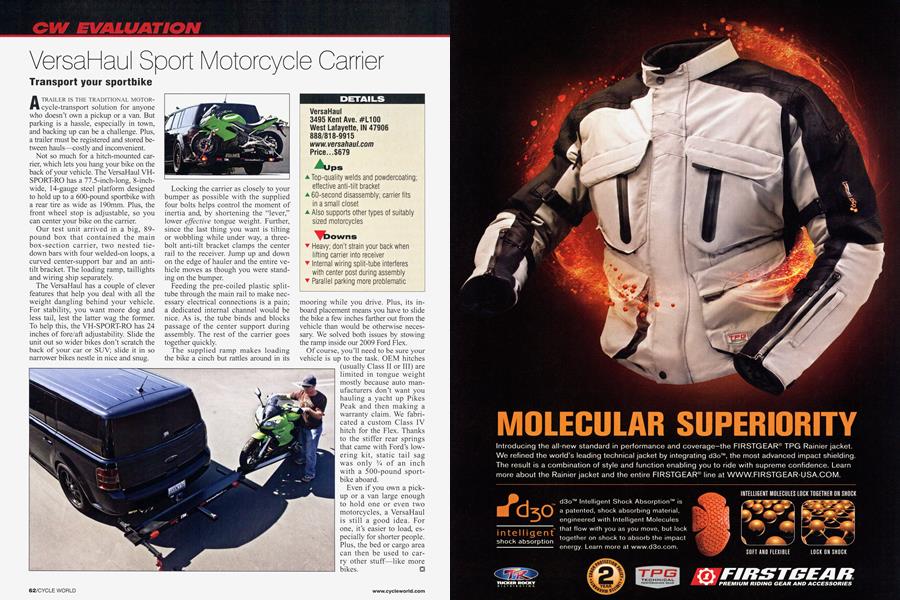
VersaHaul Sport Motorcycle Carrier
CW EVALUATION
Transport your sportbike
A TRAILER IS THE TRADITIONAL MOTORcycle-transport solution for anyone who doesn’t own a pickup or a van. But parking is a hassle, especially in town, and backing up can be a challenge. Plus, a trailer must be registered and stored between hauls—costly and inconvenient.
Not so much for a hitch-mounted carrier, which lets you hang your bike on the back of your vehicle. The VersaHaul VHSPORT-RO has a 77.5-inch-long, 8-inchwide, 14-gauge steel platform designed to hold up to a 600-pound sportbike with a rear tire as wide as 190mm. Plus, the front wheel stop is adjustable, so you can center your bike on the carrier.
Our test unit arrived in a big, 89pound box that contained the main box-section carrier, two nested tiedown bars with four welded-on loops, a curved center-support bar and an antitilt bracket. The loading ramp, taillights and wiring ship separately.
The VersaHaul has a couple of clever features that help you deal with all the weight dangling behind your vehicle. For stability, you want more dog and less tail, lest the latter wag the former. To help this, the VH-SPORT-RO has 24 inches of fore/aft adjustability. Slide the unit out so wider bikes don’t scratch the back of your car or SUV; slide it in so narrower bikes nestle in nice and snug.
Locking the carrier as closely to your bumper as possible with the supplied four bolts helps control the moment of inertia and, by shortening the “lever,” lower effective tongue weight. Further, since the last thing you want is tilting or wobbling while under way, a threebolt anti-tilt bracket clamps the center rail to the receiver. Jump up and down on the edge of hauler and the entire vehicle moves as though you were standing on the bumper.
Feeding the pre-coiled plastic splittube through the main rail to make necessary electrical connections is a pain; a dedicated internal channel would be nice. As is, the tube binds and blocks passage of the center support during assembly. The rest of the carrier goes together quickly.
The supplied ramp makes loading the bike a cinch but rattles around in its
mooring while you drive. Plus, its inboard placement means you have to slide the bike a few inches farther out from the vehicle than would be otherwise necessary. We solved both issues by stowing the ramp inside our 2009 Ford Flex.
Of course, you’ll need to be sure your vehicle is up to the task. OEM hitches (usually Class II or III) are limited in tongue weight mostly because auto manufacturers don’t want you hauling a yacht up Pikes Peak and then making a warranty claim. We fabricated a custom Class IV hitch for the Flex. Thanks to the stiffer rear springs that came with Ford’s lowering kit, static tail sag was only 3A of an inch with a 500-pound sportbike aboard.
Even if you own a pickup or a van large enough to hold one or even two motorcycles, a VersaHaul is still a good idea. For one, it’s easier to load, especially for shorter people. Plus, the bed or cargo area can then be used to carry other stuff—like more bikes. □
DETAILS
VersaHaul 3495 Kent Ave. #L100 West Lafayette, IN 47906 888/818-9915 www.versahaul.com Price...$679
Ups A Top-quality welds and powdercoating: effective anti-tilt bracket A 60-second disassembly; carrier fits in a small closet A Also supports other types of suitably sized motorcycles
Downs ▼ Heavy; don’t strain your back when lifting carrier into receiver ▼ Internal wiring split-tube interferes with center post during assembly ▼ Parallel parking more problematic