Öhlins Ttx36 Shock
Öhlins TTX36 Shock
CW EVALUATION
Turning and burning
LAST YEAR’S SUPERBIKE SHOOTOUT (“Turn & Burn,” July, 2008) looked like a runaway win for the all-new Honda CBR1000RR. But with set-up time limited by the volume of street, topspeed and track testing (eight bikes!), the big CBR produced only the sixthbest lap time at Miller Motorsports Park in Tooele, Utah. The performance of the stock Showa shock was fine on the street but left us wanting a greater range of adjustability for track use.
For a possible solution, Öhlins shipped us its latest shock, the
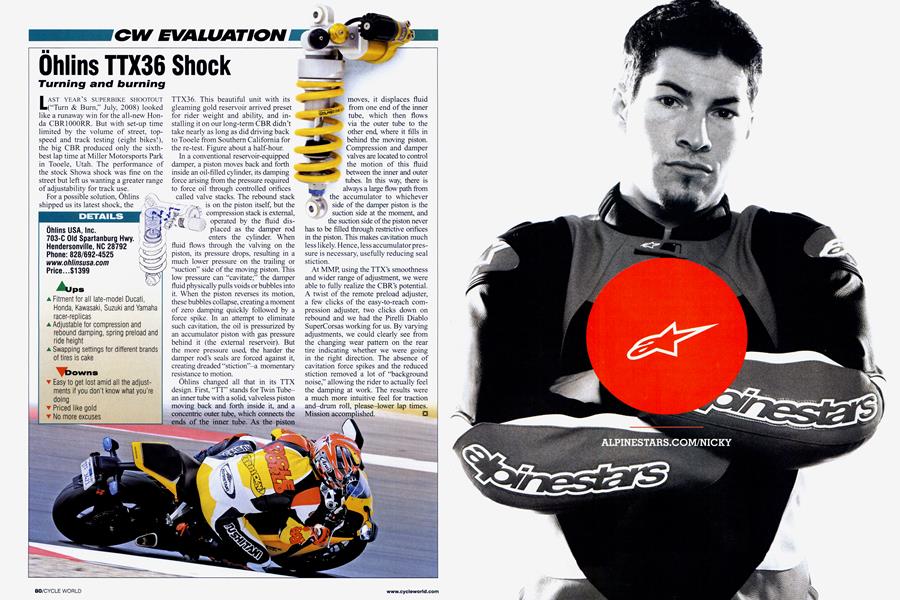
TTX36. This beautiful unit with its gleaming gold reservoir arrived preset for rider weight and ability, and installing it on our long-term CBR didn’t take nearly as long as did driving back to Tooele from Southern California for the re-test. Figure about a half-hour.
In a conventional reservoir-equipped damper, a piston moves back and forth inside an oil-filled cylinder, its damping force arising from the pressure required to force oil through controlled orifices called valve stacks. The rebound stack is on the piston itself, but the compression stack is external, operated by the fluid displaced as the damper rod enters the cylinder. When fluid flows through the valving on the piston, its pressure drops, resulting in a much lower pressure on the trailing or “suction” side of the moving piston. This low pressure can “cavitate;” the damper fluid physically pulls voids or bubbles into it. When the piston reverses its motion, these bubbles collapse, creating a moment of zero damping quickly followed by a force spike. In an attempt to eliminate such cavitation, the oil is pressurized by an accumulator piston with gas pressure behind it (the external reservoir). But the more pressure used, the harder the damper rod’s seals are forced against it, creating dreaded “stiction”-a momentary resistance to motion.
Öhlins changed all that in its TTX design. First, “XT” stands for Twin Tubean inner tube with a solid, valveless piston moving back and forth inside it, and a concentric outer tube, which connects the ends of the inner tube. As the piston
moves, it displaces fluid from one end of the inner tube, which then flows via the outer tube to the other end, where it fills in behind the moving piston. Compression and damper valves are located to control the motion of this fluid between the inner and outer tubes. In this way, there is always a large flow path from the accumulator to whichever side of the damper piston is the suction side at the moment, and the suction side of the piston never has to be filled through restrictive orifices in the piston. This makes cavitation much less likely. Hence, less accumulator pressure is necessary, usefully reducing seal stiction.
At MMP, using the TTX’s smoothness and wider range of adjustment, we were able to fully realize the CBR’s potential. A twist of the remote preload adjuster, a few clicks of the easy-to-reach compression adjuster, two clicks down on rebound and we had the Pirelli Diablo SuperCorsas working for us. By varying adjustments, we could clearly see from the changing wear pattern on the rear tire indicating whether we were going in the right direction. The absence of cavitation force spikes and the reduced stiction removed a lot of “background noise,” allowing the rider to actually feel the damping at work. The results were a much more intuitive feel for traction and-drum roll, please-lower lap times. Mission
DETAILS
Öhlins USA, Inc.
703-C Old Spartanburg Hwy.
Hendersonville, NC 28792
Phone: 828/692-4525
www.ohlinsusa.com
Price...$1399
^Llps
A Fitment for ail late-model Ducati, Honda, Kawasaki, Suzuki and Yamaha racer-replicas
A Adjustable for compression and rebound damping, spring preload and ride height
A Swapping settings for different brands of tires is cake
Downs
▼ Easy to get lost amid all the adjustments if you don’t know what you’re doing
▼ Priced like gold
▼ No more excuses