Poking Potatoes
Poking potatoes
TDC
Kevin Cameron
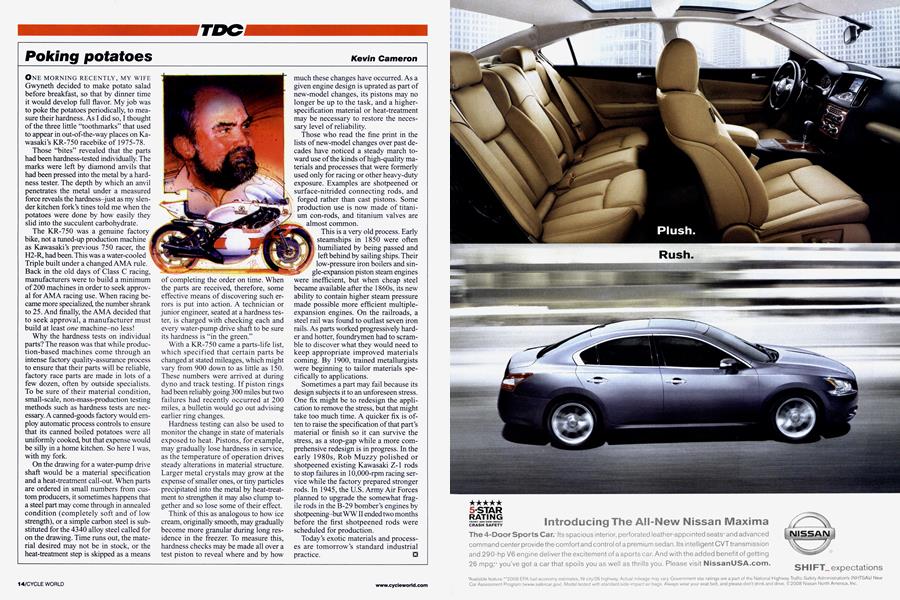
ONE MORNING RECENTLY, MY WIFE Gwyneth decided to make potato salad before breakfast, so that by dinner time it would develop full flavor. My job was to poke the potatoes periodically, to measure their hardness. As I did so, I thought of the three little “toothmarks” that used to appear in out-of-the-way places on Kawasaki’s KR-750 racebike of 1975-78.
Those “bites” revealed that the parts had been hardness-tested individually. The marks were left by diamond anvils that had been pressed into the metal by a hardness tester. The depth by which an anvil penetrates the metal under a measured force reveals the hardness-just as my slender kitchen fork’s tines told me when the potatoes were done by how easily they slid into the succulent carbohydrate.
The KR-750 was a genuine factory bike, not a tuned-up production machine as Kawasaki’s previous 750 racer, the H2-R, had been. This was a water-cooled Triple built under a changed AMA rule Back in the old days of Class C racing, manufacturers were to build a minimum of 200 machines in order to seek approval for AMA racing use. When racing became more specialized, the number shrank to 25. And finally, the AMA decided that to seek approval, a manufacturer must build at least one machine-no less!
Why the hardness tests on individual parts? The reason was that while production-based machines come through an intense factory quality-assurance process to ensure that their parts will be reliable, factory race parts are made in lots of a few dozen, often by outside specialists. To be sure of their material condition, small-scale, non-mass-production testing methods such as hardness tests are necessary. A canned-goods factory would employ automatic process controls to ensure that its canned boiled potatoes were all uniformly cooked, but that expense would be silly in a home kitchen. So here I was, with my fork.
On the drawing for a water-pump drive shaft would be a material specification and a heat-treatment call-out. When parts are ordered in small numbers from custom producers, it sometimes happens that a steel part may come through in annealed condition (completely soft and of low strength), or a simple carbon steel is substituted for the 4340 alloy steel called for on the drawing. Time runs out, the material desired may not be in stock, or the heat-treatment step is skipped as a means
of completing the order on time. When the parts are received, therefore, some effective means of discovering such errors is put into action. A technician or junior engineer, seated at a hardness tester, is charged with checking each and every water-pump drive shaft to be sure its hardness is “in the green.”
With a KR-750 came a parts-life list, which specified that certain parts be changed at stated mileages, which might vary from 900 down to as little as 150. These numbers were arrived at during dyno and track testing. If piston rings had been reliably going 300 miles but two failures had recently occurred at 200 miles, a bulletin would go out advising earlier ring changes.
Hardness testing can also be used to monitor the change in state of materials exposed to heat. Pistons, for example, may gradually lose hardness in service, as the temperature of operation drives steady alterations in material structure. Larger metal crystals may grow at the expense of smaller ones, or tiny particles precipitated into the metal by heat-treatment to strengthen it may also clump together and so lose some of their effect.
Think of this as analogous to how ice cream, originally smooth, may gradually become more granular during long residence in the freezer. To measure this, hardness checks may be made all over a test piston to reveal where and by how
much these changes have occurred. As a given engine design is uprated as part of new-model changes, its pistons may no longer be up to the task, and a higherspecification material or heat-treatment may be necessary to restore the necessary level of reliability.
Those who read the fine print in the lists of new-model changes over past decades have noticed a steady march toward use of the kinds of high-quality materials and processes that were formerly used only for racing or other heavy-duty exposure. Examples are shotpeened or surface-nitrided connecting rods, and forged rather than cast pistons. Some production use is now made of titanium con-rods, and titanium valves are ^ almost common.
This is a very old process. Early steamships in 1850 were often humiliated by being passed and left behind by sailing ships. Their low-pressure iron boilers and single-expansion piston steam engines were inefficient, but when cheap steel became available after the 1860s, its new ability to contain higher steam pressure made possible more efficient multipleexpansion engines. On the railroads, a steel rail was found to outlast seven iron rails. As parts worked progressively harder and hotter, foundrymen had to scramble to discover what they would need to keep appropriate improved materials coming. By 1900, trained metallurgists were beginning to tailor materials specifically to applications.
Sometimes a part may fail because its design subjects it to an unforeseen stress. One fix might be to redesign the application to remove the stress, but that might take too much time. A quicker fix is often to raise the specification of that part’s material or finish so it can survive the stress, as a stop-gap while a more comprehensive redesign is in progress. In the early 1980s, Rob Muzzy polished or shotpeened existing Kawasaki Z-l rods to stop failures in 10,000-rpm racing service while the factory prepared stronger rods. In 1945, the U.S. Army Air Forces planned to upgrade the somewhat fragile rods in the B-29 bomber’s engines by shotpeening-but WW II ended two months before the first shotpeened rods were scheduled for production.
Today’s exotic materials and processes are tomorrow’s standard industrial practice.