Killa Parilla
Killa Parilla
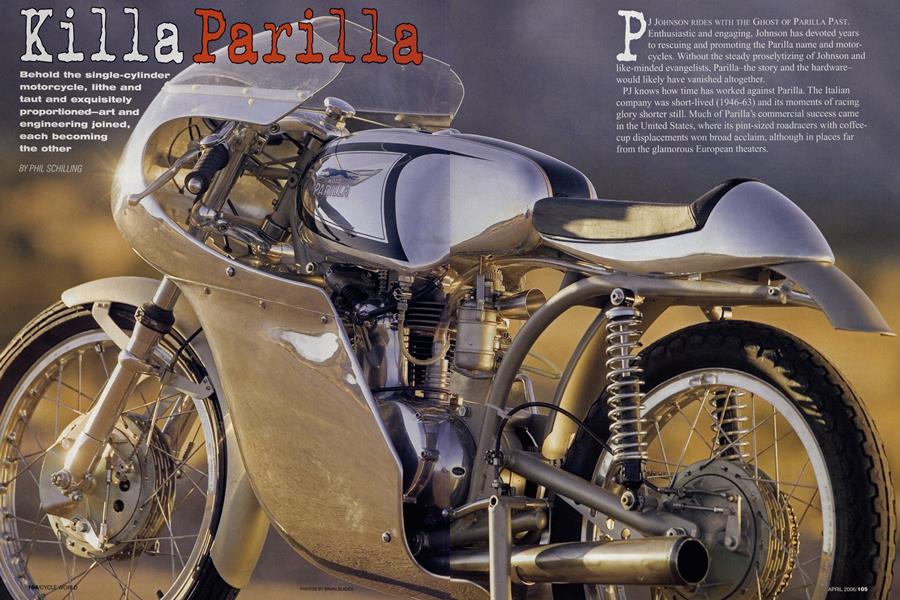
Behold the single-cylinder motorcycle, lithe and taut and exquisitely proportioned-art and engineering joined, each becoming the other
PHIL SCHILLING
P J JOHNSON RIDES WITH THE GHOST OF PARILLA PAST. Enthusiastic and engaging, Johnson has devoted years to rescuing and promoting the Parilla name and motor cycles. Without the steady proselytizing of Johnson and like-minded evangelists, Parilla-the story and the hardwarewould likely have vanished altogether.
PJ knows how time has worked against Parilla. The Italian company was short-lived (1946-63) and its moments of racing glory shorter still. Much of Parilla's commercial success came in the United States, where its pint-sized roadracers with coffee cup displacements won broad acclaim, although in places far from the glamorous European theaters.
GConsidering Parilia specialized in 175/200/250cc sportsroadsters and production racers, you might figure Johnson came to Parilia in the late Fifties as a 5-foot-4, 135-pound racer. He didn’t. For PJ-who towers at 6-foot-4-the romance began in the late Sixties, well after Parilla’s heyday, when he spotted a photograph of a 250 Grand Sport in a magazine. His eyes riveted on the bike and, as he says, he “saw perfection.”
Behold what PJ saw: a single-cylinder motorcycle, lithe and taut and exquisitely proportioned; a bike, motionless on the page yet seemingly alive with energy and movement; a beguiling, tightly sculpted engine; art and engineering joined, each becoming the other, as if existing in some special universe.
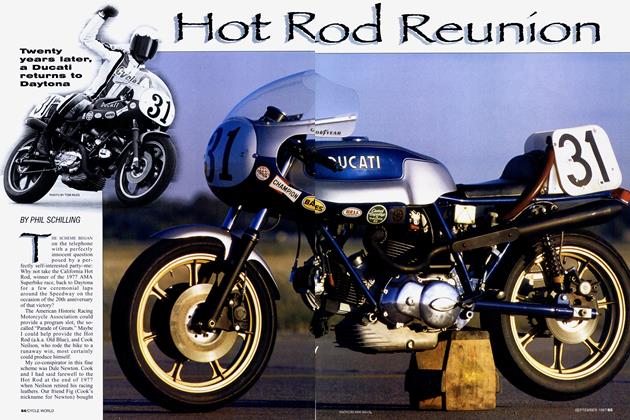
The “Killa Parilia,” Johnson’s latest and grandest project, honors his longtime love affair with the marque. This single-cylinder 250cc racebike incorporates-or is on its way to incorporating-everything PJ has learned over the past decades about making Parillas high-velocity weapons for vintage racing. He aimed “to build a piece of gorgeous hardware capable of winning a vintage event today.”
G iovanni Pamlia (yes, two r's) had a keen eye, too He loved the way Manx Nortons looked, and he drew heavily on the style and engmeenng ideas of the clas sic 500cc Norton single-cylinder production racer. In 1946, when he completed his first roadracers, Parrilla's real busi ness was the manufacture and repair of diesel-engine injec tor pumps. But his passion was racing motorcycles, and over the early years he and a coterie around him built an assort ment of small tool-room singleand double-overhead-cam racers that met with some real success.
By the early Fifties, Parrilla the man and Parilla the com pany prospered as a maker of lightweight motorcycles and transportation motorbikes. Parilla' s reputation grew out of its production machines that raced in an Italian national series called Formula 3. Here, beginning in 1956, homologated 175cc production racers faced off in a class for Macchina Sport Derivata dalla Serie. Parilla fettled and massaged its "high-cam" roadster, introduced as the Fox in 1952, into a potent production racer. In Italy these bikes were called MSDS racers. And when the bikes came to the United States, they became Grand Sports.
In 1957, Cosmopolitan Motors in Pennsylvania estab lished Parilla in the United States and began selling vari ous Parilla models. By 1960 Parilla was producing a 250cc Grand Sport because Americans preferred the larger dis placement. Cosmo had also imported Giuseppe Rottigni, a crack Parilla racer/tuner, who won the 1957 Giro d `Italia and was the fastest rider most Americans had yet seen on lightweight roadracing equipment. In addition this one man racing team provided technical support for customer! racers-and later full support for the fabled Parilla ace Tony Woodman.
If Rottigni ushered in the era of Parilla glory in America, it would end in 1964 when Orrin Hall's legend ary 250 Parilla carried Ron Grant to second place in the 250cc class at the U.S. Grand Prix at Daytona, and, a month later, took Norris Rancourt to second in the AMA's Daytona Lightweight 100-miter.
But Daytona 1964 was Parilla's last big hurrah. Sadly, the bankrupt company had already stopped manufacturing motorcycles.
Several years after he "saw perfection," PJ was able to ferret out and buy his first Parilla in the Seventies. His eyes and enthusiasm soon led him from one old beauty and basketcase to the next, and then into vintage racing, and in due course onward to Daytona, where in 1984 a serious crash ended his racing days. Undeterred, he simply redi rected his energies. "I just can't seem to stop either prepping bikes for chosen riders or cooking up events for Parillas to play a part in," he says.
To Italian motorcycle would be authentic and complete without its Grand Quirk. For Ducati, it's the desmo dromic valve system. In the case of Parilla, it's the high-cam engine with its single-lobe camshaft. Inside the outer left-hand case, a sprocket on the end of the crankshaft drives a chain that turns a sprocket attached to a one-lobe camshaft. This cam is situated high on the engine's left side. The camshaft controls the valves by means of very short and light pushrods acting on set of rocker arms. (BMW uses a
similar "cam-in-head" configuration on its current Boxers, though working conventional two-lobe camshafts.) Its clever and lightweight valvetrain, Parilla claimed, per mitted engine speeds (about 9000-9500 rpm) comparable to existing single-overhead-cam engines without the attendant complications and weight of sohc and dohc designs.
eoiiipiieatiuiis anu weign~ 01 sone aiiu uunc ueslglls. The single-lobe design, however, means that the intake and exhaust valves always have the same lift and duration. What's more, the angle between the pushrods dictates the phasing of intake and exhaust-and that remains the same no matter what camshaft is fitted. A two-lobe camshaft, by contrast, permits each valve to have a different lift and dura tion, and changing camshafts also provides a way to change the phasing of the intake and exhaust.
Since the included angle between the pushrods is 105 degrees on the Parilla, the intake/exhaust lobe centers also measure 105 degrees, a figure inside the range of contem porary practice. How Parilla settled on 105 degrees in the first place, whether by chance or experi ment or brilliance, remains a mystery. Whatever the case, Parilla's quirky camshaft arrangement could, and did, work amazingly well.
Starting point for the Killa Parilla was a 175 MSDS production-racer frame and running gear from the late Fifties. This frame has tube members rising from the rear-engine-mount/swingarm-pivot area and curving up and back to locate the upper shock mounts. This "curved frame," despite its spindly looks, handled better and had greater stability than later and much different 250 Grand Sport frames. Johnson credits this supe riority to the MSDS frame's greater strength, longer 51-inch wheelbase and possibly its 19-inch wheels.
PJ's Parilla has a frame modifica tion that originated with Giuseppe Rottigni. Johnson cut the frame's backbone tube under the seat area, heated the backbone at its front, bent it upward at the rear by about two inches, and rejoined the re-jigged frame with some custom braces. The steering head angle was not changed. This surgery creates enough clearance to remove the cyl inder head without taking the engine out of the frame and provides sufficient room to properly mount a big 32mm Dell'Orto SS1A carburetor. AHRMA rules limit vintage 250 Parillas to 30mm carburetors, virtually the same size as a stock 1960 Grand Sport. Parilla 250s do (and did), howev er, benefit from more carburetion, especially on high-speed tracks Alas, limiting carb size puts greater emphasis on developing and refining more costly performance-boosting elements such as intake porting and exhaust plumbing. elements such as intake porting and exhaust plumbing.
As for suspension, many Fifties competitors ran what came on their bikes, though brighter competitors soon started using premium forks and accessory shocks. For the Killa Parilla, Johnson shelved the standard Grand Sport fork and mounted a stronger, higher-quality, 35mm Ceriani roadracing fork. Ceriani shocks handle rear suspension for the moment; these may give way to Works Performance units. As for suspension, many Fifties competitors ran what came on their bikes, though brighter competitors soon started using premium forks and accessory shocks. For the Killa Parilia, Johnson shelved the standard Grand Sport fork and mounted a stronger, higher-quality, 35mm Ceriani roadracing fork. Ceriani shocks handle rear suspension for the moment; these may give way to Works Performance units.
The Killa’s 19-inch wheels carry newly cast 180mm magnesium Fontana replicas by Andy Molina of Stainless Engineering. The front brake has four leading shoes; the rear, two. These brakes are far superior to anything that graced Parilia racers in the past. And fresh Fontana replicas don’t pose the metal-fatigue hazard of 40-year-old magnesium brakes and hubs.
Centerpiece of PJ’s creation is the engine, a late-model 68 x 68mm Single with a five-speed box. As delivered, the 250 Grand Sport had the largest possible valves: 36mm intake and 33mm exhaust. The included valve angle measured 90 degrees, not uncommon for the Fifties, but certainly dated by today’s standards. The as-delivered 51-degree ignition advance indicated pretty slow flame propagation in the deep hemispherical combustion chamber of the stock head.
This chamber architecture made getting more compression than stock (9.0:1) difficult. Raising the piston in the chamber for higher compression hindered flame propagation enough that tuners often fitted a second sparkplug to aid more rapid combustion. The twin-plug Killa fires at 38 degrees BTDC, or backed off 13 degrees from stock.
Four decades ago, ignition systems were weak and unreliable, whether battery-and-coil or magneto. In the Killa Parilia, a modern German-made PVL CDI unit triggers the spark electronically and eliminates the old-time contactbreaker points. The system has no battery; a rotor and stator arrangement generates the energy for the system.
At least one trick Parilla part the Killa doesn't have. Parilla made a very small number of geartrains to drive the camshaft in high-cam engines. Some engines were factory-built with the geartrains; other trainsets were available as kits. Most tuners of vintage Parillas, including Johnson, now see little advantage in the gear-drive system because the stock and standard chain drive is simple, light, effec tive and reliable
Given enough resources and development time, the Killa Parilla might someday equal the performance level of the strongest, light est, fastest 250 Grand Sport of all time. That bike was built and tuned by Orrin Hall of Sacramento, California, and principally rid-
den by Norris Rancourt. Nicknamed "The Gadget," the bike dominated AFM 250cc racing in California in 1962-64. Featured in the March, 1964, issue of Cycle World, Hall was circumspect. He insisted that all the parts which determined power output were strictly production Parilla items available to anyone. The secret to his success rested on "some very minor modifications and extremely precise assembly." The total sum of small differences added up to a huge dif ference overall. Hall lightened The Gadget by drilling holes everywhere and counterboring bolt heads. (The bike was reputed to weigh less than 200 pounds without fuel.) He constructed his own magneto to fire a twin-ignition system. For maximum stopping power, he used a Norton Manx front brake. Hall ran a huge Amal GP carburetor, but the engine, which had a very broad powerband and a 9500-rpm ceiling, was incredibly tractable and could “be ridden as a regular street machine.”
Cycle World reported that The Gadget appeared “decidedly scruffy.” By comparison, the Killa Parilia is divinely immaculate, and three aluminum pieces crown the bike: tank, seat and fairing. Evan Wilcox, artist and metalcrafter, hand-hammered them all. The standard Parilia Grand Sport has a steel tank that weighs upward of 10 pounds. At a svelte 4 pounds, Wilcox’s shimmering copy remains faithful to the lines and proportions of the Stocker. Similarly, the 5-pound aluminum seat follows the banana-shaped lines of the standard 9.5-pound Grand Sport saddle. The dazzling two-piece aluminum fairing weighs 9 pounds including Dzus fasteners and windscreen.
As you can imagine, the thought of trashing those tender and beautiful aluminum panels on a savage racetrack does distress PJ. So now he ponders replicating the alloywork in carbon-fiber to save weight and safekeep the aluminum art.
Whether clad in aluminum or carbon-fiber, this bike is racetrack bound, and PJ stands ready to pitch the Killa into the maelstrom. After all, his vision includes a gorgeous Grand Sport and a consistent winner in vintage racing.
The Ghost of Parilia Past, he would tell you, deserves nothing less. □