Three Spirit
THREE SPIRIT
ROUNDUP
THERE WAS ALWAYS that 5 percent. From the time Triumph took the plunge into the "real" sportbike world with its first lightweight, high-horsepower Daytona T595 and TT600, most everybody respected the British marque for having a go, but also thought it was completely nuts to try to go toe-to-toe with the Japanese in the ultra-competitive Open-class and middleweight segments.
When asked about this at the
time, a company rep said, “We want to be a major motorcycle manufacturer. To do that, we have to compete in every segment.”
These first efforts were good streetbikes, but they were usually about 5 percent off in performance compared to the top Japanese repli-racers. To wit: The first TT600, for example, was like a good Honda CBR600F3 but, unfortunately, Honda had already introduced the F4. And so it continued.
Until now, of course. The all-new Daytona 675 perfectly expresses the spirit of a Triumph that has finally found its identity. And its
identity rocks.
Why 675? “It splits the 600cc Fours and 750cc Twins,” says product manager Ross Clifford. “Besides, if we made it 700cc, then why not 750, and if it’s 750, then why not 800. Where do you stop?”
What Triumph has ended up with is a very narrow, very lightweight sport bike made to its own rules, which is key to the company’s new direction. The idea is the antithesis of the former ethos, as the push now is to build bikes with performance and character that people just want to own, categories be damned.
Development for the Daytona 675 had already begun before the introduction of the four-cylinder Daytona 600 in 2003. And from here on out, “Four” is a four-letter word. “We built our last four-cylinder motorcycle more than six months ago,” says
Todd Anderson, VP of marketing at Triumph USA.
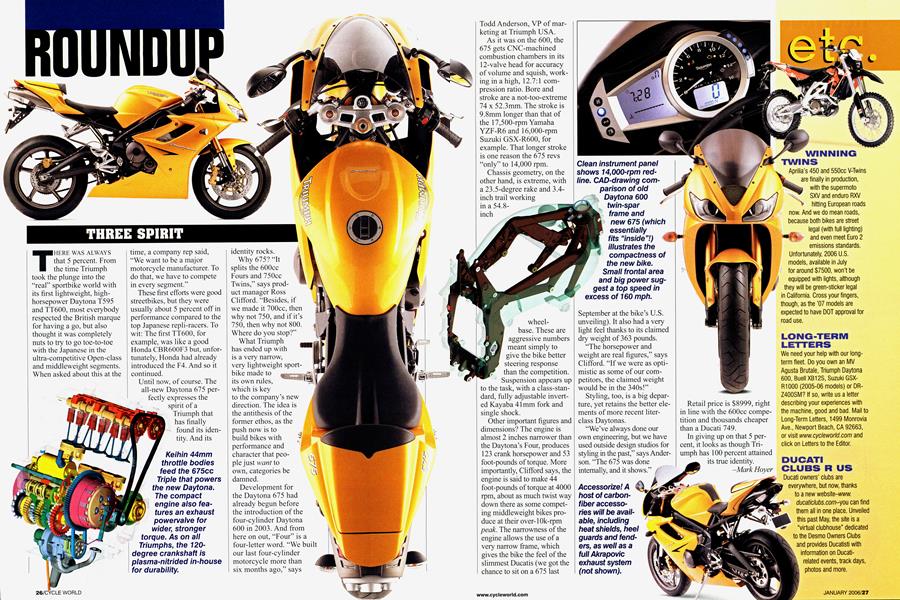
As it was on the 600, the 675 gets CNC-machined combustion chambers in its 12-valve head for accuracy of volume and squish, working in a high, 12.7:1 compression ratio. Bore and stroke are a not-too-extreme 74 x 52.3mm. The stroke is 9.8mm longer than that of the 17,500-rpm Yamaha YZF-R6 and 16,000-rpm Suzuki GSX-R600, for example. That longer stroke is one reason the 675 revs “only” to 14,000 rpm.
Chassis geometry, on the other hand, is extreme, with a 23.5-degree rake and 3.4inch trail working in a 54.8inch
wheelbase. These are aggressive numbers meant simply to give the bike better steering response than the competition. Suspension appears up to the task, with a class-standard, fully adjustable inverted Kayaba 41 mm fork and single shock.
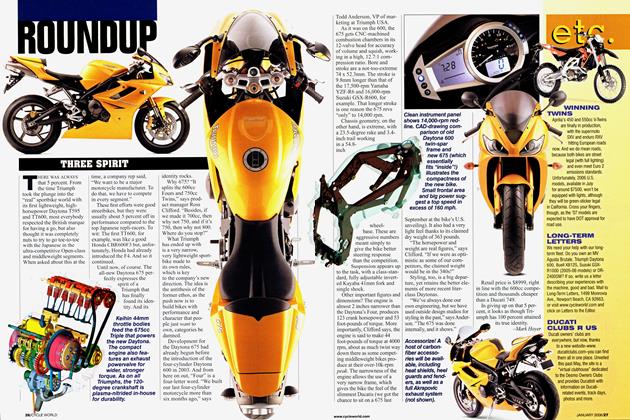
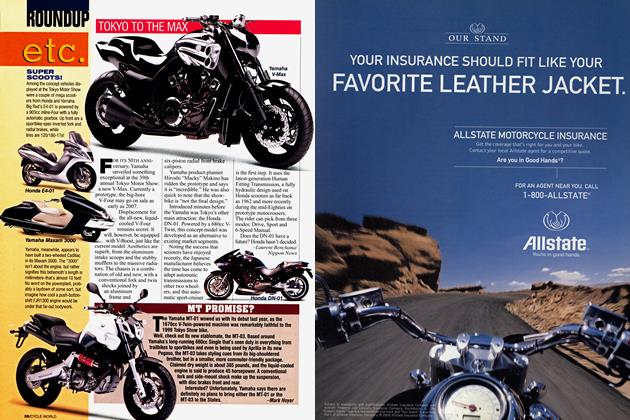
Other important figures and dimensions? The engine is almost 2 inches narrower than the Daytona’s Four, produces 123 crank horsepower and 53 foot-pounds of torque. More importantly, Clifford says, the engine is said to make 44 foot-pounds of torque at 4000 rpm, about as much twist way down there as some competing middleweight bikes produce at their over-10k-rpm peak. The narrowness of the engine allows the use of a very narrow frame, which gives the bike the feel of the slimmest Ducatis (we got the chance to sit on a 675 last
September at the bike’s U.S. unveiling). It also had a very light feel thanks to its claimed dry weight of 363 pounds.
“The horsepower and weight are real figures,” says Clifford. “If we were as optimistic as some of our competitors, the claimed weight would be in the 340s!”
Styling, too, is a big departure, yet retains the better elements of more recent literclass Daytonas.
“We’ve always done our own engineering, but we have used outside design studios for styling in the past,” says Anderson. “The 675 was done internally, and it shows.”
Retail price is S8999, right in line with the 600cc competition and thousands cheaper than a Ducati 749.
In giving up on that 5 percent, it looks as though Triumph has 100 percent attained its true identity.
Mark Hoyer