Made In New York: A Century of Motorcycles
MADE IN NEW YORK: A CENTURY OF MOTORCYCLES
THE CONCEPT BEHIND THE Great New York Motorcycle Show? Capture the richness and variety of New York's motorcycle faithful, people who spun their passion for two-wheeled transportation into reality, even if only for a short while.
On display through early April at Albany's New York State Museum, the exhibition has the appearance of a 1920s trade show. It features a variety of prototypes and production models, from bicycles with clip on engines to current customs.
Some of the highlights in clude a sampling from The Em blem Manufacturing Company, which was active from 1907 to 1925 and was perhaps the most successful of all of New York's motorcycle-makers. Emblem claimed its 10-horsepower Twin was "the strongest, most power-~: flu and sturdiest machine made. Also prominent is a 1916 Miiitaire with its channel-steel frame, four-cylinder engine, Se lective-shift transmission with reverse, and shaft drive.
Two of Glenn Curtiss' cre ations are also on display. A trail blazer in both aviation and motorcycle design, Curtiss first made his mark in 1907 as the "fastest man in the world" for having raced his eight cylinder Hercules to a j speed of 136 mph.
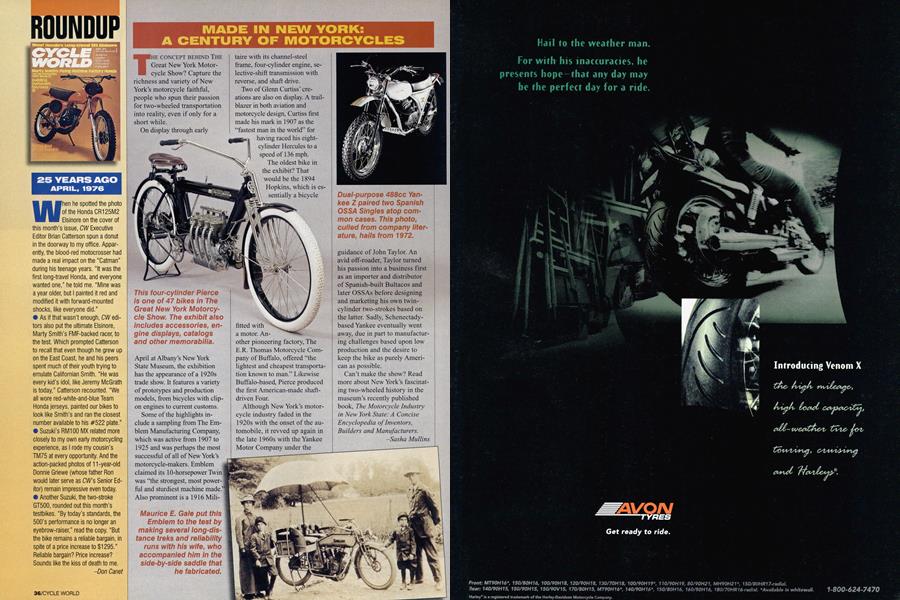
The oldest bike in the exhibit? That would be the 1894 Hopkins, which is es sentially a bicycle fitted with 7 a motor. Another pioneering factory, The E.R. Thomas Motorcycle Com pany of Buffalo, offered "the lightest and cheapest transporta tion known to man." Likewise Buffalo-based, Pierce produced the first American-made shaft driven Four.
Although New York's motor cycle industry faded in the 1920s with the onset of the au tomobile, it revved up again in the late 1 960s with the Yankee Motor Company under the guidance of John Taylor. An avid off-roader, Taylor turned his passion into a business first as an importer and distributor of Spanish-built Bultacos and later OSSAs before designing and marketing his own twincylinder two-strokes based on the latter. Sadly, Schenectady based Yankee eventually went away, due in part to manufactur ing challenges based upon low production and the desire to keep the bike as purely Ameri can as possible.
Can't make the show? Read more about New York's fascinat ing two-wheeled history in the museum's recently published book, The Motorcycle Industry in New York State: A Concise Encyclopedia of Inventors, Builders and Manufacturers.
-Sasha Mullins