2001 Suzuki Sv650s
2001 SUzuki SV650S
CYCLE WORLD TEST
Putting the finishing touches on an already entertaining motorcycle
WENDY F. BLACK
WHEN SUZUKI FIRST INTRODUCED ITS SV650 STANDARD-STYLE BIKE BACK IN 1999, we applauded. Really, what wasn’t there to like? Its easy-handling nature, swanky good looks and bargain-basement price were all things we gushed over. Heck, we even snagged one for our long-term fleet. Hands down, Suzuki had come up with a winner.
But then, human nature took over. It seems that no matter how good a thing is, the grass always seems greener somewhere else. And in the SV’s case, the lawns seemed to be much better tended over in Europe and Canada. Because those were the countries that were privy to the S-model SV650.
Introduced outside the U.S. at the same time as the naked SV, the S model came with a sportier riding position and tasty half-fairing. How come the Euro-scum get all the good stuff? Well, apparently, we magazine geeks weren’t the only ones yearning for greener, bodywork-clad pastures.
Explained an American Suzuki PR guy, “The naked SV has sold extremely well for us, but there have been a lot of dealer requests for the faired bike because they feel they can sell both. There’s also been a lot of interest on the consumer level. So we thought we’d go for it.”
And go for it, they did. The faired SV does not replace its bare sibling for 2001. On the contrary, the new (for the U.S., at least) bike merely complements the old. Entry-level riders and standard-lovers alike now have quite the choice. And it’s a healthy one at that, with the S-model priced at a relatively low $6199, just $400 over the stripper version.
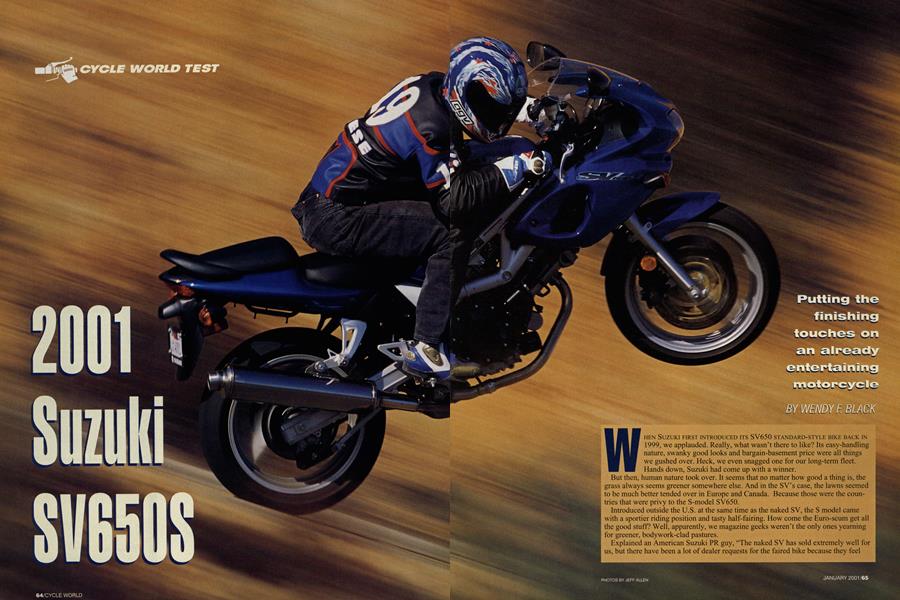
What do you get for your extra buckage? Well, in a weird sort of way, not much. Not that that’s a bad thing. Because basically, the package is the naked SV-a good bike that stands on its own merit-only it’s been loaded with rearset footpegs, lower clip-on handlebars and a TL 1000-style fairing. Giving the bike a more complete and finished appearance, the latter provides a stylish, convenient place for the cat’s-eyes headlamps and redesigned mirrors.
Aside from the sportier ergos, though, the S model varies very little from the original SV. The same 645cc, 90-degree V-Twin powers both bikes. For those who need a refresher course, that means the S’s dohc motor is liquid-cooled and sports four valves per cylinder. It inhales through two Mikuni 39mm downdraft carbs, and exhales via a stainlesssteel exhaust system. Its 65.5 horsepower and 42.6 footpounds of torque are put to the rear wheel by means of a smooth-shifting six-speed transmission.
The final gearing differs between the two bikes, but it’s a nominal difference. The S’s rear sprocket is minus one tooth, resulting in a taller final-drive ratio. Reason for this, claims Suzuki, is that the fairing-wearing S is “an open-road kind of bike” and benefits from the raised gearing.
But the engines are so similar that differences in performance numbers are negligible. The shorter-geared, fairingless SV is a touch quicker through the quarter-mile, as you’d expect, but our ’99 testbike also managed to be 2 mph faster on the top end. Go figure.
Anyway, the S-model’s chassis matches that of the naked its aluminum truss-style frame enticingly :>le. Suspension alterations are limited to a lOmm-shorter swingarm, and a rear shock with a little less rebound damping and a little more compression damping.
Up front, the Kayaba 4lmm fork houses springs with 2mm less preload. According to Suzuki, these are due to the new seating position’s redistribution of rider weight.
Braking is via a triple-disc setup: Two 290mm front discs are squeezed by Tokico two-piston calipers; out back, a single 240mm rear disc is gripped by a smaller two-opposedpiston caliper. Though the applications on both bikes are identical, braking was the only area in which we found a significant discrepancy within the bikes’ performance numbers. From 30 mph, the naked SV stopped in 3 fewer feet than the faired version; and from 60 mph, it came to a halt in 13 fewer feet.
Despite what the test gear claimed, there were no complaints about the bike’s braking ability. Nor were there any major gripes with the S overall. In fact, staffers who slung a leg over it were mostly thrilled with its performance. Like the naked SV before it, the S is just a really fun bike to ride.
Because the big news with this bike is its nosepiece, the first order of business was to head north on Los Angeles’ crowded, speed-worthy freeways for a 300-mile acid test.
No disappointments there.
Up to speeds of 65 or 75 mph, sitting bolt upright is easy and not a fatiguing exercise in fighting the wind. Accelerating beyond that is still quite comfortable. It's just a matter of slouching a bit and resting on the breeze. There’s little if any helmet buffeting, except in heavy crosswinds.
On the open road, the bike’s proven V-Twin makes plenty of tractable power over a broad range. Open up the throttle and cruise along contentedly in the fast lane. When inconsiderate drivers don’t quite grasp the concept behind the left lane, there’s more than enough power on tap for quick, efficient passing.
Granted, there’s a bit of vibration in the cushy saddle and the bars, but just enough so that you’re aware of it if you’re paying attention. Not too much as to be bothersome. And at speed, the plush suspension simply soaks up pavement abnormalities.
Satisfied with the bike’s interstate performance, we headed for the moderately tight turns of SoCal’s Ortega Highway for further experimentation. It was here that the sportier riding position came into play.
The new clip-ons allow you to sit with your upper body farther over the front of the bike. But the new bars aren't so low as to put undue pressure on the wrists. Now, they don't provide the leverage of the naked bike’s wide, dirt-trackstyle bar, so flicking the S into super-tight turns requires a little more muscle than did the SV. But, and this is important, it still doesn't require a lot of effort. The new model remains a truly light-steering bike.
Rounding out the new riding position’s features are a pair of more rearset footpegs. They're located a half-inch higher and a half-inch farther back than those of the naked bike’s. Result is that fewer sparks fly in tight switchbacks since hard parts don't kiss the tarmac quite so easily.
Overall, the S tackles twisties with the same easy-handling spunk as the original SV. So a novice can park the transmission in one gear and have a blast simply rolling on and off the throttle. Meanwhile, faster pilots can rev the snot out of the thing and flick it into corners at the last second.
But be forewarned: When pushing the S really hard in tighter going, some of the office fast guys found the suspension on the soft side. “Squashy,” was the word one tester used. Indeed, the fork dives under even moderately hard braking. Unfortunately, this doesn’t really come as a shock (sorry). Our long-term SV, with basically the same setup, suffered this malady as well. So much so that our first upgrades to the bike were Progressive Suspension springs up front and a damping-adjustable shock at the rear.
Okay, the S is not optimized for intense sportriding, but then again, it isn’t intended as a double-throwdown repliracer. So what is it? Like the naked SV, the S is a lightweight, nimble-handling motorcycle that will appeal to newbies and vets alike, as long as what they’re looking for is to have a good time. Ain’t nothin' wrong with that.
SUZUKI SV650S
$6199
EDITORS' NOTES
DON’T ASK ME WHY, BUT I’VE ALWAYS kind of identified with classic-film star Mae West. Even when I was just a little thing, I could (and would, much to my parents’ raised eyebrows) impersonate her. Often. My favorite line? In my best sultry voice, “When I’m good, I’m very, very good. When I’m bad. I’m better.” Strange though it may seem, this West-ism came to mind when I was pondering Suzuki’s tale of two SVs. The naked SV is very, very good. But the faired SV-S, it’s definitely better. It’s endowed with the naked bike’s positive traits, such as nimble handling, light weight, easy steering and slim lines. It's also got a sportier yet more comfortable (at least for me) seating position.
And, well, there is one more thing. I have to admit that the blond bombshell hidden deep inside me is attracted to the S model because with its rakish fairing, it’s also a little bit bad. No wonder l keep bleaching my hair...
Wendy F. Black, Associate Editor
ARE WE ALL SUCKERS FOR THIS KIND OF thing? This sort of return to design innocence, the simple concept of simplicity, lightness and-what to call it-material sensuality? That's SV650S in a nutshell, except that it’s also thoroughly modem and reliable. Cheap, too.
Certainly more capable vehicles can be found, both in terms of chassis and engine performance, but the sweet combination of economy, fun and, most important, overall dynamic balance, is hard to beat.
In my mind, that the S has the cool fairing and more aggro riding position make it all the better as compared to the regular SV. It retains the compact feel and almost dirtbike-likc willingness to react of the original bike, but somehow seems like a more serious motorcycle without being any more intimidating.
So, what we have in the S is a shrunken Superbike, cool commuter and raucous runabout, while underneath it all it’s just cute, easy and cheap. Basically irresistible, in other words.
Mark Hoyer, Sports Editor
SADLY, I’M ANCIENT ENOUGH TO REMEMber when motorcycles were just that. Motorcycles. Not a fashion accessory, not an ego-stroke, just simple w'ind-inthe-face fun. The SV takes me back to that time. It's a CB350 Honda for the new millennium, only way more riproaring thanks to its eager-beaver VTwin and a quarter-century’s w'orth of improvements in handling, suspension and brakes. I appreciate the past, but don't want to live there.
I’d add an opened-up pipe, tweak the spring rates, maybe fit some braided-stcel brake lines, then just ride, ride, ride, stopping only for tire changes and the occasional track school. Can you say “fun to flog?” The SV650 can.
As an old CB owner, I'm partial to the naked version, but have to admit the S-model is the choice for high-speed work. Plastic has its place.
Bottom line? Where Suzuki had one of motorcycling's best bargains and most entertaining rides, it now has two. Happy days are here again.
David Edwards, Editor-in-Chief