1998 Harley-Davidson Road King Classic
1998 Harley-Davidson ROAD KING CLASSIC
CYCLE WORLD TEST
CONTINUING THE TOURING-CRUISER TRADITION
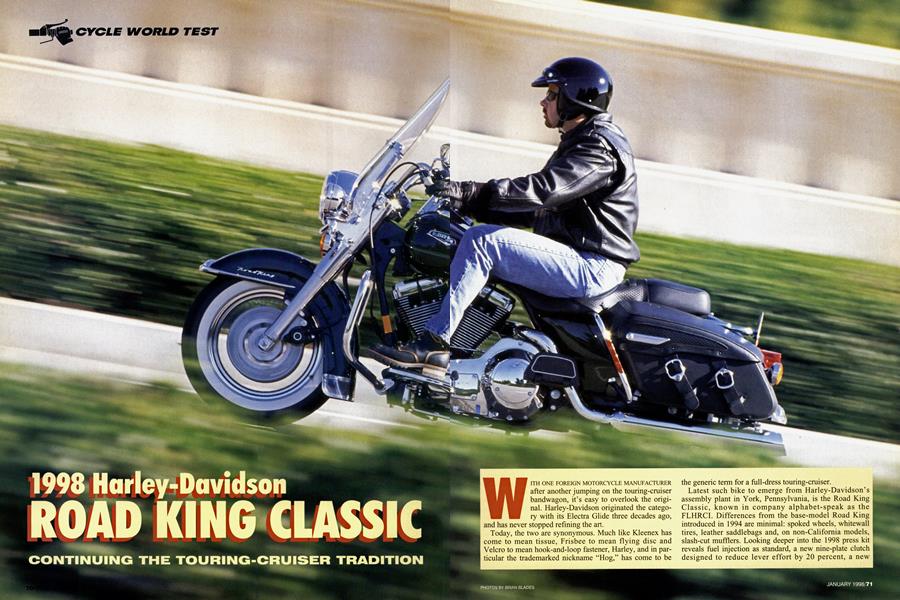
WITH ONE FOREIGN MOTORCYCLE MANUFACTURER after another jumping on the touring-cruiser bandwagon, it's easy to overlook the original. Harley-Davidson originated the category with its Electra Glide three decades ago, and has never stopped refining the art.
Today, the two are synonymous. Much like Kleenex has come to mean tissue, Frisbee to mean flying disc and Velcro to mean hook-and-loop fastener, Harley, and in par ticular the trademarked nickname "Hog," has come to be the generic term for a full-dress touring-cruiser.
Latest such bike to emerge from Harley-Davidson's assembly plant in York, Pennsylvania, is the Road King Classic, known in company alphabet-speak as the FLHRCI. Differences from the base-model Road King introduced in 1994 are minimal: spoked wheels, whitewall tires, leather saddlebags and, on non-California models, slash-cut mufflers. Looking deeper into the 1998 press kit reveals fuel injection as standard, a new nine-plate clutch designed to reduce lever effort by 20 percent, a new exhaust-pipe manufacturing method meant to minimize the number of rust-sensitive welds, and...that's it. There's noth ing else to report.
In case you weren't aware, Harley gets a lot of mileage out of its engineering efforts. The company's current lineup includes no less than 21 models powered by two basic engines-compare that to the Japanese OEMs, each of which boasts a revolving range of continually changing Singles, Twins, Fours and more. But while it may appear that Harley's engineers have been kicking back with their feet on their desks (they're not-more on that later), the styling department obviously has been working overtime. How else can you explain the never-ending procession of widgets, trinkets and chrome-plated doo-dads that distinguish one model from another?
That's okay-we've come to expect these sorts of minor yearly updates from Harley. But we've all heard the Big Rumor that there's a new Big Twin engine coming, perhaps as early as next year. What this means is that the bike pic tured on these pages very well may be the last of its kind. That being the case, this would seem an opportune time to pause and reflect.
Harley-Davidson is the lone survivor of a once-burgeoning American motorcycle industry, which in the early 1900s boasted 36 major manufacturers. As such, Harley is the old est bike-maker in the world.
The Road King Classic traces its ancestry to 1903, when William S. Harley and Arthur Davidson built their first motorcycle, a primitiYe bicycle-styled Single, in a shed behind the Davidson family home in Milwaukee, Wisconsin. Three years later, the fledgling firm set up shop on Juneau Avenue, where the company's corporate offices remain today.
In 1909, the first V-Twin-powered machine rolled out of the Harley-Davidson Motor Company, laying the foundation for Harleys as we know them. The basic layout of today's Big Twin engine-air-cooled, 45-degree Vee-angle, two pushrod-actuated valves per cylinder, single carburetor, non-unit gearbox-was set in 1936. Over the years, that design was continually refined, growing through 61 and 74 to the current 80 cubic inches (1340cc), and evolving through the so-called "Knucklehead," "Panhead" and "Shovelhead" configurations before arriving at the current Evolution engine, which carries the dubious nickname "Blockhead."
Introduced in 1984, this latest version added aluminum construction to the existing formula, helping it to earn an enviable reputation for reliability. Most recent addition is electronic fuel injection, which first appeared as an option on the 1995 Ultra Classic Electra Glide and is now standard equipment on most of the touring models.
In terms of performance, the Road King Classic feels iden tical to the last Road King CW tested (see "Exiles from Main Street," May, 1997). Riders accustomed to Japanese or European motorcycles will be blown away by the bike's lowrider seating position, unorthodox controls, quirky (but fool proof) kickstand and overall mechanical feel, but Harley fans will feel right at home. This is, after all, a Harley.
Like all Big Twins, the Road King's strong suit is its broad spread of torque, which in conjunction with the fuelinjection system provides crisp, immediate response, even when the engine is cold. Horsepower, though, is another story: With just over 50 ponies finding their way to the rear wheel, and a potential weight of more than a half-ton laden with rider, passenger and luggage, acceleration is painfully lacking. Overtaking maneuvers on two-lane highways are best planned well in advance.
Engine vibration-the bane of all unbalanced V-Twins-is almost unbearable at idle, but once underway, it miraculous ly disappears, the frame's rubber-mount system effectively isolating the rider. Then, his attention will drift to other matters, such as the clunky transmission, harsh sus pension and the flawed windshield, which has poor optics that make it difficult to see through, and which is too tall to look over.
On a brighter note, the windscreen is very effective; only 6-footers will experience any buffeting. And the supplemental dual running lights-illuminated via an awkward toggle switch on the rear edge of the top triple clamp-greatly boost vision at night. Also scoring high marks are the horn, which is notice ably louder than that found on most other motorcycles, and the triple disc brakes, which despite being old-fashioned Hayes single-piston jobbies, do a remarkable job of hauling the heavyweight steed down from speed.
This is good, because sudden evasive action isn't part of the Road King's repertoire. Instead, the bike prefers more gradual maneuvers, its low center of gravity and neutral steering imparting a light yet lazy feeling in turns. It's only when the rider attempts to take a couple of corners quickly in succession that he'll notice the bike's weight-then, and while backing it out of the garage.
Longer-legged riders may also find themselves struggling at parking-lot speeds, not because of the bike's heft, but because its wide, pullback handlebar will contact their knees at full steering lock. There are two solutions for this: Rotate the bars upward, or make wider-radius turns.
Beyond these few gripes, however, there's little to com plain about. The Road King is a sophisticated, stylish and surprisingly versatile motorcycle that pulls double duty as an around-town cruiser and cross-country tourer. Moreover, it's just plain fun to ride.
Some see Harley's reliance on long-lived engine and chassis designs as a weakness, but as long as its engineers continue to polish the gem, it's a method that works-and works well, thank you very much. The Road King Classic is proof.
EDITORS' NOTES
LET'S TALK RESALE VALUE. A FRIEND recently told me that his well-used 1995 Road King is actually worth $2000 more than it cost new. That's not sur prising. After all, the windshield-and saddlebag-equipped machine is one of the Motor Company's most versatile models, equally capable of cruising Main Street on Saturday night as trundling along Route 66.
Of course, my pal's bike is carbureted, unlike our fuelinjected Classic. So it doesn't thunder to life on cool morn ings with the same immediacy of the higher-tech version. He doesn't have the updated clutch, either, which lightens lever effort substantially. If our testbike were mine, I'd pop for Harley's Screamin' Eagle EFI Stage 11 performance kit, freer-flowing mufflers, a more supportive seat and, budget permitting, better brakes and suspension. Based on current blue-book prices, it would be money well spent. -Matthew Miles, Managing Editor
EVER NOTICE HOW WHEN YOU WAVE TO Harley riders from the saddle of a for eign motorcycle, they seldom wave back? Well, the shoe was on the other foot the other day while I was riding down Santiago Canyon, when I waved to some sportbike guys from the saddle of the Road King Classic and they didn't wave back!
Why this is, I don't know. Doesn't everybody realize that there are plenty of enthusiasts who enjoy both Harleys and "crotch rockets?" Hey, even Kenny Roberts rode a Harley at Sturgis this year! I'll be the first to admit that Harleys are graded on a curve. It's pointless to judge them by the same criteria as sporting iron from, say, Japan or Europe when they so obvi ously conform to a different set of standards. But judged within those parameters, the Road King earns straight A's, tops in its class. Remember that the next time you snub one. In the very nearly immortal words of Rodney King, "Can't we all just get along?" -Brian Gatterson, Executive Editor
TAKE A GOOD, LONG LOOK AT THE ROAD King Classic, drink it in. Nice, eh, `spe cially with those jazzy spoked wheels and wide whitewalls? A real "I Like Ike" bike.
But that's not just a motorcycle you're eyeballing. Consider it both a blueprint and a shot in the arm. See, of all Harley-D's many models, the Road King is the most popular, with the longest waiting lists and the highest dealer mark-ups (bas tards!). Other bike-makers have taken note. Witness the Valkyrie and Shadow Tourers from Honda, Yamaha's Royal Star Tour Deluxe and the new-for-'98 Kawasaki Nomad 1500 bagger. Say what you will about "classic American styling.. .blah, blah, blah," but none of these bikes would exist without the pattern laid down by the Road King. And, so popular is the genre that the previously slumbering touring segment of the marketplace, long the domain of Honda's Gold Wing, is now showing some serious sales blips. How's that for impact? -David Edwards, Editor-in-Chief
VH-D
ROAD KING
$16,560
Harley-Davidson Motor Co. Inc.