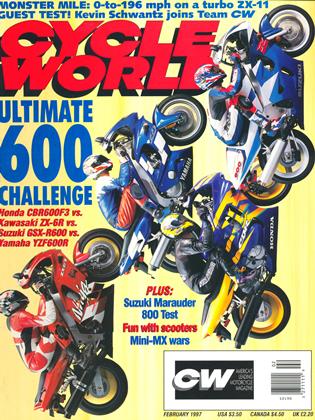
Ultimate 600 Challenge
Ultimate 600 Challenge
CYCLE WORLD COMPARISON
BATTLE OF THE 600cc SUPERBIKES
ONE OF THE GREAT THINGS ABOUT LIVING IN A DEMO cratic society is the freedom to vote. Not just for political leaders-only 49 percent of eligible Americans cast ballots in the recent presidential election, anyway-but also to vote with our wallets, to make educated purchases based on our own research. Trouble is, with so many different brands of products available to us, we're in deep danger of option paralysis. Thus, we entrust the advice of experts to help in our purchasing decisions.
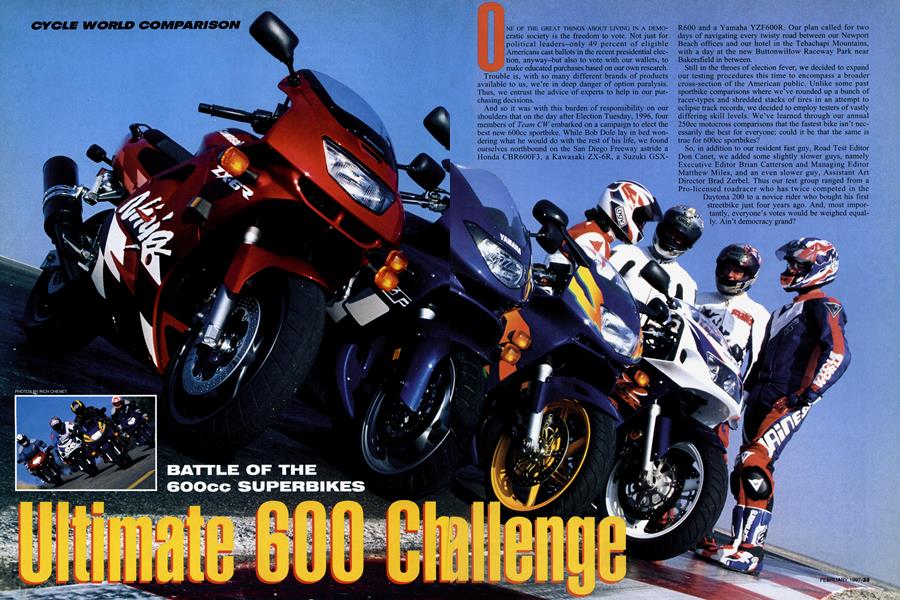
And so it was with this burden of responsibility on our shoulders that on the day after Election Tuesday, 1996, four members of Team CW embarked on a campaign to elect the best new 600cc sportbike. While Bob Dole lay in bed won denng what he would do with the rest of his life, we found ourselves northbound on the San Diego Freeway astride a Honda CBR600F3, a Kawasaki ZX-6R, a Suzuki GSX R600 and a Yamaha YZF600R. Our plan called for two days of navigating every twisty road between our Newport Beach offices and our hotel in the Tehachapi Mountains, with a day at the new Buttonwillow Raceway Park near Bakersfield in between.
Still in the throes of election fever, we decided to expand our testing procedures this time to encompass a broader cross-section of the American public. Unlike some past sportbike comparisons where we've rounded up a bunch of racer-types and shredded stacks of tires in an attempt to eclipse track records, we decided to employ testers of vastly differing skill levels. We've learned through our annual 250cc motocross comparisons that the fastest bike isn't nec essarily the best for everyone; could it be that the same is true for 600cc sportbikes?
So, in addition to our resident fast guy, Road Test Editor Don Canet, we added some slightly slower guys, namely Executive Editor Brian Catterson and Managing Editor Matthew Miles, and an even slower guy, Assistant Art Director Brad Zerbel. Thus our test group ranged from a Pro-licensed roadracer who has twice competed in the Daytona 200 to a novice rider who bought his first streetbike just four years ago. And, most impor tantly, everyone's votes would be weighed equal ly. Ain't democracy grand?
Honda CBR600F3
What can you say about Honda's CBR600F3 that p hasn't already been said? How about that it has been improved again for 1997? Introduced in 1995 as an updated version of the proven CBR600F2, the F3 benefited from the addition of a dual-stage
ram-air induction system, increased compression, 2mmlarger carburetors and a new exhaust. This year, the F3 has been revised again-call it the F3.5-possibly as a precursor to the long-rumored CBR600RR or P4 model. Remember how the original CBR600 was revised in 1990, one year prior to the F2's debut? Same here maybe.
For 1997, Honda went through the F3's engine with a fine-toothed comb, looking to reduce frictional and resis tance losses and improve throttle response. Thus, the 16valve, dohc inline-Four received a deeper oil pan, single valve springs (rather than nesting pairs), a freer-flowing muffler and a new ignition-control module that joins the cylinders in pairs. It also received a smaller, lighter starter motor, revised air-intake funnels and insulators, and a new shift drum said to improve gear changes.
Honda's engineers didn't neglect the F3 `s steel twin-spar chassis, either. The fork and remote-reservoir shock were both upgraded with Honda Multi-Action System (HMAS) cartridges, and there's a new shock linkage with increased rear-wheel travel and a smaller, lighter #525 drive chain. The redesigned front fender is said to aid aerodynamics, but the new, wedge-shaped tailpiece is admittedly only visual-and frankly, graphic artist Zerbel insisted, less dis tinctive than the original.
Changed yes, but is the F3 different? In a word, no. It's the same bike we've come to know and love, refined to an even higher level than before. Strapped to the CW dyno, the revised F3 motor made 90.8 rear-wheel horsepower, more than any of the other bikes in this test, with a linear torque curve that was the smoothest of the bunch. The CBR's engine sound is unique, with gear whine that resembles a turbine when the revs reach five-digit levels.
HONDA CBR600F3
$7799
KAWASAKI ZX-6R
$8299
SUZUKI GSX-R600
$7699
YAMAHA YZF600R
$7399
In motion, the F3 also feels much as it did before. The ride is taut, maybe even a little on the harsh side, with neu tral yet slightly heavy steering characteristics. The chassis "dances" some at speed, but the feeling isn't at all unnerv ing; conversely, the bike merely feels as though it's poised to flick into the next bend. The seating position, unchanged from the F2, remains the sportbike standard-the short bar to-seat relationship makes it as comfortable for daily com muting as it is effective for racetrack lapping.
The only major complaint we had concerned the CBR's omnipresent vibration, which was only really noticeable when we weren't busy hustling the bike from one corner to the next (which is to say, seldom). We also didn't appreciate the fairing, which may work well with the rider in a road race tuck, but does little to shelter a street rider from oncom ing wind. When we encountered 30-degree temperatures nearing our hotel (elevation 4200 feet) at the conclusion of our first day's ride, Miles was frozen stiff. Brrr...
Kawasaki ZX-6R
Largely unchanged since its 1995 debut, Kawasaki's ZX 6R remains a performance dynamo. A twin ram-air induction system feeds a vastly oversquare (66.0 x 43.8mm) engine that redlines at 14,000 rpm-500 rpm higher than the other bikes in this test. The engine is smooth, smooth, smooth, yet the combination of intake howl and exhaust growl make it sound threatening. The venera ble Ninja mill churned out 89.7 horsepower on CW's dyno (a smidge less than the class-lead ing CBR), with a torque output of 44.6 foot-pounds that was the highest in this test. Curiously, though, both figures were down from our 1995 ZX-6R test figures of 95.2 horsepower and 46.4 foot-pounds. Hmmm...
Still, the Kawasaki acquitted itself well, setting the quickest quarter-mile time, the best roll-on times and the second highest top speed by a scant .2-mph. Even more impressively, Canet hustled it around Buttonwillow's 1.07-mile, nine-turn East Loop quicker than any of the other bikes, though admit tedly the racy Suzuki was just three-hundredths of a second off the pace.
Much of the credit here goes to the ZX's unflappable alu minum twin-spar chassis, which is curiously painted silver rather than polished and clear-coated like the Suzuki's attractive piece. Last year, the 6R's frame was strengthened, and the result is the most stable machine in the class. Yet that stability wasn't obtained at the expense of steering ease; in fact, the ZX exhibits neutral steering that requires the lightest touch of this bunch. The four-piston Tokico front brakes also have the best feel.
Kawasaki's engineers didn't neglect creature comforts, either. The ZX's fairing is highly protective, and the seating position, while a bit cramped for taller riders, is very corn fortable for anyone under about 5-foot-1O. There's also a decent passenger pillion with grabrails.
The Kawasaki's few engine-related flaws include a clutch with a narrow range of engagement, a carburetion stumble just off idle when pulling away from a stop and a vague transmission that resulted in some missed shifts on the race-
track, though curiously never on the street. The suspension also isn't perfect, as both the fork and shock ride too far down into their stroke, causing a buckboard ride over rip pled pavement. Both the front and rear suspensions are fully adjustable, but the latter only has four clicks of rebound, which makes for dramatic differences between settings. The threaded ride-height adjuster at the top shock mount is an added bonus that only the Suzuki shares.
Suzuki GSX-R600
Developed alongside its bigger brother, the GSX R750, the new-for-'97 GSX-R600 is essentially the same motorcycle. It shares the same basic engine and chassis lay out, with a smattering of downsizing and cost cutting changes.
Naturally, the engine~' was debored and destroked to 65.5 x 44.5mm (vs. the 750's 72.0 x 46.0mm) to reduce displacement to 600cc. Carburetor size was similarly reduced from 39 to 36.5mm, and the 750's electronic throt tle slide assist was jettisoned. Other engine changes include a higher compression ratio, smaller valves, a reshaped com bustion chamber and a new digital-direct ignition that, like the 750, incorporates individual ignition coils in each spark plug cap. Downstairs, the fifth and sixth gear ratios were moved closer together, plus the final drive ratio was lowered to match the 600's different power curve. Other weight-sav ing measures include a downsized #525 chain, a smaller clutch with two fewer plates, a narrower primary driven gear and a smaller, lighter starter motor.
Chassis-wise, the 600 is nearly identical to the 750. Chief differences are the lack of bosses for adjusting the swingarm-pivot location (part of the 750's Superbike race kit), plus a 1 0mm-shorter swingarm that makes do without the 750's external bracing. New this year is a steering damper mount tack-welded to the left frame spar, an addi tion that also appears on the `97 750.
The 600's front suspension was also downgraded a bit, with a conventional 45mm cartridge fork (that doesn't feature adjustable compression damping) replacing the 750's fully adjustable 43mm inverted unit.
Lastly, the 750's Nissin six-piston front brake calipers were ditched in favor of less-expensive (but no less effec tive) four-piston jobs, and the _______________________ 750's 6.0-inch-wide rear wheel was replaced with a narrower 5.5-incher-still a half-inch wider than the competition.
Sum total of these changes is said to be a 7.5-pound weight reduction from the 750cc motor, and a 3.5-pound reduction from the 750's chassis, for a total savings of 11 pounds. The CW scales more or less confirmed this, as the GSX-R600 weighed-in at a scant 412 pounds dry, 10 pounds less than the GSX-R750 and 26 pounds less than the next-lightest 600, the F3.
Performance-wise, the GSX-R600 obviously takes after its bigger brother, producing 88.9 horses on our dyno and posting the highest top speed (152 mph). It also turned the second-quickest lap time and 60-80-mph roll-on time, both figures that could have been improved if we had been free to change the bike's gearing. As it was, we lost time waiting for the engine to "come on the pipe."
In a nutshell, the GSX-R600 has a peaky powerband that means you have to keep it revving. It's not so pathetic that it falls on its face at low revs, but with pronounced dips in the power curve at 5500 and 8000 rpm, it's happiest with its tach needle near redline. Further penalizing limp-wristed pilots is a lean condition at small throttle openings that caus es a slight surge.
Engine complaints weren't limited to the stratospheric power delivery, however. Our testers' biggest peeve was excessive driveline lash, followed in severity by clunky shift action and a shuddering clutch that made dragstrip launches difficult. Engine vibration was only bothersome at high rpm, however, which means that it's pretty smooth under ordi nary street-riding conditions.
We had few complaints regarding the 600's flickable twin-spar aluminum chassis. Cornering clearance is virtually limitless, steering is light and neutral, and the bike is stable at speed, with no trace of the 750's bothersome headshake. Front suspension action is slightly choppy, however, and the piggyback-reservoir shock has insufficient rebound damp ing, even at the maximum setting-too bad, because it's a quality component that many racers will be tempted to use. The seating position drew rave reviews for backroad roost ing, but poor marks for highway cruising, and the same holds true for the fairing-the windscreen is simply too low for street riding, and forces taller riders to look through it from above to see the gauges.
Yamaha YZF600R
Introduced in late 1996 as an early-release `97 model, Yamaha's YZF600R quickly won over the CWstaff's hearts. We awarded it Best 600cc Streetbike hon ors in our annual Ten Best Bikes voting, unseating the reigning class champion, the Kawasaki ZX-6R. Pretty good for a motorcycle whose Genesis slant-block engine stems from the 1985 FZ7SO.
Compared to 1994-96 YZF600Rs, the new YZF (which goes by the name "Thundercat" overseas) was predominant iy improved in the engine department. Principal among these changes is a new ram-air induction system. This works in conjunction with 2mm-larger carburetors equipped with an electronic sensor that compares engine rpm with throttle position and varies timing accordingly. Lighter, forged-alu minum pistons and a lightweight ignition rotor quicken throttle response, and a new exhaust system improves flow. Lastly, a larger capacity, liquid-cooled oil cooler helps keep operating temperature in check.
The YZF's twin-spar steel chassis is essentially unchanged, and is still painted silver to resemble the alu minum pieces employed on the Kawasaki and Suzuki. The only real change concerns the subframe, which was raised to give the rider additional legroom. The fuel tank was also reshaped to allow his knees to tuck in, and the passenger friendly one-piece seat is cOmplemented by grabrails.
Appearance-wise, the YZF's bodywork is all-new, with a sexy shark-nosed fairing that looks the most aerodynamic of this lot. The conventional cartridge fork is fully adjustable, while each of the new Sumitomo four-piston front brake calipers are cast as a single piece, then machined for screwin piston caps. The benefit is said to be reduced caliper flex.
While the YZF drew mostly praise from our testers, we did have a few complaints. Our main concern was Yamaha's familiar cheap-feeling clutch, which despite new friction-plate material and stiffer springs is still too grabby, with too narrow a range of engagement. We also didn't appreciate the chassis' tendency to weave at triple-digit speeds, and its habit of standing up if you applied the brakes while leaned over. Also, while the brakes have excellent initial bite and stopping power, they start to feel "wooden" with hard use, like previous YZFs-better pad material is needed. Some testers also complained that the adjustable front brake lever was too far from the grip, even at the closest setting.
Functionally, the YZF has dual personalities. Its plush, composed street ride gives way to a sketchy, unsettled feel ing at the racetrack, due mostly to too-soft spring rates. One negative side-effect of this is reduced cornering clearance, which severely hindered the YZF's progress around Buttonwillow. With firmer suspension, it definitely would have been in the hunt. In fact, a race-prepped Thundercat won the 1996 European Supersport Championship.
On the street, however, the YZF is pure joy. Its roomy seating position is head and shoulders above the rest, remi niscent of Yamaha's Seca II standard, and its fairing is the most protective. Its engine is also very smooth, with only a little vibration seeping through the footpegs. And while the YZF produced the least peak horsepower of this group (84.9 bhp), it has a broad spread of power that is rivaled only by the Honda. Yes, the YZF finished last in every facet of our performance testing, but never by much. That's how close the competition is in this category.
Conclusion
The results of our testing were surprisingly inconclusive. No one bike proved dominant, and as a result, our voting was anything but a landslide. In fact, no less than three bikes garnered first-place nominations from our four staffers (see "Testers' Picks," next page).
This should come as no surprise, really, as the four machines appear to have been built to a common set of specifications. The most substantial difference appears to be whether their frames are made of aluminum or steel! No, the real differences lie in how these 600s work. And while there are no losers here, each has its strengths and weaknesses.
Suzuki's new GSX-R600 was expected to be a perfor mance bombshell, and it is. It's the fastest of this group in a straight line, and damn near the quickest around a road course. Even better, at $7699, it's the second least expensive.
But. Its peaky powerband, uncompromising riding posi tion and knife-edged handling mean that it's better suited to expert-level roadracers than everyman Street riders. Hardly the stuff great streetbikes are made of. Kudos to Suzuki for doing a much better job of downsizing a 750 than last time, but unless your sole objective is strafing apexes, the GSX R600 finishes out of the money: fourth place.
The next two positions were harder fought. Kawasaki's ZX-6R has tasted victory in the 600cc sportbike wars before, and even with only cosmetic changes, it fares well against the competition. Its motor is stunning, setting the quickest quarter-mile time, and its chassis is unflappable, contributing to the quickest lap time. But all that comes at a price-at $8299, a full $500 more than the second most expensive bike, and $900 more than the cheapest. Sony, Team Green: third place.
When it comes to street riding, it's tough to beat the Yamaha. The YZF's cushy suspenders and roomy ergos mean it's comfortable enough for all-day flogs-even two up-making it perhaps the best-ever middleweight sport tourer. Sure, the YZF gives something away in the performance stakes, but it more than makes up for it in grace, and its user-friendly nature appeals to novices and experts alike. And at $7399, it's the lowest-priced bike here: second niace.
Which leaves the Honda. Simply put, the CBR600F3 does it all, from roadracing to sport-touring. The F3 may not be the best at any one thing, but it's the best at everything. And that makes it the Best 600cc Sportbike of 1997. By majority vote, of course.
TESTER'S PICKS
Don Canet, Road Test Editor
Singling out one of these 600s is like selecting the right club for a golf shot. On a road course, the Suzuki is what I'd pull from my bag. Unfortunately, the GSX-R's shifting action isn't on par with the others, and its excessive driveline lash cards it a double-bogie on the street. So I'd choose the Honda instead. The CBR600F3 is the utility club of motorcycles. It handies everything from putting around town to slicing up backroads, and its ergonomics allow for the occasional long drive. All this, while digging only a $100 deeper divot in my wallet than the Suzuki.
Brian Catterson, Executive Editor
Hardcore sportbikes like Ducati's 916 and Suzuki's GSX-R750 are impressive as hell, but for me, Honda's CBR600 will always be the benchmark sportbike. Since the very first Hurricane arrived on these shores in 1987, the CBR has won countless supersport races while somehow avoiding meta morphosing into a narrowfocus repli-racer. Honda's R&D staff deserves high praise for developing a bike that isn't compro mised one iota-it's practi cal as well as capable. That's why the CBR600F3 is my pick here.
Matthew Miles, Managing Editor
All this high speed apex-straf ing can be exhausting, so it's probably no surprise that my vote for this year's Best 600cc Sportbike goes to Yamaha's ultra-comfy YZF600R. Sure, I'm a pushover for eye-opening acceleration and edge-ofthe-envelope handling, but what little the YZF con cedes to the competition in performance, it makes up for in prize-winning ergonomics, a stunning graphic treatment and sus pension compliancy that is second to none. Having a retail price $400 less expen sive than the Honda's doesn't hurt, either.
Brad Zerbel, Assist. Art Director
I believe a motorcycle should be judged more on how it affects you emotion ally than on how it works. We're not talking refrigera tors here! Comparisons are supposed to identify win ners and losers, but in this bunch, there are no losers. So you have to decide which bike pushes your but tons. For me, it's the Kawasaki. The ZX-6R walks the fine line between race replica and street scoot. It may not have the best transmission, but it has the most exciting motor, and its stability gives me confi dence. The Little Red Zed just has the most soul.