1996 Yamaha Yzf600
1996 YAMAHA YZF600
CYCLE WORLD TEST
RUNNIN' WITH THE BIG DOGS?
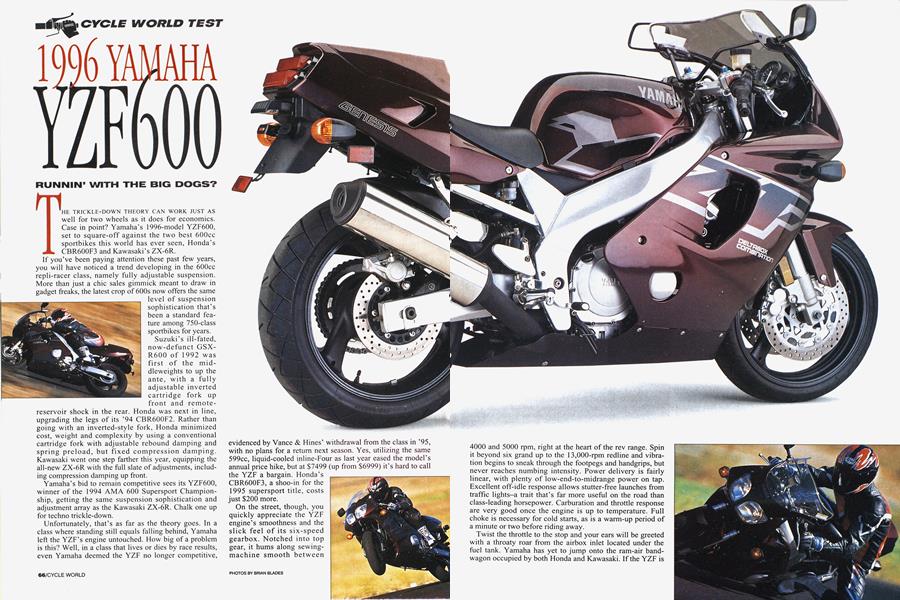
THE TRICKLE-DOWN THEORY CAN WORK JUST AS well for two wheels as it does for economics. Case in point? Yamaha's 1996-model YZF600, set to square-off against the two best 600cc sportbikes this world has ever seen, Honda's CBR600F3 and Kawasaki's ZX-6R.
if you've been paying attention tnese past rew years, you will have noticed a trend developing in the 600cc repli-racer class, namely fully adjustable suspension. More than just a chic sales gimmick meant to draw in gadget freaks, the latest crop of 600s now offers the same
level of suspension sophistication that’s been a standard feature among 750-class sportbikes for years.
Suzuki’s ill-fated, now-defunct GSXR600 of 1 992 was first of the middleweights to up the ante, with a fully adjustable inverted cartridge fork up front and remote-
reservoir shock in the rear. Honda was next in line, upgrading the legs of its ’94 CBR600F2. Rather than going with an inverted-style fork, Honda minimized cost, weight and complexity by using a conventional cartridge fork with adjustable rebound damping and spring preload, but fixed compression damping. Kawasaki went one step farther this year, equipping the all-new ZX-6R with the full slate of adjustments, including compression damping up front.
Yamaha’s bid to remain competitive sees its YZF600, winner of the 1994 AMA 600 Supersport Championship, getting the same suspension sophistication and adjustment array as the Kawasaki ZX-6R. Chalk one up for techno trickle-down.
Unfortunately, that’s as far as the theory goes. In a class where standing still equals falling behind, Yamaha left the YZF's engine untouched. How big of a problem is this? Well, in a class that lives or dies by race results, even Yamaha deemed the YZF no longer competitive,
evidenced by Vance & Hines’ withdrawal from the class in ’95, with no plans for a return next season. Yes, utilizing the same 599cc, liquid-cooled inline-Four as last year eased the model’s annual price hike, but at $7499 (up from $6999) it’s hard to call the YZF a bargain. Honda’s CBR600F3, a shoo-in for the 1995 supersport title, costs just $200 more.
On the street, though, you quickly appreciate the YZF engine’s smoothness and the slick feel of its six-speed gearbox. Notched into top gear, it hums along sewingmachine smooth between
4000 and 5000 rpm, right at the heart of the rev range. Spin it beyond six grand up to the 13,000-rpm redline and vibration begins to sneak through the footpegs and handgrips, but never reaches numbing intensity. Power delivery is fairly linear, with plenty of low-end-to-midrange power on tap. Excellent off-idle response allows stutter-free launches from traffic lights-a trait that’s far more useful on the road than class-leading horsepower. Carburation and throttle response are very good once the engine is up to temperature. Full choke is necessary for cold starts, as is a warm-up period of a minute or two before riding away.
Twist the throttle to the stop and your ears will be greeted with a throaty roar from the airbox inlet located under the fuel tank. Yamaha has yet to jump onto the ram-air bandwagon occupied by both Honda and Kawasaki. If the YZF is
to regain its position at the front of the supersport pack, a less restrictive, more up-to-date airintake system will be needed.
On the dyno, the ’96 YZF produced a peak reading of 81.2 rear-wheel horsepower at 11,500 rpm, nearly 6 horsepower less than the ’95 YZF600 we
tested in our April “Supersport Shootout” story. More to the point, the YZF is giving up approximately 5 horsepower to the Honda, 9 to the Kawasaki. A light tailwind at the dragstrip helped improve quarter-mile performance over that of the ’95 test YZF-a best pass of 11.52 seconds at 118 mph topped the l 1.72 seconds at I 17 mph turned in by last year’s bike. Using figures obtained in April’s shootout, that’s still behind the l l.2l and I 1.37 clockings of the Honda and Kawasaki, respectively. As in the past, clutch action remains a bit grabby, with a very narrow engagement band making smooth dragstrip launches difficult to achieve.
The Yamaha’s outright top speed of 143 mph was up 2 mph on last year’s YZF and close to the CBR600’s 147mph showing, though it may have a difficult time getting a whiff of the ZX-6R’s 150-mph slipstream.
Brake testing demonstrated the YZF’s dual l l.7-inch floating rotors and four-piston front calipers to be ready, willing and able, stopping the bike in 107 feet from 60 mph. The system isn’t without flaw, however; hard braking produces a slight shudder that feeds through the fork and into the bars.
Spring and damping rates of the new 41mm KYB cartridge fork maintained just enough travel in reserve to avoid bottoming when braking hard over sharp road bumps. Damping adjustment on the fork is easily achieved with a flat-blade screwdriver, and spring-preload adjustment is achieved with either a wrench or socket. Making damping adjustments to the shock requires no more than bare hands and the knowledge of which way to turn the adjuster knobs. Shock compression damping can be changed on the fly thanks to the convenient mounting location of its reservoir. More convenience comes
from the ramped spring-preload adjustment collar-no hammer and punch needed. Strangely, though, setting shock preload to its lightest position yielded only 1 inch of total rear sag with our 150-pound test rider in the saddle. This could prove to be problematic for featherweight riders, as even this lightest setting delivers a very firm ride on the street.
As it was, lapping Willow Springs Raceway’s 2.5-mile road course used up every bit of cornering clearance the YZF had to offer in right-handers, thanks to a low-hanging exhaust canister. Increasing shock preload and dialing in maximum compression damping produced a minor improvement. The stock street-compound Bridgestone Battlax tires provided impressive grip for a handful of hard laps before the rear began to break loose exiting corners. Steering manners are superb, with a light, neutral feel and little tendency to stand up while trail-braking into a comer.
Overall, the new suspension offers much improved chassis control while eliminating the rear-end pogo action we experienced on last year’s bike as its shock heated during hard track use. Likewise, charging across a series of mid-comer bumps that had the old bike twitching and lightly shaking its head in protest did little to unravel the new fork’s composure.
If all that was necessary for the YZF600 to regain its position at the front of the 600 supersport pack was a strong set of legs, the ’96 bike would be good to go. But the fact of the matter remains-both the CBR600F3 and ZX-6R have tunable suspension; both make more power. Whether you’re talking supersport championship or showroom sales appeal, the YZF will continue having the wind kicked out of it until Yamaha breathes some new life into the engine. E3
YAMAHA
YZF600
$7499
SPECIFICATIONS