Service
SERVICE
AWOL idle
Joe Minton
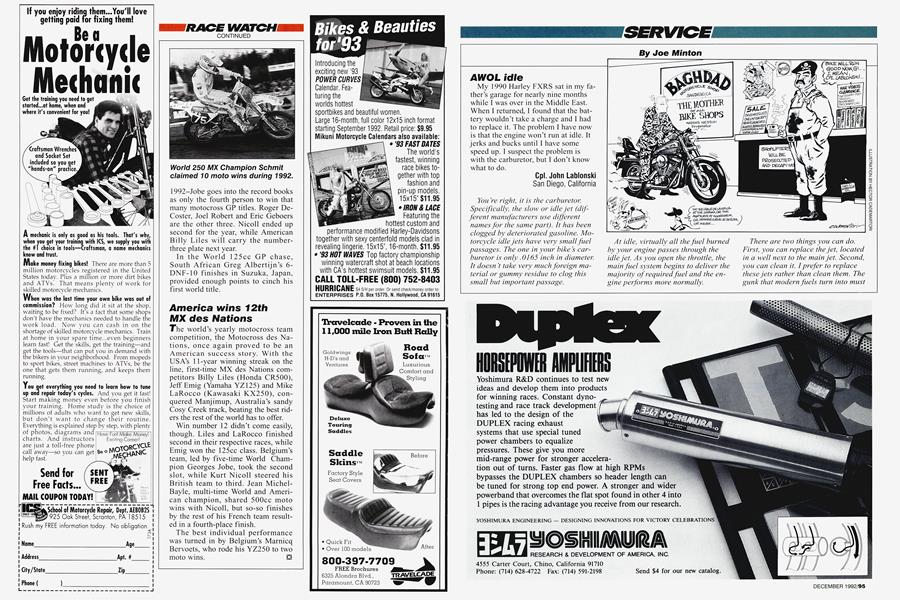
My 1990 Harley FXRS sat in my father's garage for nearly nine months while I was over in the Middle East. When I returned, I found that the battery wouldn't take a charge and I had to replace it. The problem I have now is that the engine won't run at idle. It jerks and bucks until I have some speed up. I suspect the problem is with the carburetor, but I don't know what to do.
CpI. John Lablonski San Diego, California
You `re right, it is the carburetor. Spec~flcally, the slow or idle jet (`d~f ferent manufacturers use different names for the same part). It has been clogged by deteriorated gasoline. Mo torcycle idle jets have very smallfuel passages. The one in your bike `s car buretor is only .0165 inch in diameter. It doesn `t take very much foreign ma terial or gummy residue to clog this small but important passage.
At idle, virtually all the fuel burned by your engine passes through the idle jet. As you open the throttle, the main fuel system begins to deliver the majority of required fuel and the en gine performs more normally.
There are two things you can do. First, you can replace the jet, located in a well next to the main jet. Second, you can clean it. I prefer to replace these jets rather than clean them. The gunk that modern fuels turn into must be removed physically with small wires, and that brings the risk of al tering the jet s' effective size.
I have been dealing with this sort of problem since Igot into motorcy cling three decades ago. The best so lution to the problem is to prevent it in the first place. Any bike that is going to be stored for more than two or three weeks should have its car buretor float bowl drained or run dry. If the storage is to be for more than a month, then a gasoline stabi lizer should be added to the tank. You can drain the tank but that in vites rust in most cases. Aviation gasoline is more stable than automo tive and I have used that for short term storage.
DOWN the tubes
A few months ago, my 900 Ninja started leaking oil from the right fork seal. Because the bike had 40,000 miles on it, I decided to have both seals replaced. The problem is that the new right seal started leaking soon after I got it back from the deal er. He now tells me that I will have to replace the fork tube. What is going on here? Do fork tubes wear out?
George Petersen El Paso, Texas
You `ye probably picked-up a nick in the hard-chrome plating on the right fork tube. A large grain of sand or a small pebble can ding the surface of the fork tube. The edges of the impact crater will be sharp and can cut the lip of the seal.
You can generally find these impact craters by lightly running your fin gers over the tube. The sharp edges will catch your skin. Another way to find them is with a magnifying glass. I have had considerable success with stoning the dings smooth. You should use a very fine "India" stone. A piece of 600-grade sandpaper wrapped around a smooth, hard object like a smailfile will also work. All you need to do is remove the sharp cutting edges of the crater, and then, of course, fit another seal.
This common problem is a direct re sult of the now-popular practice of leaving fork tubes' working surfaces exposed to whatever comes along the highway. A couple of decades back, most fork tubes were protected by rub ber boots or overlapping tubes on the fork sliders and triple clamp that kept sand and pebbles away from the criti cal and sensitive fork-tube surfaces.
Amped out
I have just replaced my Suzuki GS 1150 battery for the third time in the five years I've owned the bike. My pickup truck has had the same battery during that time period. What is wrong? Could the charging system be screwed up in my Suzuki? Are motorcycle batteries cheaply made? If so, they sure aren't cheap to buy: A bike battery costs as much as one for my truck. What gives, anyway?
Rick Bovier Grants Pass, Oregon
The problem is that motorcycle bat teries typically have very small vol umes of acid in relation to the surface area of the lead plates. When one of these batteries is fully discharged, it will quickly form lead sulfate on the surface of the plates. Lead sulfate is largely inert and is an insulator. Sim ply put, a sulfated battery is ruined. It will not take a charge and must be re placed.
lassume that your GSJJ5O's batter ies have been allowed to run down on occasion. When that happens, sulfa tion can take place very quickly, often in a matter ofjust afew days. If you are storing your bike for long peri ods, you should consider getting one of the many trickle-chargers avail able. Yuasa sells one made specifical lyfor motorcycle batteries.
Yuasa, which makes the majority of motorcycle batteries, has spent con siderable time and money developing bike batteries that are less sensitive to charge state and that do not sulfate nearly as rapidly as conventional bat teries. I strongly recommend that you use either Yuasa s' Yumicron or Yumi cron CX batteries.
If your Suzuki battery runs down in normal use, it could be the result of one of two problems. Either the charging system is not fully operative, or you simply don t ride far enough each time you start the engine to give the system time to replenish the battery. Have your bike charging sys tem checked "by the book" at your dealer. If it checks out, then you should invest in a trickle charger and use it regularly to keep the battery fully charged.