Moto Guzzi Le Mans 1000
MOTO GUZZI LE MANS 1000
CYCLE WORLD TEST
The Italian Boomer: not for everyone; perfect for some.
IF YOU’RE LOOKING TO BUY A BIG SPORTBIKE, THERE’S no rational reason to consider a Moto Guzzi Le Mans 1000.
Why? Simple. Honda’s Hurricane 1000, Yamaha’s FJ1200, Kawasaki’s Ninja 1000 and Suzuki’s new Katana 1100 all are better sport-tourers, with quicker acceleration, higher top speeds and more comfortable suspensions. On a racetrack or a swervy road, the GSX-R 1100 and FZR1000 racer-replicas will blow by the Le Mans and leave it for dead. And for snob appeal and technical sophistication, the BMW K100RS has it all over the Moto Guzzi.
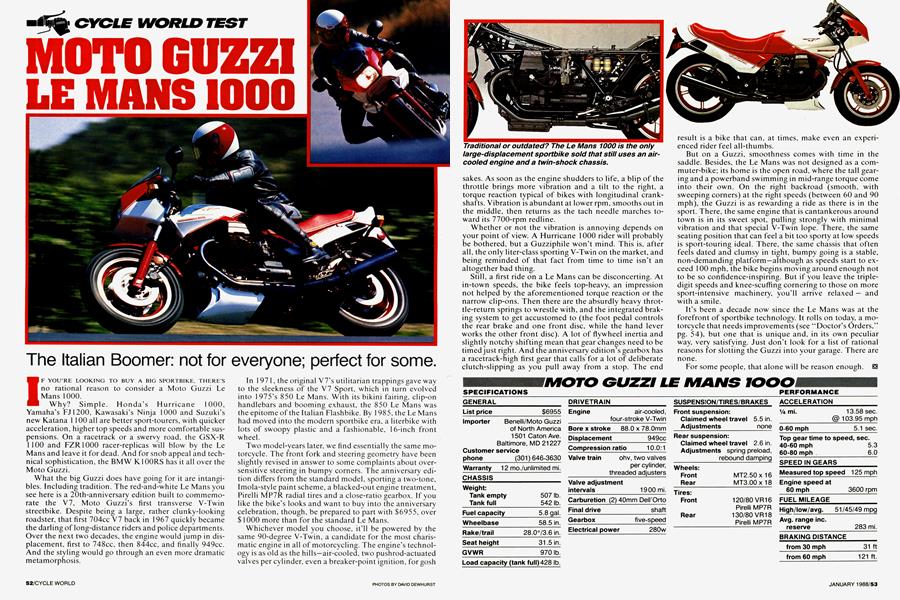
What the big Guzzi does have going for it are intangibles. Including tradition. The red-and-white Le Mans you see here is a 20th-anniversary edition built to commemorate the V7, Moto Guzzi’s first transverse V-Twin streetbike. Despite being a large, rather clunky-looking roadster, that first 704cc V7 back in 1967 quickly became the darling of long-distance riders and police departments. Over the next two decades, the engine would jump in displacement, first to 748cc, then 844cc, and finally 949cc. And the styling would go through an even more dramatic metamorphosis.
In 1971, the original V7’s utilitarian trappings gave way to the sleekness of the V7 Sport, which in turn evolved into 1975’s 850 Le Mans. With its bikini fairing, clip-on handlebars and booming exhaust, the 850 Le Mans was the epitome of the Italian Flashbike. By 1 985, the Le Mans had moved into the modern sportbike era, a literbike with lots of swoopy plastic and a fashionable, 16-inch front wheel.
Two model-years later, we find essentially the same motorcycle. The front fork and steering geometry have been slightly revised in answer to some complaints about oversensitive steering in bumpy corners. The anniversary edition differs from the standard model, sporting a two-tone, Imola-style paint scheme, a blacked-out engine treatment, Pirelli MP7R radial tires and a close-ratio gearbox. If you like the bike’s looks and want to buy into the anniversary celebration, though, be prepared to part with $6955, over $ 1000 more than for the standard Le Mans.
Whichever model you choose, it’ll be powered by the same 90-degree V-Twin, a candidate for the most charismatic engine in all of motorcycling. The engine’s technology is as old as the hills—air-cooled, two pushrod-actuated valves per cylinder, even a breaker-point ignition, for gosh sakes. As soon as the engine shudders to life, a blip of the throttle brings more vibration and a tilt to the right, a torque reaction typical of bikes with longitudinal crankshafts. Vibration is abundant at lower rpm, smooths out in the middle, then returns as the tach needle marches toward its 7700-rpm redline.
Whether or not the vibration is annoying depends on your point of view. A Hurricane 1000 rider will probably be bothered, but a Guzziphile won’t mind. This is, after all, the only liter-class sporting V-Twin on the market, and being reminded of that fact from time to time isn’t an altogether bad thing.
Still, a first ride on a Le Mans can be disconcerting. At in-town speeds, the bike feels top-heavy, an impression not helped by the aforementioned torque reaction or the narrow clip-ons. Then there are the absurdly heavy throttle-return springs to wrestle with, and the integrated braking system to get accustomed to (the foot pedal controls the rear brake and one front disc, while the hand lever works the other front disc). A lot of flywheel inertia and slightly notchy shifting mean that gear changes need to be timed just right. And the anniversary edition’s gearbox has a racetrack-high first gear that calls for a lot of deliberate clutch-slipping as you pull away from a stop. The end result is a bike that can, at times, make even an experienced rider feel all-thumbs.
But on a Guzzi, smoothness comes with time in the saddle. Besides, the Le Mans was not designed as a commuter-bike; its home is the open road, where the tall gearing and a powerband swimming in mid-range torque come into their own. On the right backroad (smooth, with sweeping corners) at the right speeds (between 60 and 90 mph), the Guzzi is as rewarding a ride as there is in the sport. There, the same engine that is cantankerous around town is in its sweet spot, pulling strongly with minimal vibration and that special V-Twin lope. There, the same seating position that can feel a bit too sporty at low speeds is sport-touring ideal. There, the same chassis that often feels dated and clumsy in tight, bumpy going is a stable, non-demanding platform—although as speeds start to exceed 100 mph, the bike begins moving around enough not to be so confidence-inspiring. But if you leave the tripledigit speeds and knee-scuffing cornering to those on more sport-intensive machinery, you’ll arrive relaxed — and with a smile.
It’s been a decade now since the Le Mans was at the forefront of sportbike technology. It rolls on today, a motorcycle that needs improvements (see “Doctor’s Orders,’’ pg. 54), but one that is unique and, in its own peculiar way, very satisfying. Just don’t look for a list of rational reasons for slotting the Guzzi into your garage. There are none.
For some people, that alone will be reason enough. 0
MOTO GUZZI
LE MANS 1000
$6955