At Large
AT LARGE
From the Kirkka to the Kerker
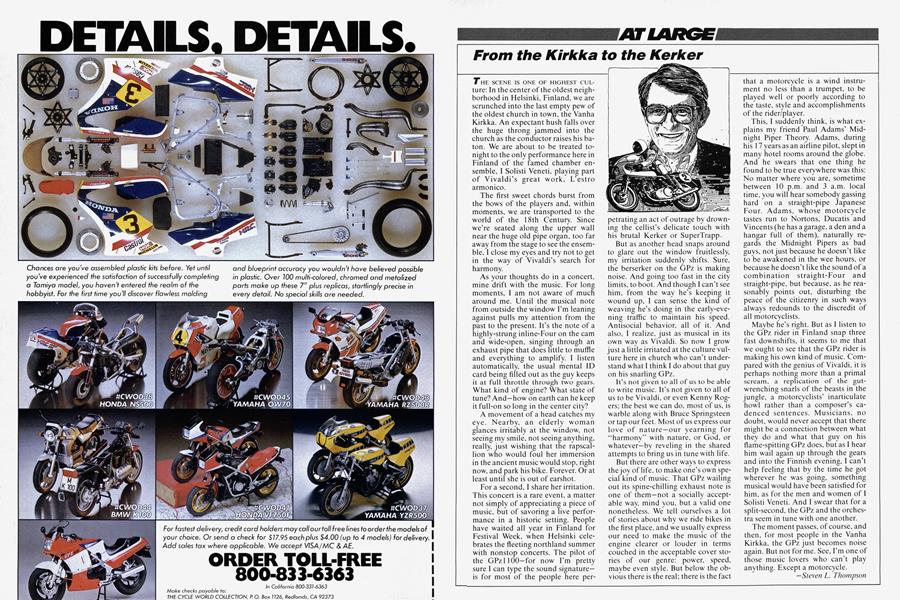
THE SCENE IS ONE OF HIGHEST CULture: In the center of the oldest neighborhood in Helsinki, Finland, we are scrunched into the last empty pew of the oldest church in town, the Vanha Kirkka. An expectant hush falls over the huge throng jammed into the church as the conductor raises his baton. We are about to be treated tonight to the only performance here in Finland of the famed chamber ensemble, I Solisti Veneti, playing part of Vivaldi’s great work, L’estro armonico.
The first sweet chords burst from the bows of the players and, within moments, we are transported to the world of the 18th Century. Since we’re seated along the upper wall near the huge old pipe organ, too far away from the stage to see the ensemble, I close my eyes and try not to get in the way of Vivaldi’s search for harmony.
As your thoughts do in a concert, mine drift with the music. For long moments, I am not aware of much around me. Until the musical note from outside the window I'm leaning against pulls my attention from the past to the present. It’s the note of a highly-strung inline-Four on the cam and wide-open, singing through an exhaust pipe that does little to muffle and everything to amplify. I listen automatically, the usual mental ID card being filled out as the guy keeps it at full throttle through two gears. What kind of engine? What state of tune? And—how on earth can he keep it full-on so long in the center city?
A movement of a head catches my eye. Nearby, an elderly woman glances irritably at the window, not seeing my smile, not seeing anything, really, just wishing that the rapscallion who would foul her immersion in the ancient music would stop, right now, and park his bike. Forever. Or at least until she is out of earshot.
For a second, I share her irritation. This concert is a rare event, a matter not simply of appreciating a piece of music, but of savoring a live performance in a historic setting. People have waited all year in Finland for Festival Week, when Helsinki celebrates the fleeting northland summer with nonstop concerts. The pilot of the GPz 1100—for now I’m pretty sure I can type the sound signature— is for most of the people here perpetrating an act of outrage by drowning the cellist’s delicate touch with his brutal Kerker or SuperTrapp.
But as another head snaps around to glare out the window fruitlessly, my irritation suddenly shifts. Sure, the berserker on the GPz is making noise. And going too fast in the city limits, to boot. And though I can’t see him, from the way he's keeping it wound up, I can sense the kind of weaving he’s doing in the early-evening traffic to maintain his speed. Antisocial behavior, all of it. And also, I realize, just as musical in its own way as Vivaldi. So now I grow just a little irritated at the culture vulture here in church who can’t understand what I think I do about that guy on his snarling GPz.
It’s not given to all of us to be able to write music. It’s not given to all of us to be Vivaldi, or even Kenny Rogers; the best we can do, most of us, is warble along with Bruce Springsteen or tap our feet. Most of us express our love of nature —our yearning for “harmony” with nature, or God, or whatever—by reveling in the shared attempts to bring us in tune with life.
But there are other ways to express the joy of life, to make one’s own special kind of music. That GPz wailing out its spine-chilling exhaust note is one of them-not a socially acceptable way, mind you, but a valid one nonetheless. We tell ourselves a lot of stories about why we ride bikes in the first place, and we usually express our need to make the music of the engine clearer or louder in terms couched in the acceptable cover stories of our genre: power, speed, maybe even style. But below the obvious there is the real; there is the fact that a motorcycle is a wind instrument no less than a trumpet, to be played well or poorly according to the taste, style and accomplishments of the rider/player.
This, I suddenly think, is what explains my friend Paul Adams’ Midnight Piper Theory. Adams, during his 17 years as an airline pilot, slept in many hotel rooms around the globe. And he swears that one thing he found to be true everywhere was this: No matter where you are, sometime between 10 p.m. and 3 a.m. local time, you will hear somebody gassing hard on a straight-pipe Japanese Four. Adams, whose motorcycle tastes run to Nortons, Ducatis and Vincents (he has a garage, a den and a hangar full of them), naturally regards the Midnight Pipers as bad guys, not just because he doesn’t like to be awakened in the wee hours, or because he doesn't like the sound of a combination Straight-Four and straight-pipe, but because, as he reasonably points out, disturbing the peace of the citizenry in such ways always redounds to the discredit of all motorcyclists.
Maybe he’s right. But as I listen to the GPz rider in Finland snap three fast downshifts, it seems to me that we ought to see that the GPz rider is making his own kind of music. Compared with the genius of Vivaldi, it is perhaps nothing more than a primal scream, a replication of the gutwrenching snarls of the beasts in the jungle, a motorcyclists’ inarticulate howl rather than a composer’s cadenced sentences. Musicians, no doubt, would never accept that there might be a connection between what they do and what that guy on his flame-spitting GPz does, but as I hear him wail again up through the gears and into the Finnish evening, I can’t help feeling that by the time he got wherever he was going, something musical would have been satisfied for him, as for the men and women of I Solisti Veneti. And I swear that for a split-second, the GPz and the orchestra seem in tune with one another.
The moment passes, of course, and then, for most people in the Vanha Kirkka, the GPz just becomes noise again. But not for me. See, I'm one of those music lovers who can't play anything. Except a motorcycle.
Steven L. Thompson