The 250cc Enduro Bikes
CYCLE WORLD COMPARISON TEST
WOODS RIDERS NEVER HAD IT SO GOOD
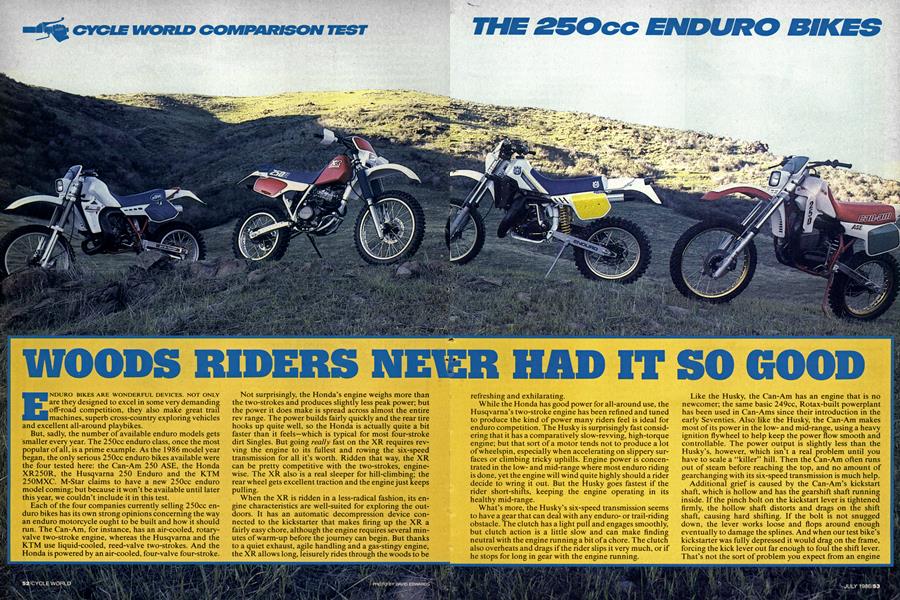
ENDURO BIKES ARE WONDERFUL DEVICES. NOT ONLY are they designed to excel in some very demanding off-road competition, they also make great trail machines, superb cross-country exploring vehicles and excellent all-around playbikes.
But, sadly, the number of available enduro models gets smaller every year. The 250cc enduro class, once the most popular of all, is a prime example. As the 1986 model year began, the only serious 250cc enduro bikes available were the four tested here: the Can-Am 250 ASE, the Honda XR250R, the Husqvarna 250 Enduro and the KTM 250MXC. M-Star claims to have a new 250cc enduro model coming; but because it won’t be available until later this year, we couldn’t include it in this test.
Each of the four companies currently selling 250cc enduro bikes has its own strong opinions concerning the way an enduro motorcycle ought to be built and how it should run. The Can-Am, for instance, has an air-cooled, rotaryvalve two-stroke engine, whereas the Husqvarna and the KTM use liquid-cooled, reed-valve two-strokes. And the Honda is powered by an air-cooled, four-valve four-stroke.
Not surprisingly, the Honda’s engine weighs more than the two-strokes and produces slightly less peak power; but the power it does make is spread across almost the entire rev range. The power builds fairly quickly and the rear tire hooks up quite well, so the Honda is actually quite a bit faster than it feels—which is typical for most four-stroke dirt Singles. But going really fast on the XR requires revving the engine to its fullest and rowing the six-speed transmission for all it’s worth. Ridden that way, the XR can be pretty competitive with the two-strokes, enginewise. The XR also is a real sleeper for hill-climbing; the rear wheel gets excellent traction and the engine just keeps pulling.
When the XR is ridden in a less-radical fashion, its engine characteristics are well-suited for exploring the outdoors. It has an automatic decompression device connected to the kickstarter that makes firing up the XR a fairly easy chore, although the engine requires several minutes of warm-up before the journey can begin. But thanks to a quiet exhaust, agile handling and a gas-stingy engine, the XR allows long, leisurely rides through the woods to be refreshing and exhilarating.
THE 250cc ENDURO BIKES
While the Honda has good power for all-around use, the Husqvarna’s two-stroke engine has been refined and tuned to produce the kind of power many riders feel is ideal for enduro competition. The Husky is surprisingly fast considering that it has a comparatively slow-revving, high-torque engine; but that sort of a motor tends not to produce a lot of wheelspin, especially when accelerating on slippery surfaces or climbing tricky uphills. Engine power is concentrated in the lowand mid-range where most enduro riding is done, yet the engine will wind quite highly should a rider decide to wring it out. But the Husky goes fastest if the rider short-shifts, keeping the engine operating in its healthy mid-range.
What’s more, the Husky’s six-speed transmission seems to have a gear that can deal with any enduroor trail-riding obstacle. The clutch has a light pull and engages smoothly, but clutch action is a little slow and can make finding neutral with the engine running a bit of a chore. The clutch also overheats and drags if the rider slips it very much, or if he stops for long in gear with the engine running.
Like the Husky, the Can-Am has an engine that is no newcomer; the same basic 249cc, Rotax-built powerplant has been used in Can-Ams since their introduction in the early Seventies. Also like the Husky, the Can-Am makes most of its power in the lowand mid-range, using a heavy ignition flywheel to help keep the power flow smooth and controllable. The power output is slightly less than the Husky’s, however, which isn’t a real problem until you have to scale a “killer” hill. Then the Can-Am often runs out of steam before reaching the top, and no amount of gearchanging with its six-speed transmission is much help.
Additional grief is caused by the Can-Am’s kickstart shaft, which is hollow and has the gearshift shaft running inside. If the pinch bolt on the kickstart lever is tightened firmly, the hollow shaft distorts and drags on the shift shaft, causing hard shifting. If the bolt is not snugged down, the lever works loose and flops around enough eventually to damage the splines. And when our test bike’s kickstarter was fully depressed it would drag on the frame, forcing the kick lever out far enough to foul the shift lever. That’s not the sort of problem you expect from an engine that’s been around for so long.
There are no such glitches with the KTM 250, and its smooth-running, compact engine also takes a different approach to power output. The engine has light flywheels and revs quickly, much like current motocross engines, and it’s the fastest of these four bikes when ridden in its power range. The engine hits hard, even though the lowend power is aided by what KTM calls a “digital control” CDI ignition that provides the optimum spark advance at all engine speeds. So overall, the rear tire hooks up quite nicely as long as there’s reasonable traction. But when the traction is poor, as it often is in enduros, the KTM engine is harder to control than the slower-revving Honda, CanAm and Husky motors.
The KTM’s five-speed transmission can also help make a ride or a race more demanding. First through third gears are spaced closely, but there’s a large jump in the gear ratios between third and fourth, and another between fourth and fifth. This ratio gap can be annoying under certain circumstances—such as in a fairly fast, sandy section—because to keep the engine from bogging, you have to wind it past the point where it is happy before upshifting from third to fourth or from fourth to fifth.
As much difference as there is in the engine performance of these four 250s, so is there a lot of dissimilarity in their chassis behavior. All have single-shock rear suspensions, of course, with rear-wheel travel ranging from 11 inches on the Honda to 13 inches on the KTM; and all have adjustable rebound and compression damping on their rear shocks.
In terms of out-of-the-crate rear-suspension performance, our test riders preferred the plush ride delivered by the Husky’s Ohlins shock. The KTM’s White Power shock is dialed-in better than previous versions have been, although it’s still somewhat harsh on the small bumps; otherwise, it works nicely.
Praising the Honda’s shock isn't quite as easy. The stock spring is too soft, and the bike constantly wallows and bottoms unless the rear-end sack is adjusted to 3 inches— about one full inch less than what we consider “normal”— and the rebound damping is adjusted to the second-stiffest (Number 3) of its four settings. The XR’s rear end then works fairly well at slow to moderate speeds but still bottoms at higher speeds. A stiffer shock spring will be necessary before the XR can offer really competitive enduro handling.
Then there’s the Can-Am’s rear suspension, which was disliked by all of our test riders. The action of the White Power shock is extremely harsh on small bumps and gets progressively worse as the severity of the terrain increases. Several compression-damping adjustments are available, but the Number One position—the softest setting—is not nearly soft enough. We did get to try a shock that had been revalved by Can-Am’s in-house enduro ace, John Martin, and we found it a slight improvement. The shock had considerably less compression damping and so was much smoother on sudden bumps, but the rear end still didn’t perform as well as the KTM’s or the Husky’s.
As far as front suspension is concerned, again, the Honda has the least travel—1 1 inches—while the Husky has 1 1.3 inches, and the Can-Am and the KTM both offer 1 1.8 inches. But the Can-Am’s Marzocchi fork was the least-liked by our test riders, for it was harsh on small bumps and tended to hydraulic-lock on the big ones. As a result, high speeds on bumpy surfaces can be quite an experience on the Can-Am as the suspension at both ends hops and jumps across the ground. Again, we went to the settings used by Martin—2.5-weight oil for compression damping and 10-weight for rebound, both at 7 inches from the top of the tubes. And again we found an improvement. The difference wasn’t earth-shaking, but we would have liked the Can-Am much more if it had come that way.
Neither did the Husky’s fork gain many friends. It now features a single oil seal (that, finally, doesn’t leak) per leg, with new damper rods and fork springs. Even at that, however, the fork could use some improvement. The rebound damping is a little too quick, and the compression damping can be harsh on rutted or rocky ground.
There’s much to praise about the KTM’s White Power fork, which is much improved compared with the one on last year’s bike. The fork still is a bit harsh on small, square-edged bumps and bottoms occasionally on large ditches and such, but the damping isn’t far off the mark. A little internal fine-tuning would turn the KTM fork into a fine performer. But in its stock form, the White Power fork was voted the second-best front suspension of the four.
That leaves the Honda’s front end as our favorite of the lot. But at first, the KYB front end was so softly sprung that it bottomed much too easily. Adding 8 psi to each fork leg, plus turning the compression-damping adjusters (on the bottoms of the sliders) a few clicks stiffer, transformed a poor fork into an excellent one. So adjusted, the fork swallows the big bumps, is compliant on small bumps, and generally works well everywhere, including on rocks.
Traversing rocky terrain is always tricky, but a bike that steers precisely makes the job a lot easier. And there are vast differences in the steering characteristics of these four bikes. Most of our testers felt the KTM had the best steering, pointing out that it responds properly and accurately to the slightest input by the rider. The Husky and Honda tied for second in steering precision. The Honda steers more quickly than the Husky, but both go where they are pointed with a minimum of effort by the rider. The Honda’s short wheelbase gives it the edge in tight going, while the Husky’s longer wheelbase makes it the best in the faster sections and in sand.
The only steering rated “poor” by our testers was the Can-Am’s; but that rating warrants an explanation. The front end of the machine reacts fairly quickly to steering input, but the back of this extraordinarily long (60-inch wheelbase) enduro bike takes a while to catch up. This results in a strange feeling that bothered all of our riders. It also makes negotiating tight switchbacks on mountain trails a real hassle, because a bike this long doesn’t like to turn sharply.
At least the Can-Am seems to be reliable, for after 500 miles of testing (on each bike), the only failures it sustained were a sparkplug cap that shorted out when wet (a dab of silicone sealer quickly fixed that problem) and the loss of the plastic rivets that secure the extension piece on the rear fender. The Husky had two failures, as well: The speedometer cable broke on the first day, and the rear exhaust-pipe bracket snapped—although the latter didn’t occur until after the pipe got slightly tweaked during a lowspeed tip-over, which may have been responsible for the later breakage.
We experienced no reliability problems whatsoever on the KTM. But that wasn’t the case with the Honda, which ran poorly and was hard-starting on the first outing. An engine teardown revealed a tiny piece of carbon stuck under an exhaust valve. The saving grace here is that the necessary repairs would have been covered by the XR’s generous six-month warranty.
Warranties or not, though, after 2000 total miles of riding and many hours of wrenching, tuning and note-taking, we finally confronted the question we had set out to answer: Which of these four 250s is the best all-around enduro machine on the market? To be as fair as possible, we decided to approach the question from two different angles. We first asked the test riders to rate the bikes in stock condition, just the way they had rolled out of their shipping crates. And then, knowing that many off-road riders are quite willing and able to perform certain modifications to their motorcycles, we asked our testers to rate the bikes in the order in which they would most likely buy them for their own use.
In the balloting for the best enduro bike in stock form, the Can-Am was voted into last place by all of the test riders. We know, of course, that Can-Ams do win enduros, sometimes even national enduros. But we also know that most of those winning Can-Ams are not stock. Besides, the bike’s track record was unable to change our testers’ opinions that the Can-Am has substandard suspension, is too long and has truly weird handling.
Third place in the box-stock results went to the XR250R. The bike was fun to ride and proved very versatile, but in stock form needs stiffer fork springs and a stiffer shock spring (not available from Honda but offered by Progressive Suspension Inc. [714] 898-2951 ). The secondplace finisher was the KTM, a serious enduro machine with a responsive, quick-revving engine, precise handling and a solid chassis. But it needs some suspension finetuning to be at its best; and riders who don’t want or can’t cope with motocross-type power in an enduro bike won’t like the KTM.
That’s one reason why, in fact, four of our five test riders chose the Husqvarna as the best stock 250cc enduro bike: The engine makes a lot of the right kind of power for enduro competition. Not only that, the suspension is very good, the six-speed gearbox allows riding in varied terrain without changing the final gearing, the handling is precise and the bike simply feels right. If you’re going to ride enduros on a stock 250, this is the one to do it on.
Surprisingly, though, the results changed radically when the riders were asked which bike they would buy. Price, and the amount of work each was willing to do to make a particular machine right, produced some surprising results, with the Honda and the KTM tieing for first, the Husky in third, and the Can-Am again in fourth.
Those choosing the Honda liked the $2198 price tag and the sheer fun of riding the bike, figuring that, for a hundred bucks or so, they could stiffen the suspension and end up with a neat motorcycle.
Selling for $3291 with its optional enduro kit, the KTM is the most expensive of the four. Still, two riders were impressed enough to choose it as the bike they would buy. As one rider stated, “The bike has a lot of potential if properly set-up, and I love its light weight (220 pounds without gas), responsive engine and crisp handling. I have more fun on the KTM than on the others, and I think that feeling would last a long time.’’
Still, if riding enduros is your primary goal, there’s no. tie in this test. While the Honda and KTM are fun machines that can win, the Husqvarna already is a winner. It requires the least amount of fiddling and modification of all four bikes before it’s enduroand trophy-ready. Sure, you can lose an enduro on the Husky. But chances are you’ll be losing to another Husky. E3