13,700 Miles With the Kawasaki Gpz1100
13,700 Miles With the Kawasaki GPz1100
Long-Term Report
Lots of Use, More Than Enough Abuse and a Record For Miles Per Year Left the Big Red Rocket Tired but Unbroken.
Remember before you went riding in the dirt? The old hands spoke only of get-offs and mechanical failure, of loops and highsides and running into trees and getting stuck in swamps and killer downhills and bruises and sprains. Because you hadn’t been there, the whole thing sounded like second prize in a firing squad raffle. But you went anyway and came home talking about bogging in the mud and doing a classic flying W over the whoops and you were scraped and contused and darned if you didn’t have the time of your life.
This is a story like that. It’s an account of harsh reality, of mechanical hassles and emotional heartbreak and the rigors of growing old before your time. At the end of the allotted year, though, we’d racked up a new mileage record for longterm machines, the ffike was still fast as a rifled slug if not your actual speeding bullet. We liked the GPzllOO when we got it and we liked it when we turned it in, never mind that most of what follows doesn’t justify the enthusiasm.
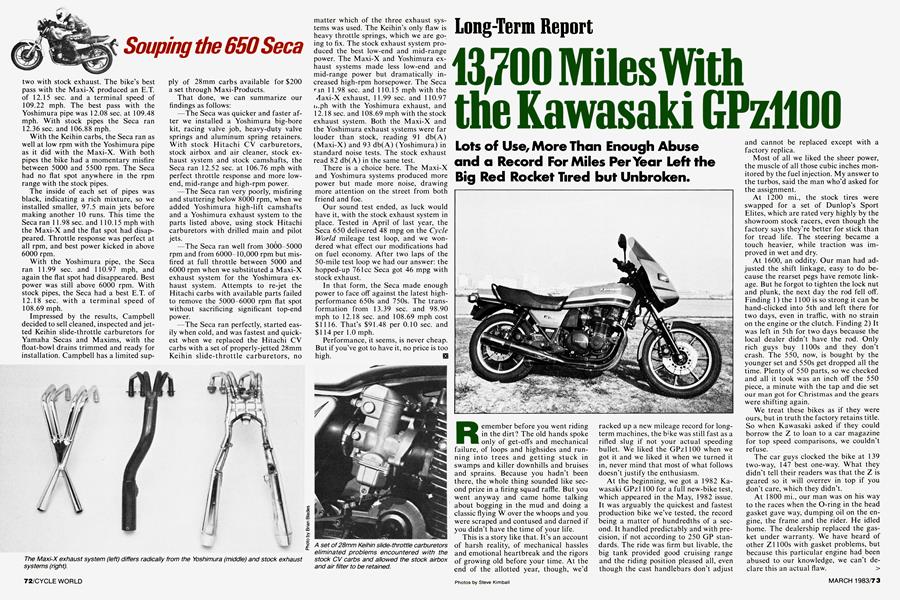
At the beginning, we got a 1982 Kawasaki GPzl 100 for a full new-bike test, which appeared in the May, 1982 issue. It was arguably the quickest and fastest production bike we’ve tested, the record being a matter of hundredths of a second. It handled predictably and with precision, if not according to 250 GP standards. The ride was firm but livable, the big tank provided good cruising range and the riding position pleased all, even though the cast handlebars don’t adjust and cannot be replaced except with a factory replica.
Most of all we liked the sheer power, the muscle of all those cubic inches monitored by the fuel injection. My answer to the turbos, said the man who’d asked for the assignment.
At 1200 mi., the stock tires were swapped for a set of Dunlop’s Sport Elites, which are rated very highly by the showroom stock racers, even though the factory says they’re better for stick than for tread life. The steering became a touch heavier, while traction was improved in wet and dry.
At 1600, an oddity. Our man had adjusted the shift linkage, easy to do because the rearset pegs have remote linkage. But he forgot to tighten the lock nut and plunk, the next day the rod fell off. Finding 1 ) the 1100 is so strong it can be hand-clicked into 5th and left there for two days, even in traffic, with no strain on the engine or the clutch. Finding 2) It was left in 5th for two days because the local dealer didn’t have the rod. Only rich guys buy 1100s and they don’t crash. The 550, now, is bought by the younger set and 550s get dropped all the time. Plenty of 550 parts, so we checked and all it took was an inch off the 550 piece, a minute with the tap and die set our man got for Christmas and the gears were shifting again.
We treat these bikes as if they were ours, but in truth the factory retains title. So when Kawasaki asked if they could borrow the Z to loan to a car magazine for top speed comparisons, we couldn’t refuse.
The car guys clocked the bike at 139 two-way, 147 best one-way. What they didn’t tell their readers was that the Z is geared so it will overrev in top if you don’t care, which they didn’t.
At 1800 mi., our man was on his way to the races when the O-ring in the head gasket gave way, dumping oil on the engine, the frame and the rider. He idled home. The dealership replaced the gasket under warranty. We have heard of other Z1100s with gasket problems, but because this particular engine had been abused to our knowledge, we can’t declare this an actual flaw.
Oh, flaws. The Z’s battery is nestled behind electrical stuff on each side, in back of the air box. You must remove the filter to see the battery top and you can’t see the sides, where it says High and Low, unless you unsnap all the wiring. We topped the battery by guesswork.
At 2000, random testing revealed an elusive weave at 100 or better. Again, no sure answer. The rear wheel was out of alignment, perhaps the tires and suspension needed to be tuned to work together. The next several weeks were spent commuting, so the weave didn’t appear again.
At 4700, tragedy. Our man left the Z at the Los Angeles airport. He came home the next day to an empty parking slot. Yes, the forks were locked. No, he hadn’t bothered to use a real lock; surely there’s no risk in the short-term lot with people zipping in and out 24 hours a day and the bike parked next to the entrance?
Wrong. We won’t make that mistake again. And for the purposes of this report, we don’t get to say how long the Sport Elites would have held up, nor to comment on the 55/100 watt halogen headlight bulb we got from Beach’s Motorcycle Adventures, and we were out $20 for new mounting hardware for the BagMan tank and saddlebags, not to mention having to take the bus home.
By good fortune, though, the lost GPz was replaced by another used one with 4700 mi. on its odometer. This one had been used by another motorcycle magazine for testing tires on a racetrack. Not abused but certainly used, so it was as close an approximation to the first example as we could have hoped for.
There were variations, of course. The second Z had a lighter, freer clutch, while the front brake growled, the engine vibrated at less than 4000 rpm and there was a surge at low revs in top gear.
The Z was treated to a fresh set of tires, Dunlop’s Touring Elites this time because the bike was to be used for summer vacation and tread life was important.
As preparation for the trip we got a windbreaker fairing from Rifle Fairing Co. This useful accessory was reported on in detail in the October, 1982 issue, but for here, it’s a half fairing that attaches to the fork legs and it will fit on bikes that are nearly impossible for conventional fairings. We used the lower of the two available shields and got the fairing body in primer so we could ship it to Luftmeister and have it painted to match the GPz’s red. The paint cost $72 and worth it, but then we have a charge account.
The summer trip involved rain, cold, heat and high speeds and was in some ways a lesson in adaptability. At 5200 mi., for example, a bolt fell out of the centerstand. We suspect it had been removed for the track sessions and not tightened. Our thanks to the AMC dealership in Rock Springs, Wyo., where the shop let our man rummage for a bolt until he found one that fit.
The miles rolled up in a hurry. During this trip the oil consumption was high, a quart every 500 mi. And during the trip the right front fork seal let go and the growl in the front brake became a click, then a knock. But none of these impeded progress, so the trip wasn’t interrupted. (Later we’d see Wayne Rainey keep pace with the pack in the superbike race at Laguna Seca after a crash bent his forks. Maybe suspension tuning isn’t as important as we like to think.)
At 9800, safely back home, the Z got full service; new right side brake rotor, new fork seal, full tune-up. The parts were done on warranty, the service cost $126.75.
The dealer’s mechanic advised running with the oil level at less than full. High speed cruising pumps it out faster, he said, if you start from the top. So the rest of the year the engine was kept between half and Caution! Oil level! and consumption evened out to 1000 mi. per quart.
By 11,000 mi. the chain, which up to this point hadn’t needed attention, began to stretch. The tools that came with our bike didn’t include a wrench large enough for the axle nut; surely this means earlier users forgot to return it to the bag. It also meant having to use a shop wrench. And we discovered that the righthand axle retainer had two smudged notches instead of the one clear one, so wheel alignment was less accurate than we would have liked.
Along about here we had the one and only hassle with the fuel injection: the rubber cap for a fitting used for tuning analysis fell off, causing erratic idle. The replacement was safety-wired and stayed put. The Z used three taillight bulbs during the year but the mysterious all-electronic fuel injection was flawless. Some of us distrust the principle but nobody can criticize the performance.
At 12,492 mi. another oil leak surfaced, so to speak. This time it was the base gasket, which was replaced under warranty. We were told some of the early 1982 Kawasaki 1100 engines used acorn nuts on the hold-down bolts and that the bolts were too long for the nuts, so the nut was tight on the bolt but not tight against the surface it was supposed to compress. We don’t know how true this is, nor how widespread the problems, if any. But such a failure on an engine that’s been in production this long, and has a reputation for durability, is disappointing.
Against that, hardly anything gave trouble. No misfires, no stripped threads or things falling off or adjustments that didn’t stay adjusted. The electric tachometer began to have spells of going blank toward the last, and because the voltmeter that’s part of the tach went dead at the same time, we figure it’s just a loose wire. Miles per gallon varied from 40 mpg when really pushing to 58 on what must have been a very easy pace. Fill-ups came at 200 mi. on the average with the record (not on purpose; we didn’t know there weren’t any gas stations within normal range) 249 mi.
At 13,700 mi., the year was up. At that time and mileage:
The chain was exhausted. It should have been replaced at 12,000 but we couldn’t see any sense in making Kawasaki a present of a nearly-new $100 chain.
The tread on the front touring Elite looked new. The rear tire had at least half its tread. Projecting, if the tire was half worn at 9000 mi., then Dunlop’s expectation of 15,000 mi. are cautious.
The black chrome on the exhaust system, cases, etc. was sort of a faded gray and defied efforts to restore.
The red paint was as bright as ever.
The weave was permanent. No threat to life and limb, more like a gentle wiggle on fast corners. Part of this may come from the shocks, which are tired, and part from the rear tire, which has worn in the center, i.e. it’s more square in profile than it was when new.
The engine is not as powerful as it once was. Quarter-mile times are a second slower, trap speeds 10 mph lower now than when new. No longer is this an 11sec. bike. The man who’s ridden the Z all year says it still has more power than any normal rider can use. Those who have been exercising the ’83 projectiles say the GPz strikes them as normal, somehow. Routine. It’s rough and, they say, hasn’t aged well.
Maybe not. But considering the length of time, the harsh demands made on the bike and the record number of miles punctuated by delays but no actual breakdowns, the GPzl 100 did the job it was built to do.