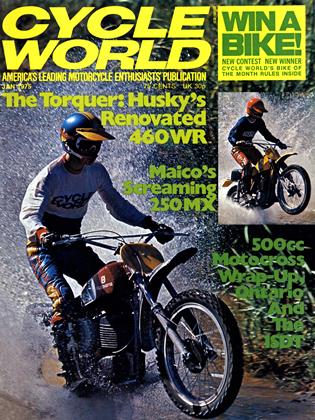
Husqvarna 460wr
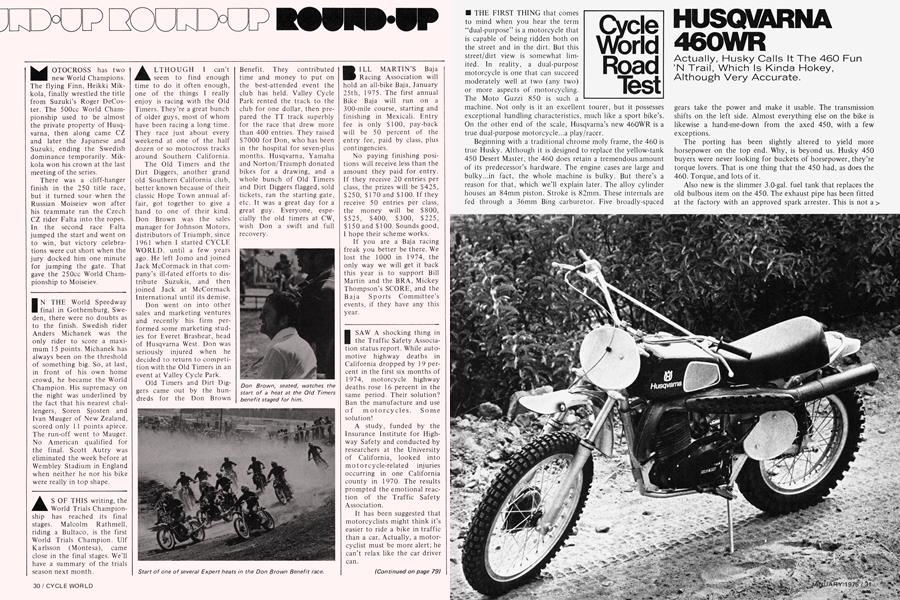
HUSQVARNA 460WR
Cycle World Road Test
Actually, Husky Calls It The 460 Fun 'N Trail, Which Is Kinda Hokey, Although Very Accurate.
THE FIRST THING that comes to mind when you hear the term "dual-purpose" is a motorcycle that is capable of being ridden both on the street and in the dirt. But this street/dirt view is somewhat limited. In reality, a dual-purpose motorcycle is one that can succeed moderately well at two (any two) or more aspects of motorcycling. The Moto Guzzi 850 is such a machine. Not only is it an excellent tourer, but it possesses exceptional handling characteristics, much like a sport bike's. On the other end of the scale, Husqvarna's new 460WR is a true dual-purpose motorcycle.. .a play/racer.
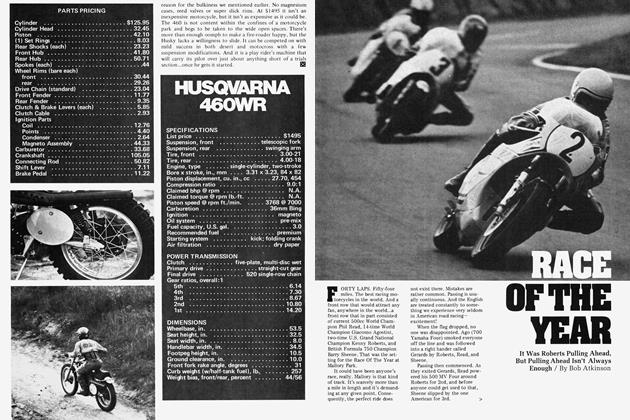
Beginning with a traditional chrome moly frame, the 460 is true Husky. Although it is designed to replace the yellow-tank 450 Desert Master, the 460 does retain a tremendous amount of its predecessor's hardware. The engine cases are large and bulky.. .in fact, the whole machine is bulky. But there's a reason for that, which we'll explain later. The alloy cylinder houses an 84mm piston. Stroke is 82mm. These internals are fed through a 36mm Bing carburetor. Five broadly-spaced
gears take the power and make it usable. The transmission shifts on the left side. Almost everything else on the bike is likewise a hand-me-down from the axed 450, with a few exceptions. The porting has been slightly altered to yield more horsepower on the top end. Why, is beyond us. Husky 450 buyers were never looking for buckets of horsepower, they're torque lovers. That is one thing that the 450 had, as does the 460. Torque, and lots of it. Also new is the slimmer 3.0-gal. fuel tank that replaces the old bulbous item on the 450. The exhaust pipe has been fitted at the factory with an approved spark arrester. This is not a: bolt-on item, but rather an integrated part of the exhaust package.
Husqvarna’s own people will tell you right away that if you are serious about racing either motocross or desert, their 400s (CR for MX and WR for desert), will gobble up the new 460. The 400s sport quicker, more radical power and stiffer suspension, are lighter and better handling. Which leaves us with a problem. Who in the world would buy a 460 when the other bikes go faster and handle better?
The answer can be found at just about any riding area in this country. The type of people who will buy a 460 are those who are not racers but occasionally like to mix it up, are not slugs but do enjoy a comfortably-paced trail ride, and who like to own a quality machine without having to hawk the old lady in order to afford one. These are the people who will buy a new 460WR, because it is these riders for whom the bike was designed.
It isn’t a hell-bent racer. It doesn’t come with forward-mounted shocks or anything fancy. Standard on the bike are Girlings on the back and Husky’s own forks up front. Both sets of cushions are sprung softer than for MX and can be bottomed during moderate to heavy use.
Although both wheels carry Akront rims, they are of the ridged variety, and, while not of serious consequence on a machine such as this, it’s always nice to see ridgeless alloy rims on any motorcycle. The rims are laced to a pair of conical hubs. Both brakes are single leading shoe types that seemed nearly impervious to water. Braking efficiency did drop a tad when wet, but picked up again right away.
This machine is no different from any other that comes out of Sweden’s largest motorcycle factory; you’ve got to ride it like you’re sitting astride an overweight horse, or the exhaust pipe and side cover for the air filter will get your calves. One of these days, Husky is going to get the message and do something about it. Honda finally got off its duff and relocated the ignition switches on its new models, a modification that the industry has been after them to undertake for more than a decade. We certainly hope it doesn’t take the Swedes that long to take the hint about their machines’ shortcomings.
Another sore point has been the footpegs. Again, no change. Slick as ever, and downright dangerous when wet. And the grips are poor...but then whose aren’t? Well, at least the Magura Power-Levers are neat.
Husqvarna has fitted Metzeier tires to its big bore, which suits us just fine. However, we’d like to see a 4.50 on the rear rather than the present 4.00. There’s not enough tire for the power the engine produces. Actually, we doubt that a 4.50 would be enough tire, but Metzelers don’t come any bigger... yet.
Handlebars, much like tires, are a matter of personal preference. No one had anything to say—either good or bad—about the bars on the Husky. Guess they pass.
The seat did receive some praise. After many years of developing a seat on which its riders could comfortably sit for a week of ISDTing, Husky has learned its lessons well. The production seats are superb. The width is perfect, the stiffness of the foam exceptionally well-suited to all our staffers. Riding the machine for several hours at a time, as most owners will be doing, is a pleasure to the posterior.
Starting is said to be aided by a newly-designed Femsa magneto/coil ignition. This Husky doesn’t have transistorized ignition. It is the price, so they say, that one must pay in order to have a bike that starts easily. But ours didn’t start easily. Maybe only three kicks when cold, if it was going to start. If not, then forget it. And when hot, if you stopped and didn’t reach to shut off the petcock with Kung-Fu-like speed, it was all over. Just be sure that when you stop your 460 and allow the engine to die, that you do so at the top of a hill, a big hill. Better yet, buy a Mikuni.
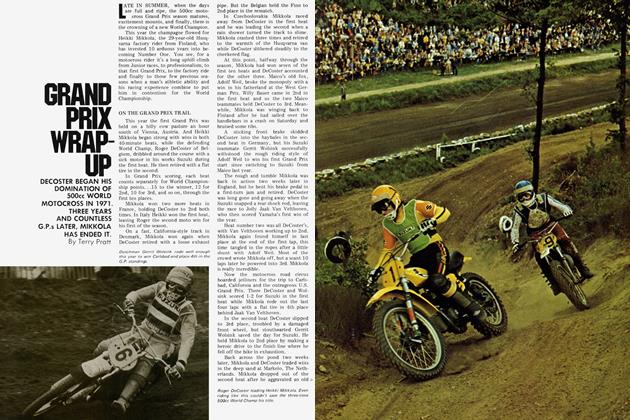
Once you do get the beast running, the fun begins. Pick out a steep hillside and just smoke it up to the top. No problem. If the hill affords little traction, then you’ll wish for that 4.50 rear tire, but you can get up most of them with what you’ve got.
Sand is particularly fun (take note desert freaks), because of the slow steering geometry designed into the bike. Stability is exceptional, although at slower speeds the front end has a tendency to knife into the sand. If you are the type of rider who finds the desert appealing, look into a 3.50-21 front tire. It helps.
To go fast requires only two things. The first is for the rider to open the throttle. The second is a stretch of relatively smooth terrain. We must make this point clear. It does not possess good enough suspension, in its stock form, to handle anything more than an occasional bump or small chuckhole at anything above 50 mph. Up to that speed, although the suspension will sometimes bottom, control over the machine is not difficult to maintain.
If you plan on riding the bike much over 50, fit booster springs and put heavier oil in the forks. And either stiffer springs or a set of Konis with stiffer springs would improve the situation in back. Trying to go WFO on this bike in rough terrain is begging for a ride in the meat wagon. The suspension will bottom violently, and when all the suspension gets used up, the pounding will begin to tweak the frame...even a frame as
strong and rigid as the Flusky’s. When the frame begins to flex, just look for a soft place to land.
This is a play/racer whose emphasis is on play. But it has tremendous power, the handling is good, and we’ve told you what to do to make it even better. But racing doesn’t have to be limited to just the desert. Gear the bike down (who ever heard of 90 mph in motocross?), for about 55-60 and go out there and bang handlebars with the pack.
For motocross, the machine should always be cornered at least one gear higher than normal. Sometimes two. Steering is not the bike’s forte because the front wheel wants to wash out almost to the point of distraction. Cornering with the throttle on—even the slightest bit above the “neutral” position—helps hold the front end in place. The more you gas it, the better it sticks, until the rear end gives way. And when it does, you usually go down. With its inherent high CG, compounded by the large fuel tank, the Husky is no slider.
Brakes aren’t up to snuff for motocross, either, but they’re not too far off. You aren’t going to beat anyone into or through any turns, just out of them sometimes and down the straights...if they aren’t too rough. Remember, you’re racing a play bike.
What the Husqvarna 460WR boils down to is this: A great play bike with awesome power at any rpm setting, a very fine chassis, soft suspension for play riding so it won’t wear you down, a large, narrower fuel tank for easier stand-up riding and an exhaust pipe fitted with an approved spark arrester for riding in areas that require them.
The Husky is a heavy motorcycle, weighing 257 lb. with half a tank of gasoline. There are no plastics, such as flexible fenders, because of cost considerations. That’s part of the> reason for the bulkiness we mentioned earlier. No magnesium cases, reed valves or super slick rims. At $1495 it isn't an inexpensive motorcycle, but it isn't as expensive as it could be. The 460 is not content within the confines of a motorcycle park and begs to be taken to the wide open spaces. There's more than enough oomph to make a fire-roader happy, but the Husky lacks a willingness to slide. It can be competed on with mild success in both desert and motocross with a few suspension modifications. And it is a play rider's machine that will carry its pilot over just about anything short of a trials section...once he gets it started.
PARTS PRICING
$125.95
HUSQVARNA 460WR
$1495