Yamaha Ty80a
YAMAHA TY80A
A For Real, Honest-To-Goodness Mini-Trailer
Cycle World Road Test
REMEMBER THE phrase “We’re number two but we try harder”? Car people put that saying fore the public, but that doesn’t alter the fact that it fits Yamaha to a tee. Why? Because Yamaha has probably done more to create new competition-based motorcycle marketing segments than any other manufacturer. Ever.
In the ’60s, when the Yamaha 80 came out, there appeared an 80cc class for sportsman racing. Yamaha’s first efforts at motocross weren’t all that impressive, but they were the first Japanese firm to offer hop-up parts to make their bikes suitable. Then came the Yamaha Mini-Enduro which put mini-cycle racing on the map. So what’s next? A mini-trials bike, that’s what. And quite frankly, it is one of the best small bikes any firm has built to date!
In the first place, trials, the sport the TY80A is designed for, is a good one for kids learning the ropes. Trials is a test of skill, rather than speed, which places the learning process in éroper perspective. Trials is also very challenging, so boredom i not a factor.
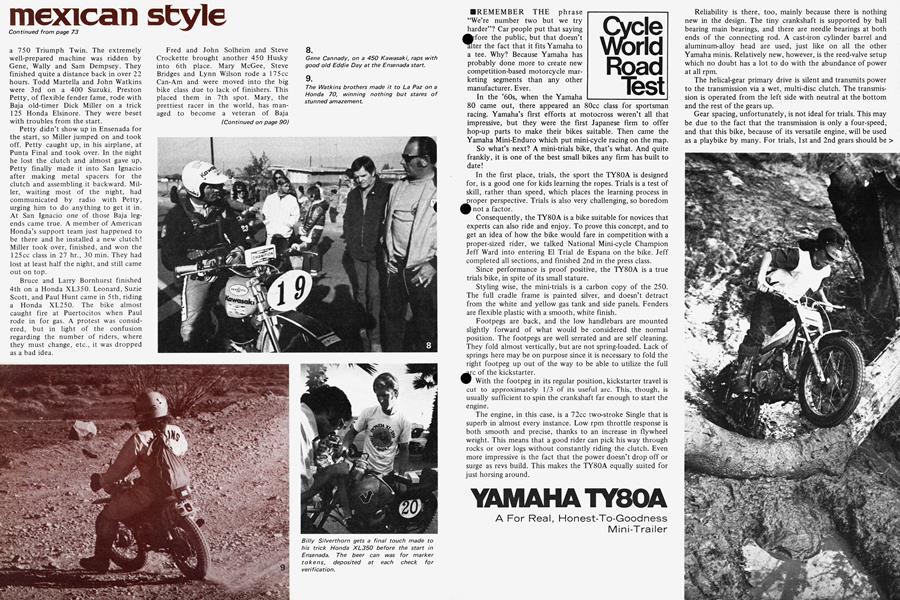
Consequently, the TY80A is a bike suitable for novices that experts can also ride and enjoy. To prove this concept, and to get an idea of how the bike would fare in competition with a proper-sized rider, we talked National Mini-cycle Champion Jeff Ward into entering El Trial de España on the bike. Jeff completed all sections, and finished 2nd in the press class.
Since performance is proof positive, the TY80A is a true trials bike, in spite of its small stature.
Styling wise, the mini-trials is a carbon copy of the 250. The full cradle frame is painted silver, and doesn’t detract from the white and yellow gas tank and side panels. Fenders are flexible plastic with a smooth, white finish.
Footpegs are back, and the low handlebars are mounted slightly forward of what would be considered the normal position. The footpegs are well serrated and are self cleaning. They fold almost vertically, but are not spring-loaded. Lack of springs here may be on purpose since it is necessary to fold the right footpeg up out of the way to be able to utilize the full c of the kickstarter.
With the footpeg in its regular position, kickstarter travel is cut to approximately 1/3 of its useful arc. This, though, is usually sufficient to spin the crankshaft far enough to start the engine.
The engine, in this case, is a 72cc two-stroke Single that is superb in almost every instance. Low rpm throttle response is both smooth and precise, thanks to an increase in flywheel weight. This means that a good rider can pick his way through rocks or over logs without constantly riding the clutch. Even more impressive is the fact that the power doesn’t drop off or surge as revs build. This makes the TY80A equally suited for just horsing around.
Reliability is there, too, mainly because there is nothing new in the design. The tiny crankshaft is supported by ball bearing main bearings, and there are needle bearings at both ends of the connecting rod. A cast-iron cylinder barrel and aluminum-alloy head are used, just like on all the other Yamaha minis. Relatively new, however, is the reed-valve setup which no doubt has a lot to do with the abundance of power at all rpm.
The helical-gear primary drive is silent and transmits power to the transmission via a wet, multi-disc clutch. The transmission is operated from the left side with neutral at the bottom and the rest of the gears up.
Gear spacing, unfortunately, is not ideal for trials. This may be due to the fact that the transmission is only a four-speed, and that this bike, because of its versatile engine, will be used as a playbike by many. For trials, 1st and 2nd gears should be > closer together. As it comes, 2nd gear is too high and simply won’t do it!
As mentioned earlier, the engine is housed in a doublecradle frame, and the steering geometry of that unit brings out Wveral different thoughts. The most consistent opinion expressed is that the bike does not steer like a true trials bike. It does, however, turn very tightly, due to its short wheelbase and tight steering lock. This makes the machine an acceptable handler in a trials section, but not without one problem.
The problem stems from the fact that the more the forks are turned toward full lock, the lower the frame gets to the ground. This means that when the rider wants to go straight again, he must not only fight the physical drag of a low pressure tire, but he must also fight both his own weight, and the weight of the machine as it rises with the re-directioning of the front wheel.
The question is: should Yamaha have instilled trials handling in a machine with such a short wheelbase, or did they do the right thing in maintaining a greater rake so that the chassis would be as versatile as the engine and rely on the machine’s wheelbase to provide the quickness essential in a proper trials mount?
It’s a tough question, but we feel that Yamaha did the right ^tíiing. Greater stability for speeding along between sections, Wnd the ability to go off precariously steeper drop-offs than if the front end were tucked in, is worth trading for some ease in steering near full lock. Too bad you can’t have everything.
Suspension is absolutely first rate. Forks offer hydraulic damping in both legs, and the spring rate is just right for riders in the 60-100 lb. range. The rear shock absorbers are interesting in that they are inverted. The reason for doing this is that it makes for less unsprung weight, but this seems sort of superfluous on a mini-trialer. At any rate, the progressivewound springs are perfect for youngsters, but will not support heavier riders without constant bottoming.
Glancing at the mini, ground clearance seems adequate, even with the suspension bottomed out; but it isn’t really. The problem is the kickstand which is mounted on the lower edge of one of the twin cradles. This not only eliminates adequate ground clearance, but because of the stand’s jaggedness, it can snag on logs or rocks, and that can abruptly end your ride.
The kickstand should be mounted to the swinging arm, where it maintains a constant distance from the ground regardless of the terrain and the suspension’s state of compression.
Tires are also a problem on the TY80A. The covers that come stock have a trials pattern, all right, but they are not really wide enough to cope with the snappy performance. The rear tire is especially limiting. A slightly wider tire, with a less rounded profile, would be better, especially for trials.
One last gripe concerns the hand grips. They have a nice shape, but are made from too hard a material. This makes it very difficult for tender hands to operate the Yamaha for extended periods of time.
What this all adds up to is that the TY80A is a very curious trialer. It’s a machine that lacks proper trials bike geometry and has rather marginal traction, but it’s a bike capable of doing well in trials events and is an absolute ball to ride. It will come as no surprise to us if Yamaha dealers sell every TY80A they can get their hands on. SI
YAMAHA
SPECI FICATIONS
List price . ...... $386